

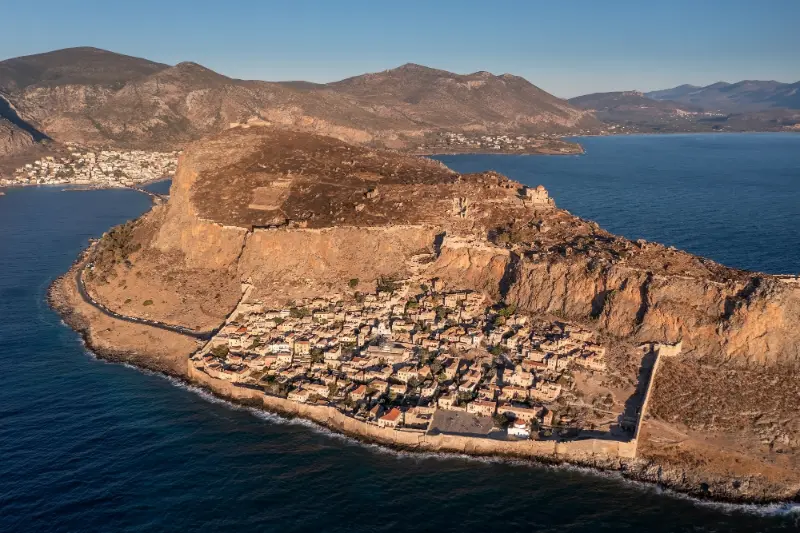
Monemvasia is one of the few places in Greece where the arrival itself feels like a reveal. You approach a massive rock off the southeastern Peloponnese, cross the narrow causeway and then pass through a gate into a medieval town hidden from the mainland road. Cars stay outside the historic settlement, and almost immediately the trip slows to walking pace.
It works beautifully as the atmospheric stop in a Peloponnese road trip. I would give it at least one night inside or near the castle town because early morning and evening are when the lanes feel most special. A rushed midday visit misses exactly what makes Monemvasia different.
Understanding Lower Town and Upper Town
Lower Town is the inhabited historic settlement: stone houses, churches, small hotels, restaurants and lanes squeezed between the rock and the sea. Upper Town is reached by a steep path and contains ruins plus the church of Agia Sofia. The climb changes the scale of the place and gives wide views, but it should be treated as a real uphill walk.
If you have limited mobility, focus on Lower Town and the sea-level atmosphere. Monemvasia is still worthwhile without climbing to the top.
Walking the castle town
The best route is deliberately imprecise. Enter through the gate, follow the main lane long enough to orient yourself, then take side alleys toward small squares, churches and sea views. The settlement rewards curiosity because stairways and arches reveal themselves gradually.
Go out early before day visitors arrive, then walk again after dinner. The same streets feel completely different when shopfronts close and the stone is lit softly.
Agia Sofia and the Upper Town
Agia Sofia stands high on the rock and is one of Monemvasia’s most memorable landmarks. The climb can be hot and exposed, so I would attempt it early in the morning or late afternoon, wearing shoes with grip and carrying water.
Do not rush the descent. Loose stone and polished surfaces demand more attention going down than going up. In strong heat or wind, it is perfectly reasonable to skip the climb and spend longer in Lower Town.
Where to stay: inside or outside the walls?
Staying inside the castle gives you the strongest atmosphere and lets you experience Monemvasia after many visitors leave. The trade-offs are luggage, steps and the absence of cars. Ask the hotel exactly how far you will carry bags from the entrance.
Staying in Gefyra on the mainland is easier for parking, larger rooms and quick vehicle access. You can walk or use local transport toward the gate. For families with lots of luggage, this can be the more relaxed choice.
Swimming and slow time
Monemvasia is primarily a cultural and romantic destination, but you can still swim nearby. Portelo offers direct sea access by the rock when conditions are suitable, and beaches on the mainland side are easy to reach by car.
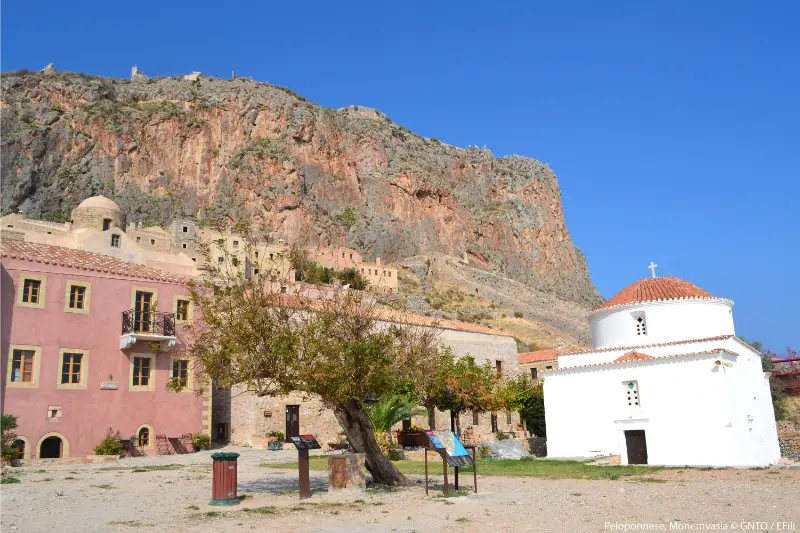
I would not fill the day with distant excursions. The point of sleeping here is to give the medieval town time to breathe: a long lunch, a quiet hour with a view, another walk after sunset.
Food and Malvasia wine
The name Monemvasia is historically linked with Malvasia wine, and local meals are a good reason to slow down. Try regional dishes rather than ordering only familiar Greek standards. A dinner inside the walls is part of the experience even if prices can be higher than in ordinary mainland villages.
Book ahead in busy periods if one particular terrace or restaurant matters to you, but keep at least one meal spontaneous.
How many nights?
| Stay | Experience |
|---|---|
| Day trip | Enough to see Lower Town, but misses the evening mood |
| 1 night | Excellent minimum |
| 2 nights | Best for Upper Town plus a slow day |
| 3 nights | For travellers combining beaches and complete downtime |
A 2-day Monemvasia plan
- Day 1: arrive by early afternoon, check in, explore Lower Town, enjoy sunset and dinner inside the walls.
- Day 2: climb to Upper Town early, visit Agia Sofia, return for lunch, swim or rest, then continue your Peloponnese route.
How I would plan the trip before booking
For Monemvasia, I would book the trip in this order: decide how many nights you genuinely have, choose inside the castle for atmosphere or Gefyra for easier parking and luggage, check the transport that controls your arrival and departure, and only then reserve day trips. This order matters because attractive hotel prices can tempt you into a base that creates unnecessary driving, transfers or early-morning stress. A good location often saves more holiday time than a slightly cheaper room.
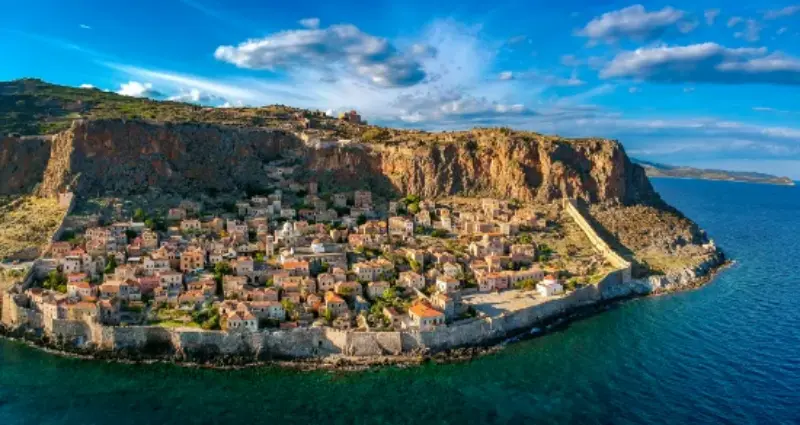
The transport question is especially important here: cars remain outside the medieval town, so the key transport decision is where you will park and how you will move luggage to the room. I would keep the first and final day lighter than the middle of the trip. That leaves space for delayed flights or ferries, heat, wind, children needing a slower morning, or simply discovering a place you want to stay longer.
For seasonality, spring and autumn are ideal for walking the rock; summer is beautiful but the Upper Town climb should be early. I also avoid building a plan in which every day depends on perfect beach weather. A museum, old town, village, food stop or short scenic walk gives the itinerary resilience when conditions change.
Who will enjoy this destination most?
Monemvasia works best for travellers who like a mixture of sightseeing and unstructured time rather than rushing between checklist attractions. It rewards mornings that start early, a long lunch or coffee break, and evenings close to the accommodation rather than another long transfer.
For families, choose accommodation with simple access, carry as little luggage as possible and consider staying outside the walls if stairs are difficult. Couples can make the trip more relaxed by staying somewhere walkable for dinner. Solo travellers generally benefit from central bases and public transport connections. Road-trippers should check parking before choosing accommodation, because a beautiful historic centre can be inconvenient with a car.
If you are combining this stop with another part of Greece, compare the pacing with Ancient Olympia if your road trip continues west. One of the biggest mistakes in Greece is treating a short transfer on a map as a short travel day; ferry check-in, port access, parking, waiting time and mountain roads all add invisible hours.
Small details that make the trip easier
I keep a small offline map on my phone, carry water in warm months, save the exact accommodation entrance rather than only the property name, and photograph parking or bus-stop information when I arrive. These tiny habits are more useful than a minute-by-minute itinerary.
Comfortable shoes matter in Greece more often than visitors expect. Polished stone, steps, uneven lanes and archaeological ground are common. Sun protection, a light layer for wind or air-conditioned transport, and a reusable bottle cover most day-to-day needs. At religious sites, modest clothing may be required, so it is useful to carry something that covers shoulders or knees.
Finally, leave one block of two or three hours completely unscheduled. The most memorable part of a trip is often the bakery you did not plan, a swim that lasts longer than expected, a village square at dusk or a viewpoint found on the way back to the hotel.
Frequently asked questions
Can you drive into Monemvasia Castle?
No. The historic castle town is pedestrian. Cars stay outside, which is why luggage planning and the exact location of your hotel matter.
Is one night enough?
Yes, and it is much better than a day trip because you experience the lanes after the busiest visiting hours. Two nights are ideal if you want the Upper Town without rushing.
Is Monemvasia suitable for children?
It can be magical for children who enjoy castles, but strollers and steep steps are awkward. Families should choose accommodation carefully and avoid the Upper Town climb during hot midday hours.
My final planning rule
The best version of a Monemvasia travel guide is not the itinerary with the most stops; it is the one that gives each stop enough time to feel different from the last. I would rather remove one attraction and arrive at dinner relaxed than spend the day checking the time. Greece rewards travellers who protect their mornings, allow long meals and accept that wind, heat or a ferry schedule may change the original plan.
Before departure, I recheck the opening hours of any archaeological site or museum that anchors the day, the transport timetable for the next move, and the exact hotel access or parking instructions. Those three checks prevent most avoidable problems. Everything else can stay flexible: the beach, the lunch stop, the viewpoint and the order of smaller sights.
I also keep one backup idea that requires little transport. That might be a town walk, an urban beach, a museum, a café neighbourhood or a slow meal. A backup is not a second full itinerary; it is permission to change the day without feeling that the trip has failed.
Continue planning Laconia with Geraki, Neapoli Voion, Cape Maleas.
Continue planning Laconia with Kyparissi, Plytra, Archangelos.
Leave a Reply