
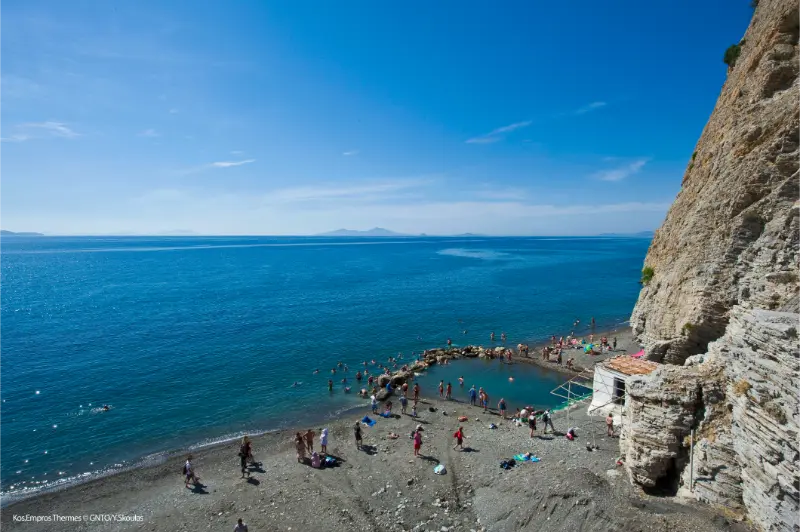
Therma Beach is one of the most unusual stops on Kos: a dark-pebble cove where naturally hot spring water flows into the Aegean and mixes inside a rough stone pool. It is not a polished spa and that is exactly why many travellers remember it. You reach a dramatic southeastern coastline, walk down from the road, smell the sulphur and step between very warm spring water and cooler sea.
The experience is simple but deserves planning. The access path, heat of the water, crowded stone pool and lack of the smooth infrastructure of a hotel spa mean Therma is not equally comfortable for everyone. Go with realistic expectations and it can be one of the island’s best short excursions.
Where Therma is and how the hot pool forms
The Municipality of Kos places Therma roughly 13 km southeast of Kos Town, beyond Agios Fokas. The official Therma page explains that hot spring water reaches the coast and mixes with seawater inside a stone-bordered pool. The municipal information gives spring temperatures in the range of roughly 42–50°C near the source, so temperature varies significantly depending on exactly where you sit.
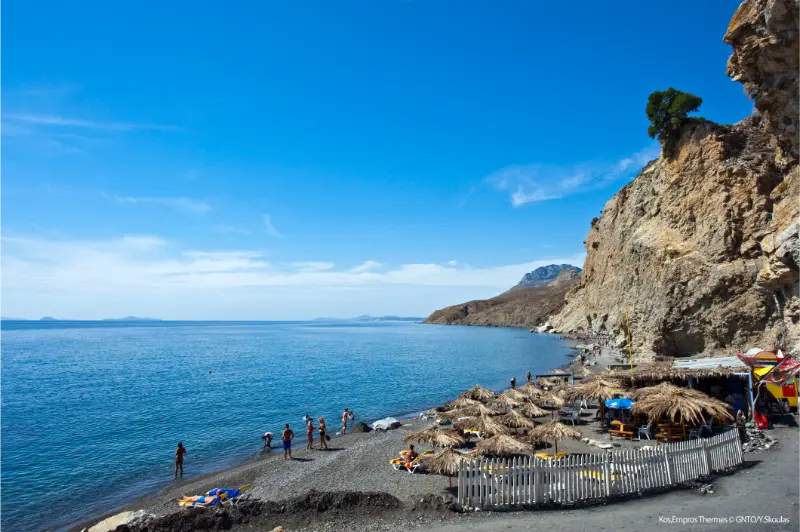
Do not position yourself at the hottest inflow because other visitors are doing it. Move gradually between sea and pool and leave immediately if you feel dizzy, faint or unwell. People with medical concerns related to heat exposure should seek appropriate professional advice rather than treating a natural spring as automatically safe.
The walk down to the beach
Public transport and road access take you to the upper area, but the official island information notes an additional walk of around ten minutes down a dusty track. That descent is manageable for many travellers but matters for anyone with limited mobility, a stroller or unsuitable shoes. The return is uphill and feels hotter than the way down.
Wear shoes with grip rather than smooth flip-flops. Carry water even though the excursion looks short on a map. After a long soak in hot water, climbing an exposed track in summer sun can feel much more demanding than expected.
What the beach itself is like
Therma is a dark-sand-and-pebble setting shaped by the island’s volcanic context. The sea can become deep away from shore, and the coastline is far more rugged than Tigaki or Paradise Beach. This is not the place I would choose for a classic all-day family sandcastle beach.
Instead, pair the thermal pool with a swim, a short rest and perhaps another stop around Psalidi or Agios Fokas. Water shoes are useful because the stones can be uncomfortable and hot surfaces around the pool are not pleasant barefoot.
Best time of day to visit
Early morning reduces heat and crowd pressure. Evening can be atmospheric because the spring feels especially distinctive after the sun drops, but darkness makes the track and uneven shore harder to navigate. If you plan a late visit, bring a proper light rather than relying on a phone battery.
Midday in July or August is the least appealing combination: hot air, hot spring water and an exposed walk. If that is your only available time, shorten the soak and prioritise hydration.
Bus, car or taxi?
The official island guide states that Therma is accessible by public transport. For travellers based in Kos Town, that can make it a car-free half-day, but route details and seasonal frequency should be checked on the day. A taxi is useful if several people are travelling together or if the last bus does not fit the evening you want.
Drivers should expect the final approach to feel more remote than the city. Park only where permitted and do not block turning space or bus access. Coastal roads can also be affected by maintenance or severe weather, so local advice outranks an old itinerary.
Can children visit Therma?
Families can visit, but the attraction is hot water rather than a purpose-built children’s pool. Closely supervise children around rocks and temperature changes, keep hot-water exposure conservative and consider whether the walk back up suits your family. For a straightforward shallow beach day, Tigaki, Marmari or Paradise Beach are easier.
The strongest family plan is often a short Therma stop for older children followed by a conventional beach elsewhere, rather than spending the entire day here.
What to bring
- Water and extra drinking water for the uphill return
- Shoes with grip plus optional water shoes
- Swimsuit and quick-drying towel
- Sun protection; shade is limited
- A small light if you plan to leave after sunset
- A bag for all rubbish—leave the natural pool as you found it
How Therma Beach fits into a wider Kos trip
Use this guide together with the main Kos travel guide, Kos Town guide and Asklepieion guide. The newer in-depth pages on Tigaki and Marmari, Kefalos and Kamari, Kardamena, Zia and Mount Dikeos, Therma, cycling, the best beaches, Kos without a car, Kos with kids and where to stay in Kos make it easier to build a trip around one area instead of crossing the island repeatedly.
Therma is best treated as a distinctive two- or three-hour experience rather than a conventional full-day resort beach. The most useful rule is to group places geographically. Kos is compact compared with many Greek islands, but a holiday still feels much better when a beach, village and archaeological stop naturally belong to the same side of the island.
Getting around and checking transport
Public transport is possible according to the Municipality of Kos, but seasonal operating details should be checked locally. Taxis simplify a late return, while a rental car lets you combine Therma with Agios Fokas or another eastern stop.
Kos Town and Psalidi are the easiest bases for reaching Therma without dedicating an entire driving day to the southeastern coast. Public transport is useful, but seasonal frequency matters. The official KTEL Kos general routes page currently lists services for Kefalos, Kardamena, Marmari, Zia, Antimachia, Tigaki, Pyli and Mastichari. KTEL also announced timetable changes taking effect from 29 June 2026, so always open the live timetable again shortly before the day you travel rather than saving an old screenshot.

Booking excursions and activities
Boat trips, island excursions and guided experiences are highly seasonal on Kos. Before booking, compare the actual time spent at each stop, whether transfers are included, the size of the boat or group, shade, swimming opportunities and cancellation conditions. Do not choose an excursion simply because it has the longest list of stops.
Mistakes that make the day harder
- Staying too close to the hottest spring inflow because other visitors are doing it.
- Walking down in slippery footwear and forgetting that the return is uphill.
- Visiting at midday in extreme heat and then soaking for a long time.
- Expecting a formal spa with changing rooms and controlled water temperature.
- Leaving rubbish in a natural coastal site.
Frequently asked questions
How hot is the water at Therma?
Official Kos tourism information gives the spring temperature at roughly 42–50°C near the source, but it cools as it mixes with seawater.
Can you get to Therma by bus?
The Municipality of Kos states that the area is accessible by public transport. Check the current route and return times for your travel date.
Is Therma free to visit?
The natural coastal spring itself is an open natural attraction; ancillary services can change. Check local conditions rather than assuming facilities are always operating.
Is Therma a good beach for young children?
It is more rugged than the island’s shallow sandy beaches. Families can visit, but the hot water, rocks and uphill access require closer supervision.
How long should you spend at Therma?
For most visitors, a couple of hours is enough for the walk, thermal pool and a sea swim. Extend the outing by combining it with nearby southeastern beaches rather than staying in the hottest water for a long period.
Final planning advice
Kos is at its best when you leave some space between the headline attractions. The island is easy enough to explore that there is little benefit in forcing four distant stops into one day. Pick one anchor experience, add one or two nearby places, and keep time for a swim, a long lunch or an evening walk. That slower structure usually produces a better holiday and makes delays, wind or summer heat much easier to handle.
How to plan around wind and summer heat
Wind and heat should be treated as planning variables, not annoyances that have ruined the schedule. Kos has enough coastline and enough non-beach alternatives that you can move a swimming day, shorten an exposed walk or swap a western drive for a museum and town afternoon. Check conditions each morning, especially before a boat trip, long cycle ride or remote-beach drive.
In July and August, schedule archaeological sites, village walks and cycling early. Keep the middle of the day for swimming, shade or a long lunch, then use late afternoon for another short outing. This is more comfortable and usually produces better photographs than forcing outdoor sightseeing under the harshest sun.
How much should you plan in advance?
Reserve the things with real capacity constraints—specific hotels, popular boat excursions and important airport transfers—then leave ordinary beach days flexible. A rigid seven-day schedule is vulnerable to one windy day; a flexible plan can move the boat trip and still protect the experiences that matter most.
Keep addresses, bus information and booking confirmations available offline. Mobile coverage is generally good in populated areas, but a dead battery or weak signal is a poor reason to miss the last bus. For driving days, download an offline map and verify that navigation is not sending a standard rental car onto an unnecessary rough track.