
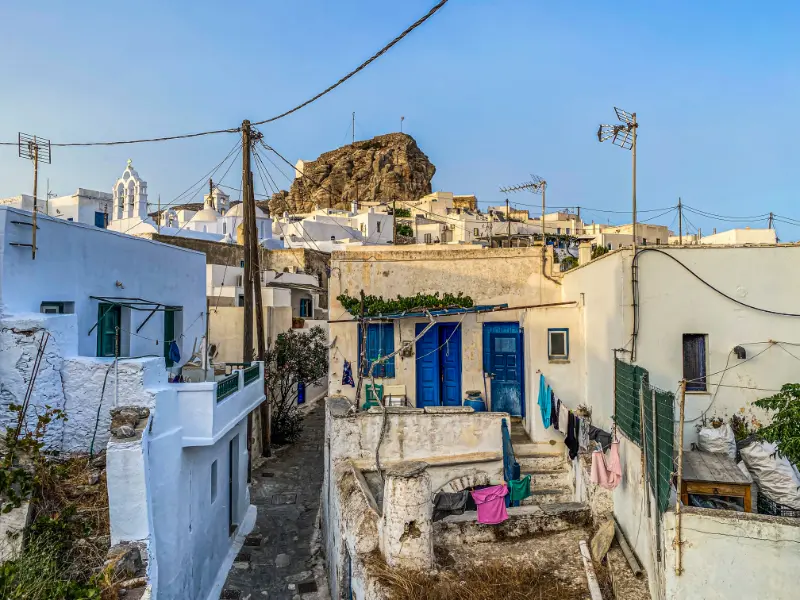
Chora is the kind of Cycladic capital that makes sense only after you stop trying to “do” it quickly. Built high above the sea, around 400 metres according to the municipal tourism guide, it hides from the coast behind folds of rock. White lanes, tiny squares, blue-domed churches and old windmills appear almost without warning as you turn corners. The 13th-century Venetian castle on the rocky outcrop gives the settlement a strong focal point, but the pleasure is in the network of lanes around it.
For a first visit I would give Chora at least one slow afternoon and evening, then return another day if you are using it as a base for Hozoviotissa or hiking. It is only about 5.5 km from Katapola, yet the atmosphere is completely different: no harbour promenade, more height, cooler evening air, steeper walking and a stronger village feel.

At a glance
| Best for | Atmosphere, evenings, Hozoviotissa, hiking |
| Altitude | About 400 m above sea level |
| From Katapola | About 5.5 km |
| From Aegiali | About 16 km |
| Car essential? | No, if buses match your plans |
Why Chora feels different from a seaside Cycladic town
The capital developed away from the shore, a defensive pattern that gives it a compact maze rather than a waterfront grid. You move through covered passages, little staircases and irregular squares, with sudden views of the surrounding ridges. The village is particularly rewarding before sunset, when day visitors begin to leave and cafés and tavernas become the focus.
The municipal guide describes Chora as a medieval mountain village surrounded by windmills. That is useful context: this is not simply a photogenic collection of white houses, but a settlement shaped by exposure, defence and the need to build tightly on difficult ground.
The Venetian castle and the rock of Kera Leousa
The castle sits on the prominent rock above the village and is one of Chora’s defining landmarks. Access conditions can change and the final approach is steep, so do not treat it as an effortless viewpoint. Even if you do not climb every last step, the rock is visible from many lanes and helps you orient yourself.
Nearby churches and old houses create a much richer visit than a quick “castle photo”. Walk slowly around the base, notice how buildings adapt to the rock and look back toward the windmills on the ridge.
Windmills and sunset viewpoints
The line of old windmills above Chora is one of the classic Amorgos scenes. Some are ruins rather than restored interiors, but they show how exposed the ridge is to wind. Go late in the day for softer light, yet bring a layer because the temperature can fall quickly after sunset.
For photography, do not crowd doorways or private terraces. The best compositions often come from stepping back and using the rock, churches and windmills together rather than trying to photograph a single “famous” angle.
Museums and churches
Chora has an archaeological museum, ecclesiastical collections and a folklore dimension that add context to the landscape. Seasonal hours can be limited, so verify locally rather than building an entire day around a museum timetable copied from an old blog post.
The island has an extraordinary density of chapels and religious sites. Visit respectfully, dress appropriately where requested and remember that small churches are active places of worship rather than decorative interiors.
Using Chora for Hozoviotissa and Agia Anna
Chora is the most natural land base for the Monastery of Hozoviotissa. The road reaches the parking/approach area outside the village and the final climb is on foot. Agia Anna lies below the monastery on the same dramatic east coast, so the two are often paired in one half-day.
For the practical details, use the Hozoviotissa Monastery guide and Agia Anna and Mouros guide. Do not plan a swim as if the monastery dress code, walking time and heat do not exist; order matters.
Where to stay in Chora
Stay in Chora if you value evenings, village atmosphere and easy access to the centre of the island more than having a beach outside the door. It is especially good for couples, walkers and travellers who like to return from a day trip, shower and walk to dinner without driving again.
Before booking, ask about luggage access, stairs, parking and the exact distance to the bus stop. “In Chora” can still involve steep lanes that feel very different with a suitcase. For a full comparison with Katapola and Aegiali, see where to stay in Amorgos.
Eating and evening rhythm
Chora is one of the best places to explore Amorgian cooking in a setting that feels alive after dark. Look for patatato, local cheeses, seasonal greens and psimeni raki rather than ordering only generic island dishes. The Amorgos food guide explains what is genuinely local.
Dinner later in the evening fits the rhythm of summer Chora. If you are hiking early the next morning, keep the late-night bar stop optional: the exposed trails are much more enjoyable when you start rested and before the heat builds.
Tours and experiences
Organised activities on Amorgos are more limited than on Santorini or Mykonos, which is part of the island’s appeal. When a guided hike, boat trip or cultural tour fits the plan, compare the exact meeting point, duration, cancellation conditions and whether transport is included before booking.
Frequently asked questions
Is Chora the best place to stay in Amorgos?
It is one of the best choices for atmosphere, restaurants, central access and Hozoviotissa. Katapola is easier for port logistics, while Aegiali is better for a sandy beach and the northern villages.
Does Chora have a beach?
No major beach sits in the village itself. Agia Anna and Kambi are reached on the east side, while Katapola and Aegiali provide different beach options.
Can I visit Chora without a car?
Yes, when seasonal buses operate on the routes you need. Always check the current timetable because frequency changes through the season.
How long should I spend in Chora?
Allow at least half a day plus an evening. Staying overnight gives a much better sense of the village after day visitors leave.
Is Chora difficult with luggage?
It can be. Narrow lanes, stairs and vehicle restrictions mean the exact accommodation location matters more than the map distance suggests.
What should I combine with Chora?
Hozoviotissa and Agia Anna are the obvious combination, while the Fotodotis trail links Chora toward Katapola for walkers.
Planning details that make a real difference
Amorgos looks compact on a map, but a day based in Chora works best when you respect the island’s long, mountainous shape. Roads bend around ridges, buses are seasonal and several beaches or trailheads still require walking. Build the day around one part of the island instead of repeatedly crossing from north to south.
In July and August, start exposed walks early and treat the middle of the day as swimming, lunch or shade time. The Meltemi can make the air feel cooler than it is, so do not use wind as a substitute for sun protection. In May, June, September and early October, walking is often more comfortable, but transport and boat services may run less frequently than at peak summer.
Keep water, a hat and shoes with reliable grip in your day bag even when the plan does not sound like a hike. Many rewarding places on Amorgos are reached by stone steps, rough paths or steep village lanes. For remote beaches, assume there may be no shade, shower, shop or mobile signal exactly where you need it.
Finally, leave some flexibility. Strong wind can change boat trips and beach conditions, a bus timetable can be revised, and a village festival may be a better evening than the restaurant reservation you planned months earlier. Organise the essential logistics, then allow the island to change the order of the day.
Continue planning Amorgos
For the rest of the island, continue with Katapola Amorgos Guide; Aegiali, Langada and Tholaria Guide; Hozoviotissa Monastery Guide; Agia Anna and Mouros Beaches Guide; Best Beaches in Amorgos; Amorgos Hiking Guide; Amorgos Without a Car. These guides are designed to work together, so you can move from a general idea to the practical details of transport, beaches, walking and where to base yourself.
Useful official resources
For current destination information use Amorgos Municipality tourism guide. For public buses check the Amorgos Bus Company timetable page, which explicitly advises travellers to confirm route changes on arrival. For walking and beach overviews, Visit Greece hiking information and Visit Greece beaches of Amorgos are useful starting points. Recheck opening hours, buses and boat departures shortly before travel.
Final practical advice
Chora is best approached as a place to wander rather than a checklist. See the castle and windmills, sit in a square, visit a museum if it is open, then let dinner stretch into the evening. If you stay here, accept the steps and parking limitations in exchange for one of the most atmospheric bases on Amorgos.
How I would fit this into a first Amorgos trip
For a first visit, I would avoid using this subject as an isolated checklist. Build it into a route that gives Chora, Katapola and the north enough time to feel different. A five- to seven-night stay can include one dedicated hiking day, two flexible swimming days, one cultural day around Hozoviotissa and Chora, and an evening in both a port and a mountain village. This balance is more revealing than trying to collect every beach and viewpoint in one loop.
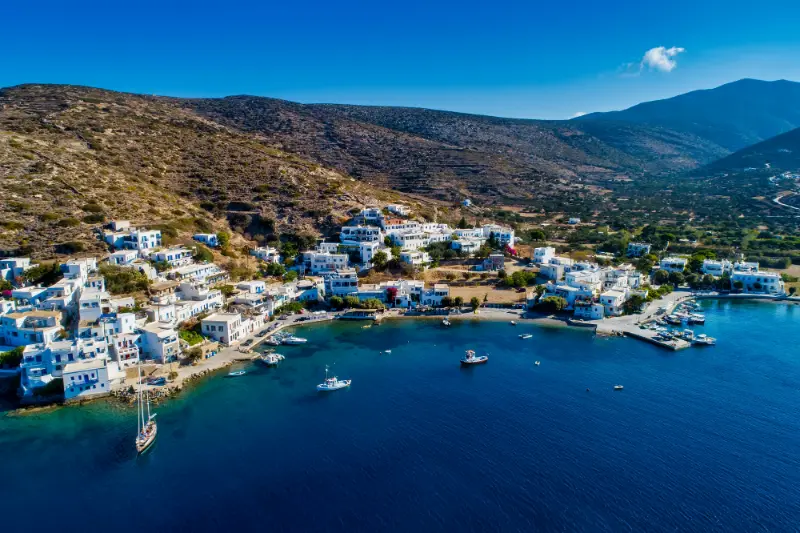
Ferry times should shape the first and last day. If you arrive in Katapola, keep the first evening local instead of immediately crossing the island. If you arrive in Aegiali, enjoy the north first. The same logic applies on departure: sleep where the morning connection is easiest when the ferry is early, rather than creating a stressful taxi transfer simply to spend one final night in a prettier village.
Amorgos also rewards seasonal thinking. May and early June suit walking and flowers but the sea may feel cool; July and August bring the broadest visitor services plus stronger heat and wind; September often combines warm water with better hiking temperatures, although bus and boat frequencies can begin to ease. October can be beautiful for independent travellers who accept a quieter island and fewer daily connections.
Budget for occasional taxis even if you plan to use buses. One well-timed taxi can protect a hiking plan, solve an early ferry connection or let you eat in another village after the last convenient bus. That is usually better value than renting a car for an entire week if you only need private transport twice.
Leave a Reply