
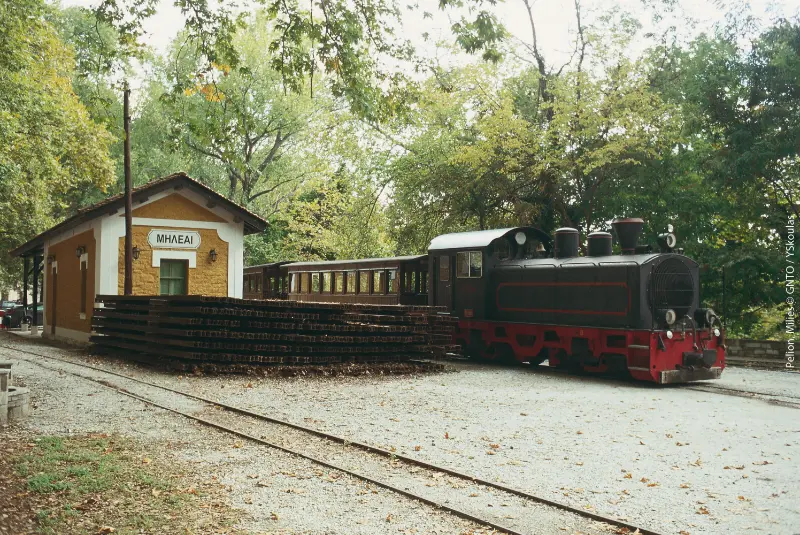
The Pelion Train is one of the rare attractions in Greece where the journey itself is the destination. The narrow-gauge line climbs from Ano Lechonia toward Milies through olive groves, forest, stone bridges and mountain scenery. It is not the fastest way to reach Milies, and that is exactly the point.
Because the service is seasonal and schedules can change, this is also one Pelion experience that should never be planned from an old blog post. The information below reflects Hellenic Train’s published schedule in September 2026, but verify the official Pelion Train page before travel.
Quick planning facts
- Current September 2026 regular service: Saturday–Sunday.
- Published departures: Ano Lechonia 10:00; Milies 15:00.
- Journey about 15 km / 90 minutes each way, with a 15-minute Ano Gatzea stop.
- Verify extra dates and timetable directly with Hellenic Train.
- Do not assume Interrail covers this tourist railway.
2026 timetable: what is running now
As of September 2026, Hellenic Train lists the regular service on Saturdays and Sundays. Train 3800 leaves Ano Lechonia at 10:00 and reaches Milies at 11:35. Train 3801 leaves Milies at 15:00 and reaches Ano Lechonia at 16:30. Both directions include a 15-minute stop at Ano Gatzea.
Hellenic Train has also announced extra Friday services on selected September dates, including 18 and 25 September 2026. These additions show why you should always check the current operator notice rather than assuming that last year’s pattern still applies.
Route, distance and travel time
Hellenic Train describes the tourist section as approximately 15 km long and around 90 minutes each way. The line uses a 60 cm gauge, one of the narrowest in the world, and follows infrastructure built in stages between the late 19th and early 20th centuries.
The scenery changes gradually rather than through one spectacular moment. You pass vegetation, stone works, bridges and views toward the Pagasetic side before arriving below Milies.
Ano Gatzea and the intermediate stop
The published timetable includes a 15-minute stop at Ano Gatzea in both directions. Treat it as a short break, not enough time for independent sightseeing. Stay close to the train and follow crew instructions.
This stop is part of the rhythm of the excursion. The Pelion Train is deliberately slow, and trying to optimise every minute misses the appeal of travelling on a historic mountain railway.
The De Chirico bridge and railway history
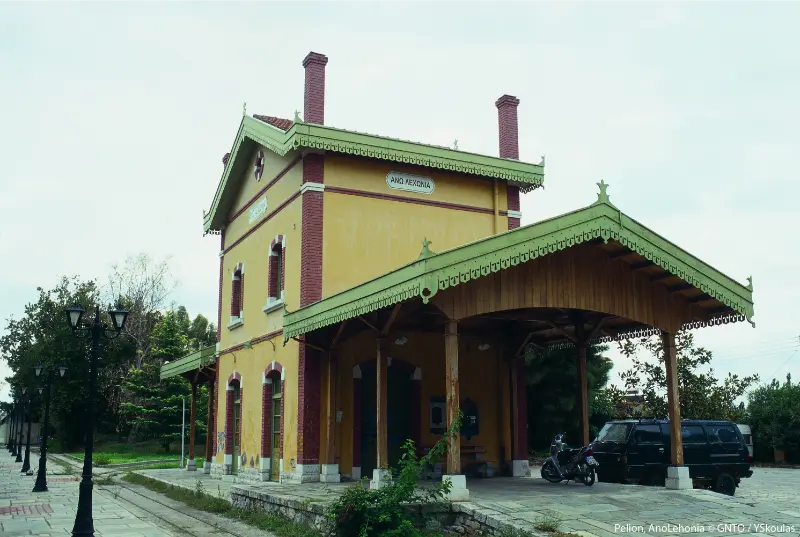
One of the best-known engineering features is the Taxiarchis, or De Chirico, metal bridge near Milies. The line was supervised by Evaristo de Chirico, father of painter Giorgio de Chirico, who was born in Volos. Hellenic Train notes the connection between the railway environment and imagery that later appeared in the artist’s work.
The line once connected Volos with Pelion communities and contributed to regional development. Tourist operation preserves a small but tangible part of that transport history.
What to do during the Milies stop
The current schedule gives several hours between arrival around 11:35 and departure at 15:00. From the station, a traditional cobbled path leads uphill toward Milies. Use the time for a village walk, lunch and one or two key stops rather than attempting a wider road trip.
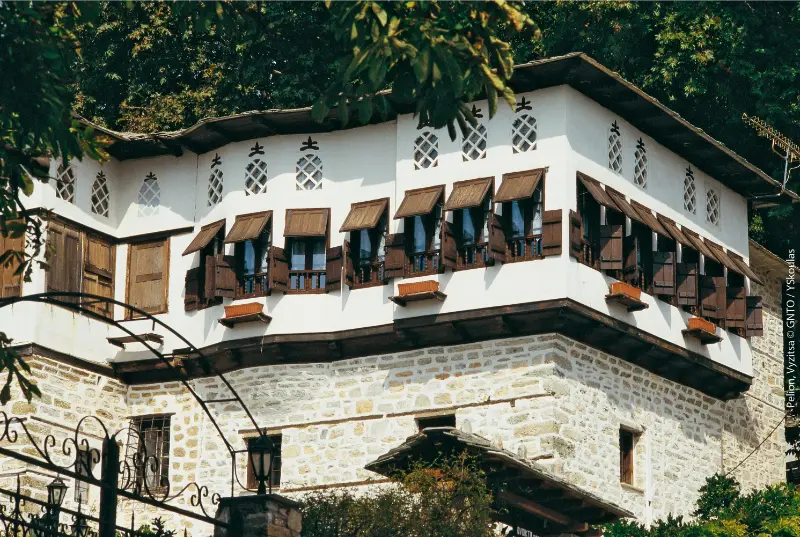
My Milies and Vyzitsa guide explains how to make the village part of a longer stay. If you are returning on the same train, watch the clock: missing a historic tourist service is much more complicated than missing a frequent city metro.
Tickets, booking and practical preparation
Book through official Hellenic Train channels and confirm the operating date before travelling to Ano Lechonia. Tourist services can sell out on popular weekends. Save your booking offline and arrive with enough time to park and find the platform without rushing.
Interrail/Eurail coverage should not be assumed: Hellenic Train’s current Interrail information explicitly excludes the Ano Lechonia–Milies tourist route. Check the fare and conditions that apply to your own journey.
How to build the day around the train
If you are staying in Volos or western Pelion, drive or transfer to Ano Lechonia in the morning, ride to Milies, have lunch and return on the afternoon service. Do not add distant east-Pelion stops on the same day. The timetable already creates a full excursion.
If you stay in Milies, you can ride the line in the opposite direction only if the schedule works for your plan. Always verify same-day return possibilities instead of assuming symmetric departures.
Photography and where to sit
The best views change side repeatedly as the line bends, so there is no single “correct” seat for the entire journey. If photography matters, keep the camera ready but do not spend ninety minutes pressed against a window. Bridges, vegetation and glimpses of the gulf appear quickly, and the atmosphere inside the small train is part of the experience too.
Be considerate when moving for photographs and follow crew instructions. Historic tourist trains have different space and safety constraints from modern intercity services. If a particular bridge or view matters to you, enjoy it first and photograph second; the train will not stop simply because the angle was not perfect.
What to do if the train is sold out or not running
Do not build the entire Pelion trip around one service. If tickets are unavailable, drive to Milies and explore the village, walk part of the railway-aligned trail from Kala Nera, or visit Ano Gatzea independently. You will miss the ride itself, but not the landscape and villages that make the route interesting.

This backup matters outside peak operating periods, when tourist-rail schedules can be limited. A flexible Pelion itinerary should treat the train as a highlight rather than a transport necessity.
Practical planning checklist
- Check the mountain forecast as well as the Volos/coastal forecast before driving or hiking.
- Keep offline directions and your accommodation phone number because mountain roads and village lanes can be confusing after dark.
- Allow more driving time than the kilometre count suggests; Pelion roads are scenic but winding.
- Do not overfill the day. One village, one walk and one meal often produces a better Pelion experience than five rushed stops.
- For the wider region, use my complete Pelion travel guide and Volos travel guide.
Frequently asked questions
Does the Pelion Train run every day?
No. As of September 2026, Hellenic Train lists regular weekend service with selected extra Friday dates. Always check the current timetable.
How long is the ride?
Hellenic Train describes the tourist route as about 15 km and around 90 minutes each way.
Can you visit Milies between trains?
Yes. The published timetable leaves several hours in Milies, enough for a walk and lunch if you keep track of the return time.
Where does the train start?
The current tourist route starts at Ano Lechonia and runs to Milies, with a stop at Ano Gatzea.
Final thoughts
The Pelion Train is worth doing because it forces you to travel at the mountain’s pace. The scenery, engineering and time in Milies matter more than speed.
Treat the operator timetable as part of the attraction, verify it close to departure and keep the rest of the day deliberately simple.
How I would make the day less rushed
The easiest way to enjoy Pelion Train 2026 is to protect one slow block of time. I would avoid booking a timed attraction immediately before or after a mountain drive, and I would not assume that a short road distance means a quick transfer. Pelion travel is shaped by bends, parking, walking surfaces and the temptation to stop for views. Build those realities into the plan instead of treating them as delays.
I also keep one alternative nearby. If the Aegean is rough, I switch to a village walk. If rain makes stone paths slippery, I use the time for food, architecture or a shorter route. If parking is chaotic, I move on and return later. This flexibility is one of the reasons Pelion is rewarding: mountain, forest, village and sea give you several good versions of the same day.
What to verify before you leave your hotel
Before driving, check the weather, road route, parking location and whether your chosen restaurant or attraction is actually open that day. Seasonal businesses may change hours outside peak summer. For hikes, ask whether recent rain, maintenance or fallen trees have affected the path. For beach days, look at wind and sea conditions rather than only air temperature.
Save your route offline and carry water. In a region of dense forest and winding roads, mobile coverage can vary. These are small preparations, but they keep a pleasant day from becoming an unnecessary logistical problem.
One more practical note before you go
A useful final check for Pelion Train 2026 is to look at the day as a sequence rather than a list of places. Decide where the car will be left, how much walking comes before lunch, when the hottest or busiest period is likely to occur, and what your easiest fallback will be. Pelion becomes tiring when every stop requires a parking search followed by a steep walk and another winding drive. One carefully planned anchor usually makes the rest of the day easier.
I also avoid measuring success by the number of villages or beaches reached. The region is most distinctive when you have time to notice the old stone paths, sit in a shaded square, eat a regional dish and adjust to the weather. If one stop takes longer because the meal is good or the light is beautiful, let the next minor stop go. That flexibility is not lost time; it is the reason a Pelion road trip feels different from a sightseeing race.
Before leaving the accommodation, confirm fuel level, water, offline navigation and the final parking point. If you are walking, carry shoes with grip and a small layer for changing mountain weather. If you are swimming, check the sea on the same day. These simple habits matter more here than squeezing another pin into the itinerary.