
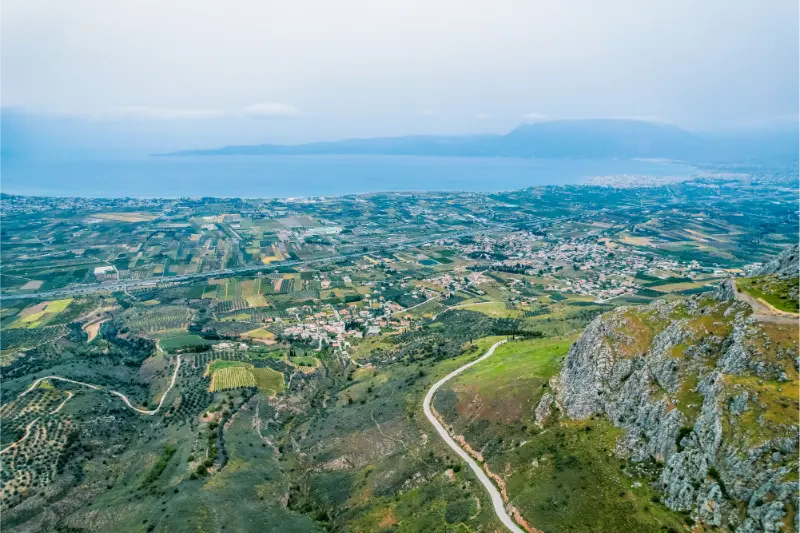
Corinth is one of the easiest places to underestimate because the name refers to several different stops: modern Corinth, the archaeological site of Ancient Corinth, the fortress of Acrocorinth and the Corinth Canal at the Isthmus. They are related geographically but are not one attraction you can see from a single car park.
Together, however, they make one of the best history-and-landscape days between Athens and the Peloponnese. The route also fits naturally into my Peloponnese Road Trip if you are continuing toward Nafplio, Mycenae or Epidaurus.
Why this place deserves more than a quick photo
Ancient Corinth shows the remains of a major Greek and Roman city in a strategic location between mainland Greece and the Peloponnese. The Temple of Apollo, Roman forum, fountains and road alignments create a much more urban experience than a single sanctuary.
Acrocorinth adds the defensive layer above the city, while the modern canal explains why control of the Isthmus remained strategically important into the industrial age. Visiting all three creates a continuous story about movement, trade and geography.
A short history before you visit
Corinth prospered because of its position near routes connecting the Saronic and Corinthian gulfs. Ancient infrastructure, ports and the Diolkos helped exploit the narrow Isthmus long before the modern canal was completed.
The city was destroyed and re-founded in antiquity, and the archaeological remains include strong Roman elements alongside earlier Greek monuments. Christian visitors also connect Corinth with the journeys and letters of St Paul.
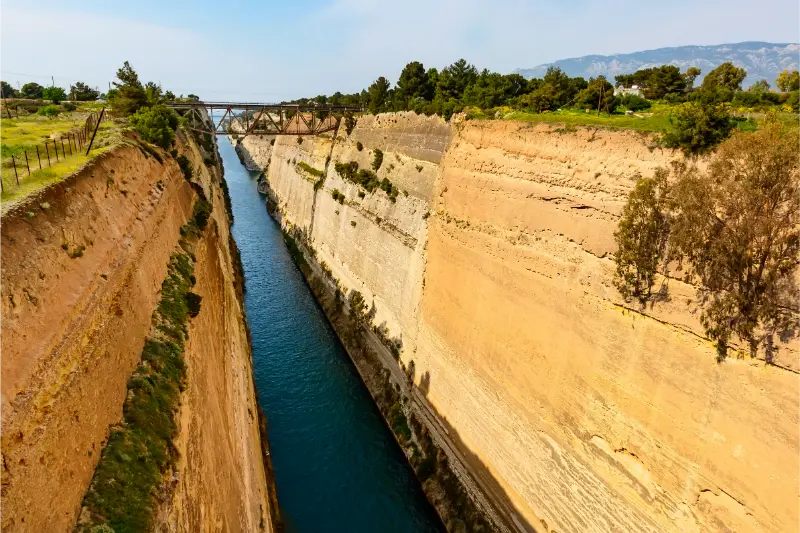
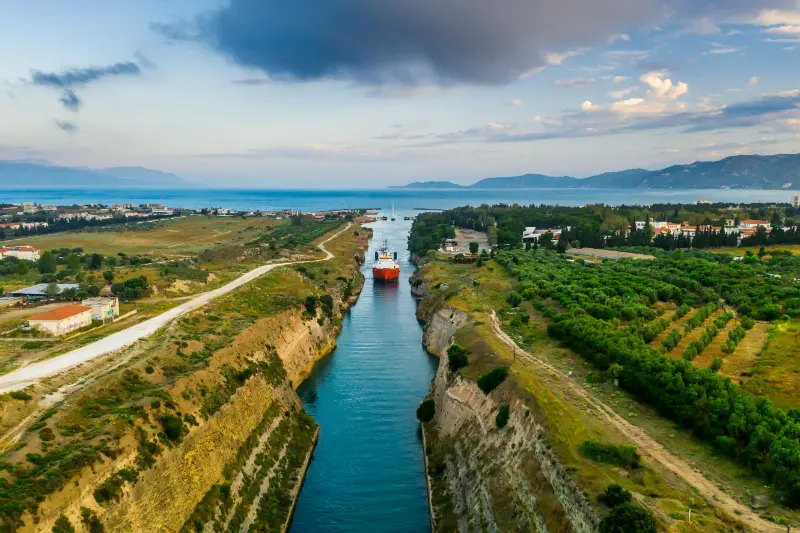
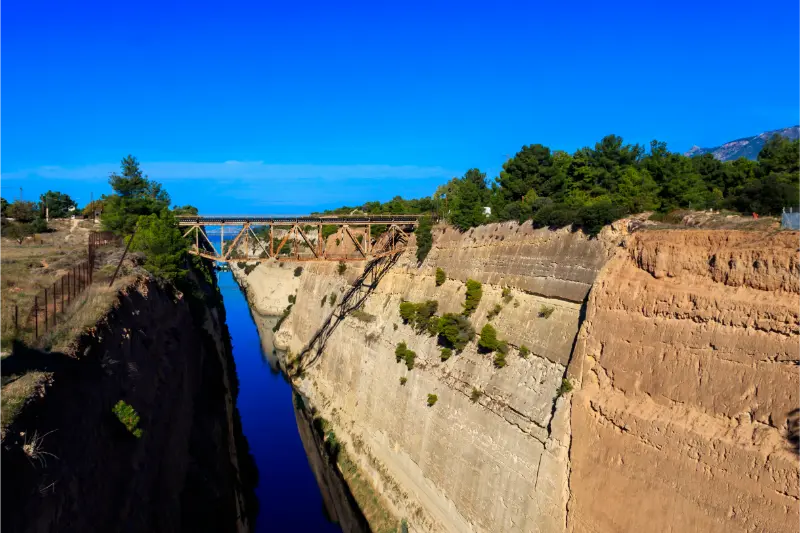
The modern Corinth Canal was completed in 1893. Visit Greece describes it as a 6,346-metre cut through the Isthmus, with near-vertical sides that make the viewpoint impressive even for travellers who are not interested in engineering. See Visit Greece – Corinth Canal.
What to see: the essential highlights
- Temple of Apollo: the most visually recognisable ancient monument and a useful anchor for understanding the older city.
- Roman Forum: the civic heart of the later city, with buildings and monuments that reveal Corinth’s importance under Roman rule.
- Peirene Fountain: one of the site’s best places to connect mythology, water infrastructure and urban life.
- Lechaion Road: the route toward the ancient port helps visitors imagine the city as a commercial centre.
- Acrocorinth: the massive hilltop fortress above Ancient Corinth, with layers from multiple periods and extraordinary views.
- Corinth Canal: a short modern stop that makes the geography of the Isthmus immediately obvious.
The route I would follow
With a car, I would visit the canal either first or last depending on your direction of travel, then give the historical core most of the day.
- Stop at a safe, official canal viewpoint and spend twenty to thirty minutes understanding the Isthmus.
- Continue to Ancient Corinth and visit the archaeological site and museum before the hottest hours.
- Have lunch in the village area rather than rushing directly uphill.
- Drive to Acrocorinth if weather, road conditions and opening hours make the fortress practical.
- Finish with a relaxed drive toward Nafplio or back to Athens, rather than adding another major site after sunset.
Without a car, an organised excursion can make the three-part route easier. Independent public transport may reach Corinth, but linking the archaeological site, fortress and canal efficiently requires more planning.
How much time do you need?
Ancient Corinth itself deserves around two hours for a first visit. Add another one to two hours for Acrocorinth depending on walking and access, plus a short canal stop. A full day is ideal when travelling from Athens.
If you are only passing through on a road trip, choose either Ancient Corinth or Acrocorinth as the main visit and keep the canal brief.
How to get there
The Corinth area is a straightforward drive from Athens and sits directly on the route into the northeastern Peloponnese. Drivers should distinguish clearly between “Corinth,” “Ancient Corinth,” “Acrocorinth” and “Corinth Canal” in navigation apps.
For public transport, verify the current train/bus situation and last-mile options before departure. A taxi from a transport hub may be necessary for the archaeological site or fortress.
Best time of day and best season
Spring and autumn are ideal. Summer visits should begin early at the archaeological site, with Acrocorinth attempted only if heat and wind are manageable.
The canal viewpoint is easy to visit throughout the year, but the archaeological and fortress experience depends more heavily on daylight and weather.
Tickets, opening hours and current information
Ancient Corinth and Acrocorinth can have different access arrangements, and opening hours may change seasonally. Check official Hellenic cultural sources. The canal viewpoint is a separate modern stop rather than part of the archaeological ticket.
What to wear and what to bring
- Comfortable shoes for ruins and fortress surfaces.
- Water and sun protection.
- A charged phone with each stop saved separately.
- A wind layer for exposed Acrocorinth in cooler months.
- Enough time to drive between locations without rushing.
Visiting with children
The mix of ruins, a huge hilltop fortress and a dramatic canal makes Corinth more varied for children than a long museum-only day. I would keep explanations short and use the geography as the story.
At Acrocorinth, supervise closely around uneven ground and exposed edges. At canal viewpoints, remain behind barriers and treat traffic areas seriously.
Accessibility and physical effort
Ancient Corinth is generally easier than Acrocorinth, though archaeological surfaces remain uneven. The fortress involves slopes and rough paths that can be difficult for limited mobility.
The canal can be appreciated from roadside viewpoints with comparatively little walking, making it a useful stop even for travellers who skip the hilltop fortress.
Photography without missing the place itself
The Temple of Apollo looks strongest when framed against Acrocorinth, because the photograph then explains the city’s topography. At the canal, wide lenses exaggerate depth but keep yourself safely behind barriers.
On Acrocorinth, panoramic images toward the gulfs show why the hill was so strategically valuable. Do not climb unstable walls for a better angle.
What to combine with your visit
Continue to Nafplio, Mycenae or Epidaurus if you are entering the Peloponnese.
From Athens, Corinth works as a dedicated day trip. I would not add both Mycenae and Epidaurus unless you are comfortable with a very long sightseeing day and have your own transport.
Where to stay for the easiest visit
Most visitors do not need to sleep in Ancient Corinth if they are based in Athens or Nafplio. Staying nearby can make sense for a slow road trip or an early Acrocorinth start.
Nafplio offers the more atmospheric overnight base if your next day continues through Argolis.
Common planning mistakes
- Typing only “Corinth” into navigation and arriving at the wrong area.
- Treating the canal as if it were beside Ancient Corinth.
- Attempting Acrocorinth in extreme midday heat.
- Underestimating the amount of walking at the fortress.
- Adding too many other archaeological sites to the same day.
A slower, better way to experience it
Corinth becomes coherent when you keep looking at the landscape. Ancient roads point toward ports, Acrocorinth dominates the plain and the modern canal cuts the Isthmus at a different point. The story is about movement as much as monuments.
Give the archaeology enough time to separate Greek, Roman, medieval and modern layers instead of blending everything into “old Corinth.”
Frequently asked questions
Can I visit Ancient Corinth from Athens in one day?
Yes. With a car or organised excursion, Ancient Corinth, the canal and possibly Acrocorinth fit comfortably into a full day.
Is the Corinth Canal at the archaeological site?
No. It is a separate stop at the Isthmus and requires its own navigation destination.
Is Acrocorinth worth visiting?
Yes for fortress history and views, especially in comfortable weather. It is more physically demanding than Ancient Corinth.
How long do I need at Ancient Corinth?
Around two hours is a good first visit, longer if you enjoy museums and detailed archaeology.
Can I combine Corinth with Nafplio?
Yes. It is an excellent stop on the drive from Athens into the northeastern Peloponnese.
Final advice
Ancient Corinth makes the most sense as part of a three-layer day: city ruins, hilltop fortress and Isthmus geography. That combination explains why this narrow part of Greece mattered for so many centuries.
Start early, keep the canal brief, give the archaeology your attention and save Acrocorinth for conditions that make the climb enjoyable rather than punishing.
Ancient Corinth versus Acrocorinth: which should you prioritise?
If you have limited time, choose according to interest. Ancient Corinth is better for urban archaeology, Roman history, St Paul context and a structured museum visit. Acrocorinth is better for fortifications, panoramic geography and the sense of controlling the Isthmus from above. Travellers who enjoy both history and landscape should make time for both, but they should not be confused as two entrances to the same site.
I would prioritise Ancient Corinth with young children, older travellers or anyone visiting in intense heat. I would prioritise Acrocorinth for photographers, fortress enthusiasts and travellers who are already comfortable with uneven uphill walking.
A realistic Athens-to-Nafplio travel day
Corinth works exceptionally well on the transfer day from Athens to Nafplio. Leave Athens after breakfast, stop at the canal for twenty minutes, spend the late morning at Ancient Corinth, have lunch, then decide whether weather favours Acrocorinth. You can still reach Nafplio with enough time for an evening walk instead of arriving after a marathon of archaeological sites.
Why the canal is worth a short stop
The canal does not need a long visit. Its value is explanatory: in a few minutes you see the narrowness of the Isthmus and understand why ancient rulers, engineers and merchants repeatedly imagined cutting through it. Treat it as a geographic lesson and engineering viewpoint, not as the day’s main attraction.
More detailed Peloponnese planning
Continue with Acrocorinth Guide for more detailed planning.
For more ideas in northern Peloponnese, continue with Corinth city, Isthmia, Loutraki.