

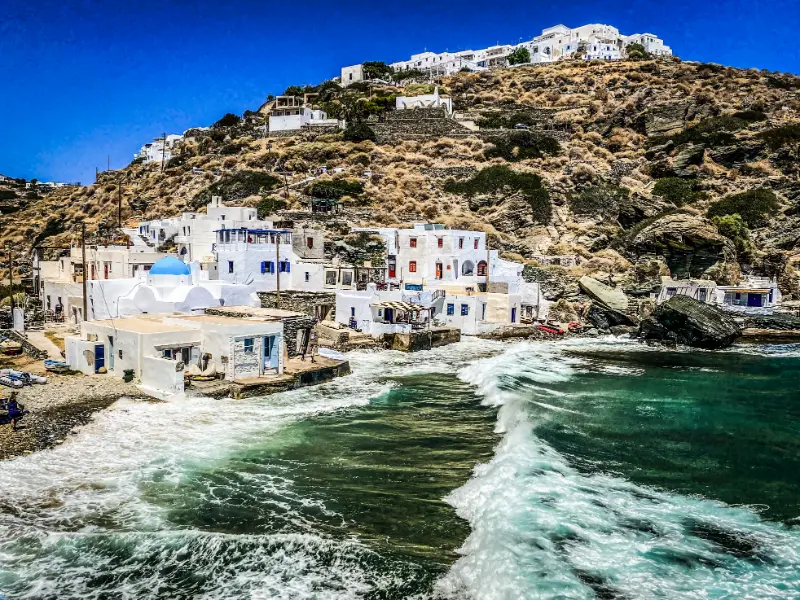
Kastro is one of the places that makes Sifnos feel deeper than a beach island. It was the old capital, preserves a defensive medieval layout and sits on a site inhabited since prehistoric times. Ancient columns, Roman sarcophagi, narrow gateways, chapels and white houses appear inside the same compact settlement, while the small church of Eptamartyres stands dramatically below the village above the Aegean.
The temptation is to arrive for one famous photograph and leave. I would do the opposite: give Kastro enough time to read the settlement slowly, add the Archaeological Museum if open, walk toward Eptamartyres and decide whether conditions suit the descent to Seralia or a longer route toward Panagia Poulati.
Kastro at a glance
| Character | Historic fortified village and former capital |
| Main sights | Medieval lanes, Eptamartyres, Archaeological Museum |
| Swimming nearby | Seralia; rocky swimming around Poulati for experienced swimmers |
| Best time | Morning or late afternoon |
| Good with a car? | Yes, but park outside the pedestrian core |
Why Kastro matters
The Municipality of Sifnos describes Kastro as the ancient city mentioned by Herodotus and notes continuous occupation from the third millennium BC to the present. The village flourished in the sixth century BC and later developed the fortified form that gives it its modern name. This continuity is visible rather than abstract: old stone elements are embedded in newer buildings, and the settlement still follows the hilltop defensive logic.
Two rings of buildings helped create protection, with wealthier houses historically concentrated further inside. Six gateways, known as lodges, controlled the entrances. Once you know this, the lanes stop looking like a random maze and start reading like a defensive urban plan.
How to walk the village
Enter without trying to follow the fastest line through the centre. Look for marble details, old coats of arms, reused ancient fragments and the changing sea views between houses. Because Kastro is still inhabited, keep voices down in residential lanes and do not treat doorways or terraces as photo props.
The highest parts reveal the compact geometry of the settlement. The real pleasure comes from the contrast between enclosed lanes and sudden openings toward the sea. Allow at least an hour for the village itself before adding the museum or coastal paths.
Eptamartyres: the famous chapel below Kastro
East of Kastro, the chapel of the Seven Martyrs—Eptamartyres—sits on a rocky outcrop below the village. The descent gives one of the most recognisable views on Sifnos. It is not a beach promenade: steps and exposed rock can be slippery, hot and windy, so use proper footwear and avoid treating the railings or cliff edge casually for photographs.
The return is uphill. In strong summer heat, do this section early or late rather than immediately after lunch. If the wind is rough, the visual experience is still excellent even if you decide not to spend time close to the water.
Archaeological Museum of Sifnos
The Archaeological Museum is in Kastro and holds material from prehistoric through Roman periods, including sculpture and coins. Small island museums can have seasonal hours or a weekly closing day, so verify the current Ministry of Culture information shortly before travelling rather than relying on an old blog timetable.
The museum is most rewarding after you have walked the village because it gives context to the ancient city hidden inside the later settlement. It also provides a useful indoor break from midday heat.
Seralia and Panagia Poulati
At the foot of Kastro hill, Seralia is the small historic harbour area. It is a pleasant extension if you want a waterside meal or swim, but the climb back should be included in your plan. North of Kastro, the old path leads toward Panagia Poulati, one of the island’s striking church-and-coast landscapes.
Poulati is better understood as a rocky coastal swimming area than a conventional sandy beach. Sea conditions matter. Do not enter rough water simply because other people are doing so; the safest beach choice on a windy day may be elsewhere on the island.
Getting to Kastro
Kastro can be reached by road and is also linked to the central villages by the old path network. Seasonal buses serve Kastro at selected times, but the number of services changes through the year. If you are travelling without a car, build the day around the current municipal timetable and keep a taxi number as backup for dinner or a missed connection.
Walkers can connect Kastro with central settlements and other routes described in the Sifnos Hiking Guide. In hot weather, do not underestimate the lack of shade on exposed sections.

Kastro with children
School-age children who enjoy castles and exploration may love the gateways and winding streets. Families with toddlers should be more cautious around steep steps, exposed viewpoints and the descent toward Eptamartyres. A carrier is usually more practical than a stroller inside the historic core.
Food and evening atmosphere
Kastro has a small selection of tavernas and cafés rather than the breadth of Apollonia. That makes it a good place for a slower meal if you value setting over choice. For a wider evening scene, return to Apollonia and Artemonas.
A realistic half-day plan
- Arrive early or in late afternoon.
- Walk the fortified settlement and its gateways slowly.
- Visit the Archaeological Museum if its current hours fit.
- Descend toward Eptamartyres only if heat, wind and footwear are suitable.
- Add Seralia for a swim or meal, or save your energy for a longer hike toward Poulati.
Official background
The official Kastro page provides detailed historical context, while the municipality’s archaeological sites page explains the island’s ancient mining, towers and acropoleis.
Tours and activities
If you want a guided walk, food experience, boat trip or another organised activity, compare what is available for your exact dates. On a small Cycladic island the choice can change by season, so check the meeting point, duration, language, cancellation terms and whether transport is included before booking.
Frequently asked questions
Is Kastro worth visiting?
Yes. It combines archaeology, medieval urban form, sea views and one of the island’s most recognisable chapels in a compact area.
How long do I need?
Allow two to three hours for the village, museum and Eptamartyres; longer if you add Seralia or a hike.
Can I swim at Kastro?
Seralia is the easiest nearby option. Poulati and other rocky spots require more caution and suitable sea conditions.
Can I reach Kastro by bus?
Seasonal buses serve the village, but frequencies change, so check the current municipal timetable.
Is Kastro stroller-friendly?
No. Steps, narrow lanes and uneven surfaces make a carrier more practical for small children.
When is the best time to visit?
Morning or late afternoon gives cooler walking conditions and better light; midday can be very hot in summer.
Final practical advice
Kastro rewards curiosity more than speed. Read the lanes as part of a fortified town, give the archaeology context and let the sea views appear naturally rather than racing from one photo point to another. Combined with Faros and Chrysopigi or a central-village walk, it becomes one of the strongest culture days on Sifnos.
Planning details that are easy to overlook
Build each day around geography rather than a list of saved pins. Sifnos is compact, but repeated returns through the central road network can still waste time. Group central villages together, south-coast beaches together and Kastro with the eastern side. This leaves more time for meals and swimming, which are not empty gaps in a Sifnos itinerary but part of the experience.
In July and August, heat changes the order of the day. Walk early, swim through the hottest hours and return to villages in late afternoon. In May, June, September and October, longer daytime walks become more realistic, but ferry and bus frequency may be lower. Always verify the transport that operates on your exact dates before making a non-refundable plan around it.
Carry a refillable bottle, sun protection and shoes with grip even on days that are not labelled “hiking”. Stone lanes can be polished, coastal paths can be dusty and a five-minute viewpoint detour can become uncomfortable in smooth sandals. A light layer is useful for wind on evening terraces and ferry decks.
For churches and monasteries, dress respectfully and avoid entering during services simply to take photographs. For pottery workshops, ask before photographing artisans at work. For beaches, leave stones, plants and shells where they are and take rubbish back to a serviced settlement if there are no bins.
Finally, keep one flexible half-day in the itinerary. Wind, a changed bus timetable, a festival or a restaurant recommendation may give you a better plan than the one you made months earlier. Sifnos rewards travellers who organise the essentials but leave enough room for the island to change the schedule.
A realistic pace for the day
Avoid planning Sifnos as a sequence of ten-minute stops. Roads are short, but parking, bus waits, stone lanes, meals and beach access all add time. A realistic day normally has one main village or walk, one swim and one unhurried meal. This rhythm also makes it easier to adapt when wind changes the beach choice or when a small museum has different seasonal hours than expected.
If you are combining this area with another part of the island, choose the nearest logical neighbour rather than crossing Sifnos repeatedly. Keep Kastro with the eastern side, Faros and Chrysopigi with the south-east, Platis Gialos with the south and Kamares with ferry-day logistics. This simple approach reduces unnecessary transfers and creates more time for the experiences that make the island distinctive.
Leave a Reply