

You can visit Andros without renting a car, but the island rewards careful base selection more than many small Cyclades destinations. The ferry arrives at Gavrio in the west, Chora is on the east coast, Batsi sits between the port and the main western beaches, and Korthi is farther south. Buses and taxis connect the main centres, while hiking routes create an unusual alternative for active travellers.
A car-free trip works best when you accept that you will not collect every remote beach. Choose a base where dinner and one good beach are walkable, then use buses, taxis or one organised day for the rest. That approach is cheaper and more relaxing than trying to imitate a rental-car itinerary with constant transfers.
Best car-free bases
| Base | Why it works | Main limitation |
|---|---|---|
| Batsi | Beach, restaurants, accommodation and west-coast bus corridor | Farther from Chora museums |
| Chora | Walkable culture, town beaches, hiking routes | Longer transfer from ferry |
| Gavrio | Ferry convenience and buses | Less atmospheric for a full holiday |
| Korthi | Quiet and good for hiking | Fewer transport options for a first no-car trip |
Arriving at Gavrio
Most ferries from the mainland use Rafina and arrive at Gavrio. Before sailing, check the current Andros bus timetable and note the next departure toward your base. If the connection is poor, budget for a taxi rather than assuming one will be inexpensive or immediately available during a busy ferry arrival.
For late arrivals, one night in Gavrio can be sensible. It is better to begin the holiday rested than to force a cross-island transfer after dark. Our Gavrio and Agios Petros Guide covers the port area.
Batsi without a car
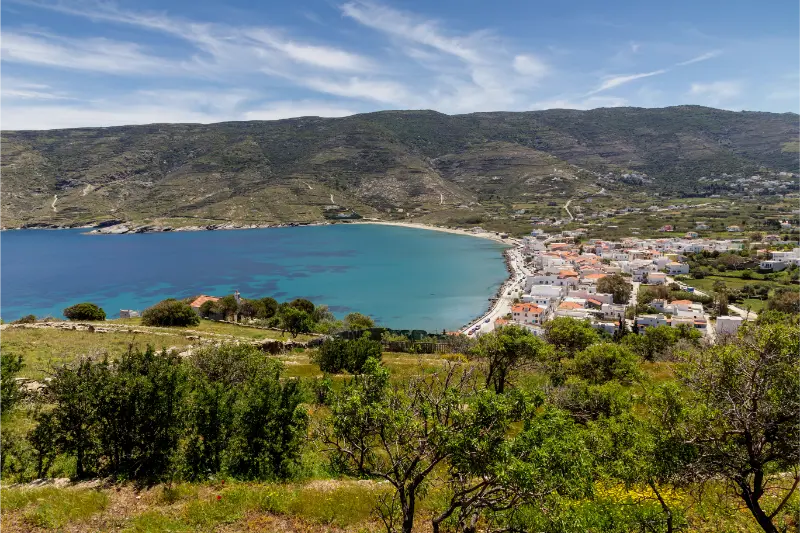
Batsi is the easiest all-round choice. The main beach, restaurants, cafés and accommodation are concentrated around the bay. You can spend a full day without transport and use buses or taxis for Chora, Gavrio and nearby west-coast beaches. This makes Batsi especially attractive for a four- or five-night trip.
The limitation is remote access. Achla, Zorkos and some hiking trailheads are awkward without a private vehicle. Treat them as optional rather than as failures if your trip remains car-free.
Chora without a car
Chora is excellent if museums, architecture and walking are priorities. Nimborio and Paraporti are on foot, and marked trails lead toward central villages. A bus or taxi is still needed for Batsi, Gavrio and many beaches, but you can fill two days locally without feeling trapped.
The transfer from Gavrio is the main practical issue. Align your ferry and bus if possible, and ask the hotel about the nearest drop-off because pedestrian lanes can make luggage handling different from a road-front property.
Using buses
Andros bus timetables are seasonal. Do not publish or rely on a fixed “every hour” assumption. Save the current timetable shortly before travel and recheck locally because extra summer services or shoulder-season reductions can change the practical network.
Build each day around the last return bus, not just the outward trip. If the final connection is early, have a taxi number as backup. In small islands, missing the last bus is not a disaster, but it can become an unexpectedly expensive evening.
Taxis and private transfers
Taxis are useful for ferry transfers, point-to-point hikes and evenings when bus schedules do not align. For a long hiking day, pre-book the pickup rather than hoping a car is nearby at the finish. Confirm the approximate fare before setting out if budget matters.
A strategic taxi can make a no-car trip much more flexible. Spending money on two carefully chosen transfers may still cost less than renting and parking a car for a week.
Hiking as transport
Andros is unusual because walking can connect villages rather than simply loop around a viewpoint. Marked paths link Chora, Apikia, Menites, Korthi and other areas. This makes an active no-car itinerary genuinely possible, but only if you plan luggage and return transport.

Use the Andros Hiking Guide and current Andros Routes maps. A hiking path should never be used as an improvised shortcut with luggage just because it appears shorter than the road.
Beaches without a car
From Batsi, the town beach is effortless and some nearby western beaches can be reached by seasonal bus or short taxi. From Chora, Nimborio and Paraporti are walkable, while Gialia can be combined with a hike. Remote north-east beaches are the main sacrifice of a car-free trip.
The Best Beaches in Andros guide identifies which beaches are convenient and which are genuinely road-trip destinations.
A 5-day no-car plan
Day 1: arrive and stay in Batsi. Day 2: Batsi beach and nearby west coast. Day 3: bus to Chora for museums and town beaches. Day 4: taxi or bus to a central-village walking route around Menites/Apikia. Day 5: relaxed Batsi morning and return to Gavrio. If hiking is your priority, switch the fourth day for a point-to-point trail with a pre-arranged pickup.
This plan deliberately leaves out remote beaches. That is not a weakness; it is what makes the itinerary reliable. If you later decide you want a single driving day, rent locally for 24 hours rather than restructuring the whole trip.
Best time to visit
For a trip that mixes villages, walking and beaches, May, June, September and early October are the most balanced periods. The landscape is easier to enjoy on foot, roads and parking are less stressful than in peak August, and the sea is usually part of the day rather than the only reason to travel. July and August bring the strongest holiday atmosphere, more ferry capacity and fully active beach businesses, but they also demand earlier starts, stronger sun protection and more flexible planning around wind.
Spring can be excellent for hikers because Andros is unusually green for the Cyclades, although winter and spring growth can temporarily obscure sections of old paths before maintenance teams clear them. In 2026 Andros Routes published repeated spring and summer maintenance updates, a useful reminder that even well-marked trails are living infrastructure rather than indoor attractions. Always check the latest route notes if walking is central to the trip.
Who this part of Andros suits best
A car-free Andros trip is best for travellers who enjoy walking, are comfortable using buses and taxis, and prefer two or three strong areas over an island-wide checklist. Batsi is the easiest holiday base; Chora is best for culture; serious hikers can build more complex point-to-point routes.

What to carry
Keep the bus timetable, ferry ticket, hotel address and taxi contacts saved offline. Travel with manageable luggage because stairs and pedestrian lanes are common. For walking days, carry proper shoes, water, sun protection and a power bank.
Common mistakes to avoid
The biggest planning error on Andros is underestimating the island because it sits close to Athens. Roads cross steep terrain, villages are separated by valleys and a beach that looks near on a map may require a very different approach road. Build days around one part of the island instead of zigzagging from north to south. The second mistake is assuming the famous Cycladic wind affects every bay equally; conditions can differ sharply by coast, so keep a second beach or walking plan in mind.
A third mistake is treating the ferry timetable as the only transport decision. The ferry arrives at Gavrio, while Chora is on the opposite side of the island. If you are travelling without a car, the timing of the onward bus or taxi matters. If you drive, check parking at your accommodation and do not assume narrow village lanes are appropriate for through traffic.
Continue planning your Andros trip
Use the guides together rather than as separate checklists. Start with the main Andros travel guide and then open the specialist pages that match your route: Andros Travel Guide; Chora Andros Guide; Batsi Andros Guide; Gavrio and Agios Petros Guide; Korthi Andros Guide; Menites, Apikia and Pythara Guide; Ancient Andros Guide. The remaining guides are linked throughout the cluster where they are most relevant, so you can move from a base or beach decision to transport and hiking without rebuilding the itinerary from scratch.
Useful official sources before you go
For current destination information I cross-check the Municipality of Andros visitor portal and the Andros Routes project. Trail conditions, museum schedules, ferry services and local transport can change seasonally, so verify time-sensitive details shortly before travel.
Frequently asked questions
Can I see Andros without a car?
Yes. Batsi, Chora and Gavrio are practical with buses and taxis, and marked hiking routes add options.
What is the best base without a car?
Batsi is the easiest all-round base; Chora is better for culture and town-based walking.
Can I reach remote beaches by bus?
Not all of them. Some wild beaches are much easier by car, taxi or boat.
Should I rent a car for one day?
It can be a good compromise if you want one remote-beach or village road trip without driving for the whole holiday.
How do I get from the ferry to Chora?
Use the seasonal bus when it matches your ferry or take a taxi. Check the schedule for your exact arrival date.
Final planning advice
Andros rewards a slower plan. Choose a base that makes your mornings easy, group nearby villages and beaches into the same day, and leave room for weather. The island is varied enough that a windy beach day can become a museum, village or hiking day without feeling like a compromise. That flexibility is one of the reasons Andros works so well for repeat visits as well as a first Cyclades trip.
Leave a Reply