
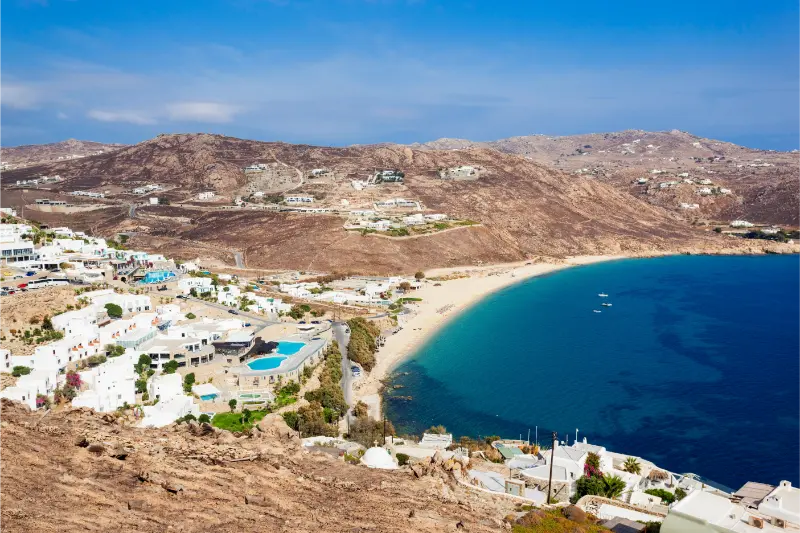
Elia and Agrari sit next to each other on the south coast yet deliver different versions of a Mykonos beach day. Elia is long, organised and well known, with public-bus access and a broad choice of beach services. Agrari is smaller and usually feels quieter, making it useful when you want the same sheltered side of the island with less intensity.
Elia or Agrari?
| Elia | Long sandy beach, organised services, seasonal public bus |
| Agrari | Quieter neighbouring bay, fewer transport options |
| Best without a car | Elia |
| Best for a calmer atmosphere | Agrari |
| Good strategy | Use the coast flexibly according to crowds and wind |
Elia Beach
Elia is one of the largest developed beaches on Mykonos. It suits travellers who want a complete beach day with restaurants, sunbeds and water activities, but there is no need to purchase the most expensive setup to enjoy the coast. Arrive earlier if you want more choice over where to settle and a calmer first swim.
Agrari Beach
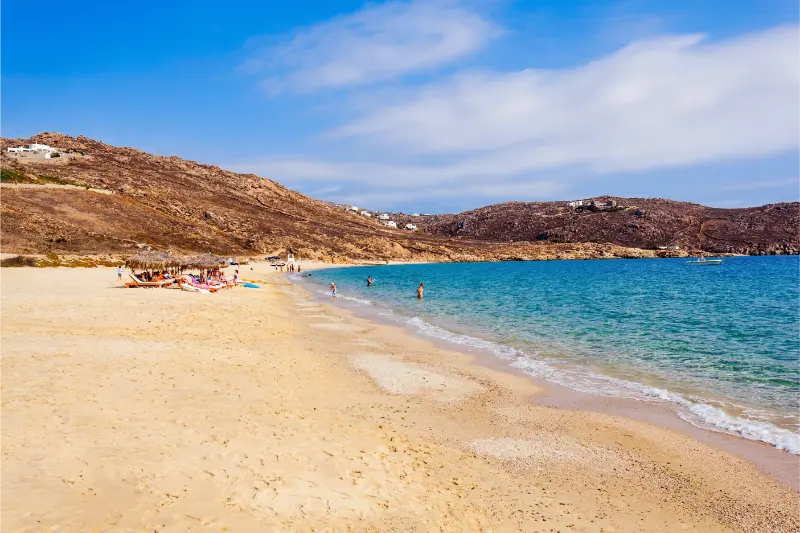
Agrari is close geographically but feels less like a destination built around constant arrivals. It can be a good choice for couples, repeat visitors and travellers who prefer to bring a simple beach setup. Services are more limited, so carry water and do not assume every facility is operating outside the peak months.
Getting to Elia by public bus
The 2026 Mykonos Bus timetable lists repeated Old Port/New Peripheral–Elia services in season. That makes Elia much easier than Agrari for travellers without a car. Use the official Mykonos Bus timetable because the exact departure pattern changes during the season.
Water access and beach hopping
Seasonal water-taxi and boat services can connect parts of the south coast, making it possible to combine organised beaches without fighting road traffic. These are commercial services rather than a fixed public-transport guarantee, so confirm the operating date, sea conditions and final return before treating a boat as your only way back.
LGBTQ+ travellers and beach culture
Elia has long been popular with LGBTQ+ visitors and is generally associated with an inclusive beach atmosphere. As anywhere, individual venues have their own style and pricing. Choose the section where you feel comfortable, respect other beachgoers and remember that nudity or clothing expectations can vary by area and crowd.
A simple south-coast day
- Travel to Elia in the morning while buses and roads are straightforward.
- Swim before committing to paid seating for the whole day.
- Have lunch or a long shaded break during peak sun.
- Move to Agrari only if you genuinely want a quieter atmosphere.
- Return before the final transport option unless you have arranged a taxi or transfer.
Wind, swimming conditions and the meltemi
Mykonos is known as the Island of the Winds for good reason. During summer, the meltemi often blows from the north and can transform the character of a beach. South-facing bays are usually the safer default for a calm swimming day, while north-coast beaches can be magnificent when the wind is light and uncomfortable when it is strong. Do not decide purely from photographs or a general island forecast: look at the water, ask locally and keep a second beach in mind.
Wind matters even when you are not swimming. It increases dehydration, can make an exposed viewpoint feel much cooler than town and can turn an umbrella into a hazard. For families, older travellers and anyone who wants a relaxed sea day, flexibility is more useful than a rigid itinerary. One of the easiest ways to enjoy Mykonos is to treat the wind as a planning variable instead of trying to force the same beach plan in every condition.

Getting around Mykonos in practice
Mykonos looks small on a map, but summer traffic, limited parking and the shape of the road network can make short distances take longer than expected. Public buses are genuinely useful when your route matches the network. The operator currently publishes seasonal services from Fabrika and the Old Port/New Peripheral toward Ornos, Agios Ioannis, Platis Gialos, Paradise, Super Paradise, Ano Mera, Elia, Kalafatis, Panormos, the airport and the ports. Check the official Mykonos Bus timetable shortly before every journey because schedules change during the season rather than staying fixed for the whole year.
For ferry arrivals at Tourlos, the Mykonos SeaBus is often simpler than joining road traffic: its published service connects the New Port with the Old Port/Mykonos Town area and is designed to carry luggage and pushchairs. If you rent a car, treat it as a tool for selected days—Ano Mera, remote beaches, lighthouse viewpoints—rather than assuming you need it every day. Staying near a bus corridor can save money and reduce the stress of parking close to Chora.
Budget and booking strategy
Mykonos can be expensive, but the biggest costs are usually accommodation, private transport, premium beach seating and nightlife—not the act of walking through Chora, visiting a monastery or laying a towel on public beach space. Decide which experiences matter enough to pay for and keep the rest simple. A hotel on a useful bus route can be better value than a cheaper room that forces several taxis every day.
During the busiest weeks, reserve accommodation, high-demand restaurants and any tour with limited capacity in advance. For ordinary beach time, keep some flexibility so you can change coast when the wind changes. Prices, minimum spends and sunbed policies at commercial venues change quickly, so verify them directly rather than building a budget around an old screenshot or social-media post.
Accessibility and comfort
Accessibility changes dramatically from one part of Mykonos to another. Waterfront promenades and some modern beach facilities may be relatively straightforward, while Chora lanes, monastery steps, rocky coves and lighthouse ground can be difficult for wheelchairs, pushchairs or anyone with limited mobility. Ask hotels and attractions for the exact route, surface and number of steps rather than relying on the phrase “close to the centre”.
The SeaBus specifically notes easy wheelchair access on its main connection, but onward routes and old-town streets still require individual assessment. Heat is another accessibility issue: even a short exposed walk can be demanding in mid-summer. Morning visits, shaded breaks and realistic taxi or bus transfers can make a major difference.
Responsible travel and local etiquette
Mykonos is both an international resort and a lived-in Cycladic island. Dress respectfully in churches and monasteries, keep voices low around worshippers, avoid blocking narrow lanes for photographs and never enter private courtyards because they look photogenic. On unorganised beaches, take rubbish away with you and avoid driving or parking on dunes, vegetation and informal coastal paths.
At archaeological sites and museums, follow barriers and photography rules. Around crowded viewpoints, do not step onto unstable walls or road edges for a better angle. These small choices matter on an island that receives very heavy visitor pressure in summer, and they usually make the experience calmer for you as well as for residents.
Tours and activities
South-coast boat trips can connect several famous beaches in one day. For a more relaxed trip, choose an itinerary with fewer stops and longer swim time rather than a checklist of bays.
Frequently asked questions
Is Elia good without a car?
Yes. Seasonal public buses serve Elia and make it one of the easier eastern beaches for car-free visitors.
Is Agrari quieter than Elia?
Usually, yes, although conditions and crowds vary by day.
Can I walk between Elia and Agrari?
They are neighbouring bays, but terrain and access routes are not the same as a flat promenade. Ask locally before relying on a beach walk.
Is Elia family-friendly?
It can be, especially for families who want organised services, but check wind and choose the part of the beach that fits your comfort level.
How long should I stay?
A full beach day is easy at Elia; if you prefer variety, combine it with Ano Mera rather than adding several distant beaches.
More Mykonos guides for the same trip
Continue planning with Ano Mera, Armenistis Lighthouse, Ornos and Agios Ioannis, Paradise and Super Paradise, Panormos and Agios Sostis, plus the main Mykonos travel guide, the Mykonos Town guide and the Mykonos beaches guide.
Choosing the right season
June and September are often the easiest months for travellers who want warm-water beach time without the absolute peak of July and August. July and August deliver the fullest transport schedules, nightlife and beach services, but also the highest accommodation pressure, hottest midday walking and busiest roads. May and October can be rewarding for culture and landscape, yet some seasonal venues reduce hours or close. Build the trip around what you want to do rather than assuming the busiest month is automatically the best month.
A note on road safety
Mykonos roads are often narrow, busy and shared by cars, buses, scooters, delivery vehicles and pedestrians. If you rent a scooter or ATV, do not treat it as a holiday toy: wear proper protection, avoid alcohol completely and choose a vehicle only if you are experienced with that type of driving. Pedestrians should also avoid long road walks after dark when there is no clear pavement. A short taxi fare can be a better decision than a risky roadside walk.
Final thoughts
Elia is the practical all-day choice; Agrari is the quieter neighbour. The most useful approach is to treat them as one south-coast zone and let transport, wind and crowd levels decide how much you move. That is more relaxing than chasing a fixed list of “must-see” beaches.