

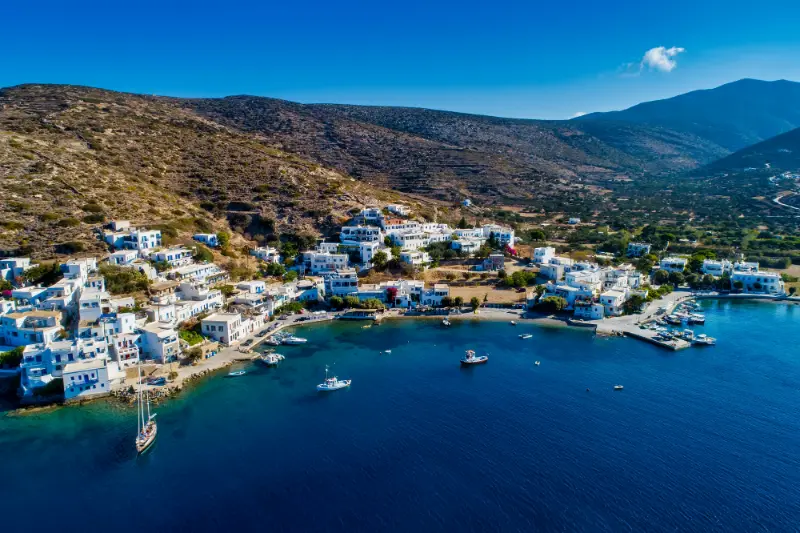
Katapola is more than the place where the ferry door opens. Its deep natural harbour is divided into distinct waterfront areas, with Katapola village on one side and Xylokeratidi on the other. Boats, cafés and low white houses create an easy first impression, while Ancient Minoa rises on Moundoulia Hill above the bay and walking paths begin almost from the water.
For travellers who dislike complicated arrival days, Katapola is one of the most practical bases on Amorgos. You can step off the ferry, reach many rooms on foot, connect by bus to Chora and Aegiali, and use local boats or paths for nearby beaches. It is not the island’s most dramatic village, but it often produces the smoothest trip.
At a glance
| Best for | Ferry logistics, buses, harbour evenings |
| To Chora | About 5.5 km |
| To Aegiali | About 21 km |
| Nearby history | Ancient Minoa |
| Nearby swim | Maltezi and harbour-area coves |
Understanding the harbour
Katapola Bay is broad enough that “staying in Katapola” needs a little precision. The ferry quay and main village have practical services and transport, while Xylokeratidi across the bay has a quieter waterfront feel. Walking around the harbour helps you understand why many repeat visitors prefer one side over the other.
If your ferry arrives late, choose accommodation that can explain the exact walking route and luggage transfer. The last few hundred metres matter more than the distance from the centre shown on a booking map.
Xylokeratidi and the Evangelistria walk
Xylokeratidi is the northern side of the bay and a good place for an evening stroll. From here, the marked Evangelistria route makes a compact introduction to Amorgos walking. The municipal trail description gives the circular route at about 3.7 km and roughly one hour, passing Nera, Vigla and the early Byzantine chapel of Evangelistria.
This is a useful first hike because it is shorter and less committing than the island’s ridge routes. You still need proper shoes, water and sun protection; “easy” on a Cycladic path does not mean a flat paved promenade.
Ancient Minoa above Katapola
Ancient Minoa occupies Moundoulia Hill about 3 km above the port. The municipal guide describes occupation from the 11th century BC to the 4th century AD, with remains of defensive walls, a gymnasium, sanctuary structures and other buildings.
The site can be reached by road or on foot; the municipality gives a walking time of about 35 minutes from Katapola. Go early in hot weather because the exposed hillside is part of the experience. Even when archaeological access is limited, the relationship between the hill and the natural harbour helps explain why the location mattered.
Maltezi and nearby swimming
Maltezi is one of the better-known sandy choices near Katapola and can be reached seasonally by local boat; walking options also exist depending on your route and conditions. Do not assume the boat runs on a fixed year-round timetable. Confirm locally, especially outside July and August.
For a broader comparison, use Best Beaches in Amorgos. Katapola works best when you mix one easy local swim with day trips rather than expecting every famous Amorgos beach to be around the harbour.

Buses from Katapola
Katapola is one of the main nodes in the seasonal bus network. Published timetables have included direct services toward Chora, Hozoviotissa/Agia Anna, Aegiali and parts of Kato Meria, but times and frequencies change. The bus company itself tells passengers to check again for route changes on arrival.
That makes Katapola a strong base for Amorgos without a car, provided you design the itinerary around the current timetable instead of assuming a late bus will always exist.
Where to stay around Katapola Bay
Choose the ferry-side village for maximum convenience and the easiest access to buses, shops and arrivals. Choose Xylokeratidi for a calmer harbour atmosphere and immediate access to short walks. Both sides can work without a car.
Check ferry noise, stairs, luggage access and the precise bus-stop distance before booking. Travellers with early departures often appreciate being able to walk to the quay rather than depending on a taxi before dawn.
Food and evenings
Katapola has enough waterfront dining to make evenings easy, but the best strategy is not to choose every meal by the closest sea-view table. Look for local dishes and ask what is cooked that day. Psimeni raki has a particularly strong association with the village: the local festival is held in Katapola on July 26.
Read the Amorgos food guide before arriving if you want to recognise patatato, pasteli, anevates and the island’s distinctive liqueur rather than defaulting to the same dishes throughout Greece.
Tours and experiences
Organised activities on Amorgos are more limited than on Santorini or Mykonos, which is part of the island’s appeal. When a guided hike, boat trip or cultural tour fits the plan, compare the exact meeting point, duration, cancellation conditions and whether transport is included before booking.
Frequently asked questions
Is Katapola a good base without a car?
Yes. It is one of the most practical bases because ferries, buses and harbour services meet here. Seasonal schedules still need checking.
Can I walk to Ancient Minoa?
Yes. The municipal guide describes a walk of about 35 minutes from Katapola, though heat and exposure can make it feel longer.
Is there a beach in Katapola?
There are swimming options around the bay, while Maltezi is a popular nearby sandy beach reached seasonally by boat or on foot routes.
Katapola or Aegiali?
Katapola is stronger for ferry logistics and central connections; Aegiali is stronger for a long sandy beach and access to Langada and Tholaria.
How many nights should I stay?
Three to five nights works well if Katapola is your only base. For a longer trip, some travellers split time with Aegiali.
What is the easiest walk near Katapola?
The Evangelistria circuit from Xylokeratidi is a good introduction, while other routes link toward Valsamitis and Chora.
Planning details that make a real difference
Amorgos looks compact on a map, but a stay based around Katapola Bay works best when you respect the island’s long, mountainous shape. Roads bend around ridges, buses are seasonal and several beaches or trailheads still require walking. Build the day around one part of the island instead of repeatedly crossing from north to south.
In July and August, start exposed walks early and treat the middle of the day as swimming, lunch or shade time. The Meltemi can make the air feel cooler than it is, so do not use wind as a substitute for sun protection. In May, June, September and early October, walking is often more comfortable, but transport and boat services may run less frequently than at peak summer.
Keep water, a hat and shoes with reliable grip in your day bag even when the plan does not sound like a hike. Many rewarding places on Amorgos are reached by stone steps, rough paths or steep village lanes. For remote beaches, assume there may be no shade, shower, shop or mobile signal exactly where you need it.
Finally, leave some flexibility. Strong wind can change boat trips and beach conditions, a bus timetable can be revised, and a village festival may be a better evening than the restaurant reservation you planned months earlier. Organise the essential logistics, then allow the island to change the order of the day.
Continue planning Amorgos
For the rest of the island, continue with Chora Amorgos Guide; Aegiali, Langada and Tholaria Guide; Hozoviotissa Monastery Guide; Agia Anna and Mouros Beaches Guide; Best Beaches in Amorgos; Amorgos Hiking Guide; Amorgos Without a Car. These guides are designed to work together, so you can move from a general idea to the practical details of transport, beaches, walking and where to base yourself.
Useful official resources
For current destination information use Amorgos Municipality tourism guide. For public buses check the Amorgos Bus Company timetable page, which explicitly advises travellers to confirm route changes on arrival. For walking and beach overviews, Visit Greece hiking information and Visit Greece beaches of Amorgos are useful starting points. Recheck opening hours, buses and boat departures shortly before travel.
Final practical advice
Choose Katapola when port convenience, buses and a relaxed harbour matter more than having the island’s longest sandy beach outside the door. Stay long enough to see Xylokeratidi, walk one of the easy paths and climb toward Ancient Minoa; otherwise you have only used a real place as a transit lounge.
How I would fit this into a first Amorgos trip
For a first visit, I would avoid using this subject as an isolated checklist. Build it into a route that gives Chora, Katapola and the north enough time to feel different. A five- to seven-night stay can include one dedicated hiking day, two flexible swimming days, one cultural day around Hozoviotissa and Chora, and an evening in both a port and a mountain village. This balance is more revealing than trying to collect every beach and viewpoint in one loop.
Ferry times should shape the first and last day. If you arrive in Katapola, keep the first evening local instead of immediately crossing the island. If you arrive in Aegiali, enjoy the north first. The same logic applies on departure: sleep where the morning connection is easiest when the ferry is early, rather than creating a stressful taxi transfer simply to spend one final night in a prettier village.
Amorgos also rewards seasonal thinking. May and early June suit walking and flowers but the sea may feel cool; July and August bring the broadest visitor services plus stronger heat and wind; September often combines warm water with better hiking temperatures, although bus and boat frequencies can begin to ease. October can be beautiful for independent travellers who accept a quieter island and fewer daily connections.
Budget for occasional taxis even if you plan to use buses. One well-timed taxi can protect a hiking plan, solve an early ferry connection or let you eat in another village after the last convenient bus. That is usually better value than renting a car for an entire week if you only need private transport twice.
Leave a Reply