

Knossos is one of those places where the famous name can get in the way of the actual visit. Many travellers arrive expecting a single intact palace and instead find a large archaeological site made of courts, storerooms, staircases, reconstructed architectural elements and layers of interpretation. Once you understand that, the site becomes far more interesting: you are walking through the administrative and ceremonial heart of a Bronze Age society that developed on Crete long before classical Athens reached its height.
The palace lies just south of Heraklion, which makes it one of the easiest major archaeological sites in Greece to add to a city stay. I would combine it with the Heraklion travel guide and, ideally, the Heraklion Archaeological Museum. If you are moving around the island, the Crete road trip itinerary shows where Knossos fits without turning the day into a rushed checklist.
Why Knossos matters
Knossos was the largest Minoan palatial centre on Crete and is closely associated with the myths of King Minos, the Labyrinth, the Minotaur, Theseus and Ariadne. Archaeology and mythology are not the same thing, but the myths give the site an additional imaginative layer. The historical story is already remarkable without embellishment: the palace complex reflects sophisticated administration, craft production, storage, ritual activity and long-distance connections across the eastern Mediterranean.
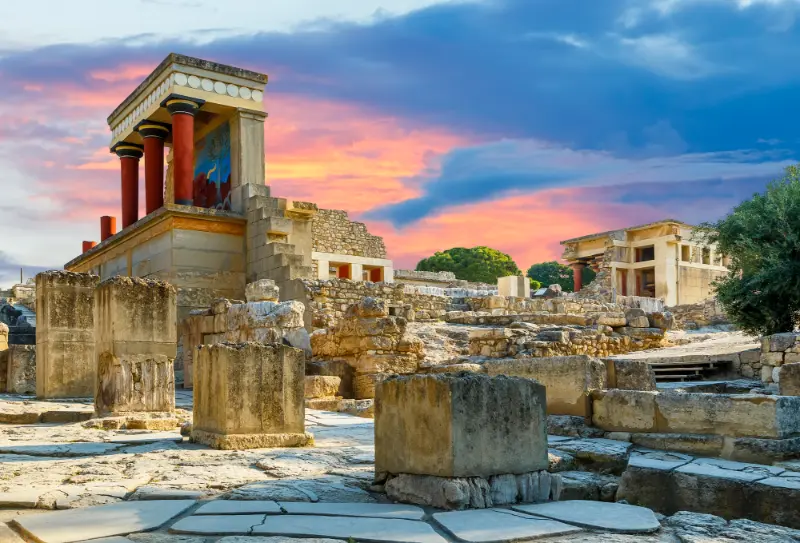
The visible remains belong to several phases because the site was repeatedly rebuilt after destruction. This is important when you look at walls and rooms: Knossos was not frozen in one moment. Its architecture changed across centuries. The excavations led by Arthur Evans from 1900 also introduced reconstructions that remain controversial. They help visitors visualize spaces, but they also reflect early twentieth-century archaeological interpretation. I treat the reconstructions as one layer of the site rather than as a perfect recreation of the Bronze Age palace.
What to see inside the palace
Start by orienting yourself around the Central Court. From there, the most memorable areas include the West Magazines with their long storage rooms and large pithoi, the Throne Room complex, the Grand Staircase, the Queen’s Megaron area and the sections associated with the famous fresco reconstructions. Even if you have seen photographs, the relationship between levels, corridors and courts is easier to appreciate on site.
Do not rush from one famous reconstruction to another. Look at drainage channels, thresholds, storage spaces and changes in floor level. These quieter details explain why Knossos feels so advanced to modern visitors. The palace was not simply a royal residence; it was part of a wider economic, religious and political system.
How long you need
For a first visit I would allow about two hours inside the archaeological site. A fast visitor can walk the main circuit in less, but that leaves little time to understand what each area represents. If you enjoy archaeology, three hours is easy to justify, especially when the site is not crowded.
Add at least another two hours for the Heraklion Archaeological Museum on the same day or the following morning. Many of the original finds and frescoes connected with Minoan Crete are in the museum, so the two visits complete each other. Seeing the objects after the architecture gives context; seeing the museum first can make the palace easier to decode.
Best time of day to visit
In warm months, early morning is my first choice. There is limited shade across large parts of the site, and the combination of heat and tour groups can make midday tiring. Late afternoon can also be pleasant when opening hours allow, but check the official schedule because seasonal hours change.
Spring and autumn are especially comfortable for archaeological sightseeing in Crete. In July and August, carry water, wear a hat and treat sun protection as essential rather than optional. If your schedule is flexible, avoid building a tight ferry or flight connection immediately after the visit.
Tickets and official information
Ticket prices and opening hours can change, so I recommend checking the official Hellenic Heritage information immediately before travel rather than relying on an old screenshot or a blog post. Buying online can be useful in busy periods. The official Greek cultural authorities also publish information on free-admission days and reduced categories.
Use the official information as the final word on access. Archaeological sites can occasionally modify hours because of heat, weather, maintenance or special events. I prefer to verify again on the morning of the visit when the weather forecast is extreme.
How to get to Knossos from Heraklion
Knossos is close enough to Heraklion that you do not need a rental car just for this excursion. Public buses connect the city with the archaeological site, and taxis are straightforward. If you already have a car for a wider Crete trip, driving is convenient, but remember that Heraklion traffic and parking can be more stressful than the short distance suggests.

If you are staying in Chania or Rethymno, I would not travel across the island solely for a rushed one-hour stop. Make Knossos part of an eastern or central Crete day and pair it with Heraklion. The Rethymno guide and Chania guide explain why Crete works better when you divide the island into regions.
Knossos and the Heraklion Archaeological Museum
The museum is not an optional afterthought if you want to understand the Minoans. It contains major finds from sites across Crete, including pottery, jewellery, ritual objects, sculpture and celebrated frescoes. The palace gives you scale; the museum gives you detail.
My preferred sequence for first-time visitors is museum in the morning, lunch in Heraklion, then Knossos later if temperatures are reasonable. In midsummer I reverse that: Knossos at opening time, then the air-conditioned museum during the hotter part of the day.
Is a guide worth it?
Knossos is a strong candidate for a guided visit because much of what matters is not self-explanatory. A good guide can distinguish excavation history, reconstruction, myth and archaeological evidence. That helps prevent the visit from becoming a sequence of photographs with little understanding.
If you prefer to visit independently, read a short Minoan overview beforehand and use the site panels carefully. I would still avoid overly confident stories that present every room name or mythological connection as settled fact. Archaeological interpretation changes, and some labels are conventional rather than certain.
What to bring
- Comfortable shoes with grip, because surfaces can be uneven.
- Water, especially from late spring through early autumn.
- A hat and sunscreen; shade is limited in many areas.
- A small amount of patience for narrow viewing points when tour groups arrive.
- A downloaded ticket or screenshot if mobile reception is unreliable.
Large luggage is a bad match for an archaeological visit. If Knossos falls between hotel check-out and a flight or ferry, arrange storage in Heraklion rather than dragging bags to the site.
How to build Knossos into a Crete itinerary
For a three-day Heraklion stay, I would give one day to the city and museum, one day to Knossos plus nearby interests, and one day to a beach, winery or another archaeological site depending on your priorities. For a longer Crete trip, Heraklion works well as a two-night stop between western Crete and eastern Crete.
Knossos is not a reason to race through the rest of the island. Crete rewards slower travel. Use the complete Crete travel guide to decide whether your trip should emphasize history, beaches, hiking, villages or a balanced mix.
Common mistakes to avoid
The biggest mistake is arriving in the hottest part of the day with no water and expecting constant shade. The second is skipping the museum. The third is treating Evans’s reconstructions as if every colour and architectural detail were unquestionably ancient.
I would also avoid planning Knossos, the museum, a cross-island drive and a ferry departure on the same day. The palace is easy to reach, but the value of the visit comes from having enough mental space to understand what you are seeing.
Frequently asked questions
Is Knossos suitable for children?
Yes, especially for school-age children who enjoy myths and ancient history. Keep the visit shorter in hot weather and turn the Labyrinth and Minotaur stories into a starting point, while explaining that mythology and archaeology are different kinds of evidence.
Can I visit Knossos without a car?
Yes. From Heraklion, public transport and taxis make the palace straightforward to reach. A car becomes more useful only when Knossos is one stop in a broader day outside the city.
Should I visit Knossos or the museum first?
Both sequences work. In very hot weather I prefer Knossos early and the museum later. In cooler weather, seeing the museum first can make the palace easier to understand because you already know the objects, frescoes and Minoan visual language.
Is Knossos a full-day trip?
The palace itself is usually a half-day activity at most, but Knossos plus the Heraklion Archaeological Museum and a relaxed meal can fill most of a day without feeling rushed.
A slower way to experience Knossos
If you have the time, resist the instinct to move continuously. Spend several minutes in the Central Court, then revisit one section after you have read the museum labels or guide notes. Archaeological sites become clearer on a second look because your mental map has improved. I also like to compare reconstructed elements with untouched masonry so the difference between ancient fabric and modern interpretation stays visible.
After the palace, return to Heraklion without immediately adding another major attraction. A long lunch, a walk by the Venetian harbour and the museum create a more coherent Minoan day than racing toward a distant beach. This pacing is especially useful for first-time visitors who are already processing unfamiliar dates, names and archaeological terminology.
Before leaving Crete, consider how Knossos connects with other Minoan palatial centres and museums across the island. Even if you do not visit them, knowing that Knossos was part of a wider network prevents the common mistake of imagining all Minoan life concentrated in one palace. Crete’s Bronze Age story is regional, complex and still being researched.
More archaeology and history guides: UNESCO World Heritage Sites in Greece, Mycenaean Greece guide, Minoan Crete guide, Roman Greece guide, Byzantine Greece guide, Venetian Greece guide, Ottoman heritage in Greece, best ancient theatres in Greece, best archaeological museums in Greece, Greek castles and fortresses.