

Rethymno is the Crete base I would choose when I want an old town with character but also a long beach immediately beside the city. It sits between Chania and Heraklion, which makes it tempting as a central compromise, yet its real value is that it has enough atmosphere to be a destination in its own right: Venetian streets, the Fortezza, a small harbour, restaurants, student energy and easy access to villages and the mountains.
Because it lies between Crete’s two main northern cities, Rethymno fits naturally into a longer route. You can arrive from Chania, continue toward Heraklion, and still give Rethymno two or three nights rather than treating it as a lunch stop.
What to see in Rethymno Old Town
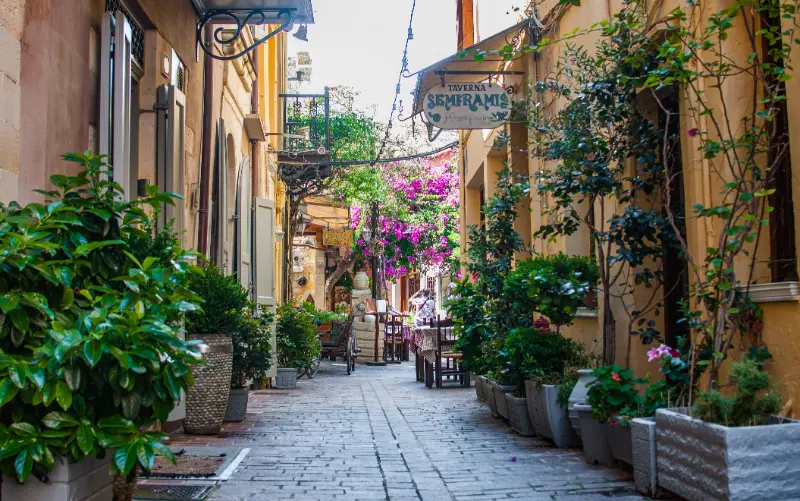
The old town is compact enough to explore without a formal route. Start near the Venetian harbour, move through the lanes toward the Rimondi Fountain and continue uphill to the Fortezza. Along the way, minarets, Venetian doorways, Ottoman details and small workshops create the layered look that makes Rethymno distinct.
Go once in the morning and again after sunset. During the day you notice architecture and shopfronts; at night the same lanes become dining streets and quiet corners. The city is especially pleasant when you allow time to wander rather than trying to photograph every landmark in sequence.
The Fortezza
The Fortezza dominates the western edge of the old town and gives broad views over the sea and rooftops. It is exposed, so early morning or late afternoon is more comfortable in summer. The visit is not about ornate interiors; it is about understanding the scale of the fortifications and the city’s strategic position.
I would combine it with the old town rather than making a separate trip. Wear shoes with grip, carry water and keep some energy for the lanes below.
Rethymno beach
One reason Rethymno is easy for mixed-interest groups is that a long sandy beach begins close to the city. Someone can spend the morning sightseeing while another prefers the sea, then everyone meets for lunch. This flexibility is particularly useful for families and couples with different holiday rhythms.
The urban beach is convenient rather than remote or wild. For more dramatic scenery, plan a car day toward the south coast or mountain interior.
Where to stay
Inside the old town you get maximum atmosphere and can walk everywhere, but parking and luggage access need attention. The beachfront east of the historic centre is better for families who want a pool, sand and straightforward vehicle access. A location between the two zones can give you the best balance.
Before booking, map the exact walking distance from your room to the beach and to the old town entrance. “Rethymno” covers a long urban strip, and two properties in the same city can create very different holidays.
Day trips from Rethymno
The mountain interior around Psiloritis adds a completely different landscape. Villages, monasteries and traditional food make a strong contrast with the beach. Arkadi Monastery is one of the region’s important historical stops. The south coast offers beaches and villages that feel far removed from the north even when the distance on a map is modest.
If you drive across the island, remember that mountain roads can be slower and more tiring than kilometre counts suggest. Plan one clear objective per day rather than linking five pins simply because they look close.
Rethymno with children
Rethymno works well with children because the beach and old town are adjacent. A family can build short sightseeing blocks around swim time, naps and meals. The main challenge is heat in the Fortezza and cobbled lanes with a stroller.
Choose accommodation based on the child’s daily routine. A hotel with easy beach access may be more valuable than the prettiest old-town balcony if you expect several returns to the room each day.
How many days?
| Stay | Best for |
|---|---|
| 1 night | Taste of the old town, but too quick for day trips |
| 2 nights | Old town, beach and relaxed meals |
| 3–4 nights | Best for a day trip plus city time |
| 5+ nights | Good base for a slower central-Crete stay |
A 4-day Rethymno itinerary
- Day 1: old town, Venetian harbour, Fortezza and dinner in the historic centre.
- Day 2: easy beach morning, long lunch and a second slow old-town walk.
- Day 3: Arkadi Monastery and inland villages, with a traditional taverna stop.
- Day 4: south-coast excursion or a quiet beach day before moving on.
How I would plan the trip before booking
For Rethymno, I would book the trip in this order: decide how many nights you genuinely have, choose the edge of the old town if you want walking access, or the beachfront if sand and a pool matter more, check the transport that controls your arrival and departure, and only then reserve day trips. This order matters because attractive hotel prices can tempt you into a base that creates unnecessary driving, transfers or early-morning stress. A good location often saves more holiday time than a slightly cheaper room.
The transport question is especially important here: you can enjoy the city without a car, but a rental car opens mountain villages and the south coast. I would keep the first and final day lighter than the middle of the trip. That leaves space for delayed flights or ferries, heat, wind, children needing a slower morning, or simply discovering a place you want to stay longer.
For seasonality, May to June and September to early October give a strong balance of beach weather and comfortable sightseeing; midsummer is hotter and busier. I also avoid building a plan in which every day depends on perfect beach weather. A museum, old town, village, food stop or short scenic walk gives the itinerary resilience when conditions change.
Who will enjoy this destination most?
Rethymno works best for travellers who like a mixture of sightseeing and unstructured time rather than rushing between checklist attractions. It rewards mornings that start early, a long lunch or coffee break, and evenings close to the accommodation rather than another long transfer.
For families, the beach beside town makes daily logistics unusually easy, but limit long mountain drives and protect children from midday sun. Couples can make the trip more relaxed by staying somewhere walkable for dinner. Solo travellers generally benefit from central bases and public transport connections. Road-trippers should check parking before choosing accommodation, because a beautiful historic centre can be inconvenient with a car.
If you are combining this stop with another part of Greece, compare the pacing with the complete Crete guide. One of the biggest mistakes in Greece is treating a short transfer on a map as a short travel day; ferry check-in, port access, parking, waiting time and mountain roads all add invisible hours.
Small details that make the trip easier
I keep a small offline map on my phone, carry water in warm months, save the exact accommodation entrance rather than only the property name, and photograph parking or bus-stop information when I arrive. These tiny habits are more useful than a minute-by-minute itinerary.
Comfortable shoes matter in Greece more often than visitors expect. Polished stone, steps, uneven lanes and archaeological ground are common. Sun protection, a light layer for wind or air-conditioned transport, and a reusable bottle cover most day-to-day needs. At religious sites, modest clothing may be required, so it is useful to carry something that covers shoulders or knees.
Finally, leave one block of two or three hours completely unscheduled. The most memorable part of a trip is often the bakery you did not plan, a swim that lasts longer than expected, a village square at dusk or a viewpoint found on the way back to the hotel.
Frequently asked questions
Is Rethymno better as a base than Chania?
Rethymno is more central and gives you a city beach beside the old town. Chania has the more famous harbour and easier access to western Crete’s headline beaches. Your day-trip priorities should decide.
Can you visit Rethymno without a car?
Yes. The old town and beach are walkable, and buses connect major cities. A car is useful only when you want villages, monasteries, remote beaches or flexible south-coast days.
How long does the old town take?
You can see the core in a few hours, but that misses the point. Rethymno is better when you spread the old town across a morning and an evening, leaving time for coffee, shops and dinner.

My final planning rule
The best version of a Rethymno travel guide is not the itinerary with the most stops; it is the one that gives each stop enough time to feel different from the last. I would rather remove one attraction and arrive at dinner relaxed than spend the day checking the time. Greece rewards travellers who protect their mornings, allow long meals and accept that wind, heat or a ferry schedule may change the original plan.
Before departure, I recheck the opening hours of any archaeological site or museum that anchors the day, the transport timetable for the next move, and the exact hotel access or parking instructions. Those three checks prevent most avoidable problems. Everything else can stay flexible: the beach, the lunch stop, the viewpoint and the order of smaller sights.
I also keep one backup idea that requires little transport. That might be a town walk, an urban beach, a museum, a café neighbourhood or a slow meal. A backup is not a second full itinerary; it is permission to change the day without feeling that the trip has failed.
More detailed planning
Continue with Preveli Beach Crete Guide for a more detailed plan.
More detailed planning
Continue with Arkadi Monastery Guide; Rethymno Old Town and Fortezza Guide for more detailed planning.
For deeper planning, continue with Plakias, Agia Galini, Triopetra and Agios Pavlos.
Continue planning with our new guides to Anogeia, Spili.
Continue planning with our new Crete guides: where to stay in Rethymno, best beaches near Rethymno.
Related itinerary: Western Crete in 7 Days: Chania, Rethymno, Balos and Samaria Gorge Itinerary, Crete in 14 Days: Chania, Rethymno, Heraklion and Eastern Crete Road Trip.
Leave a Reply