
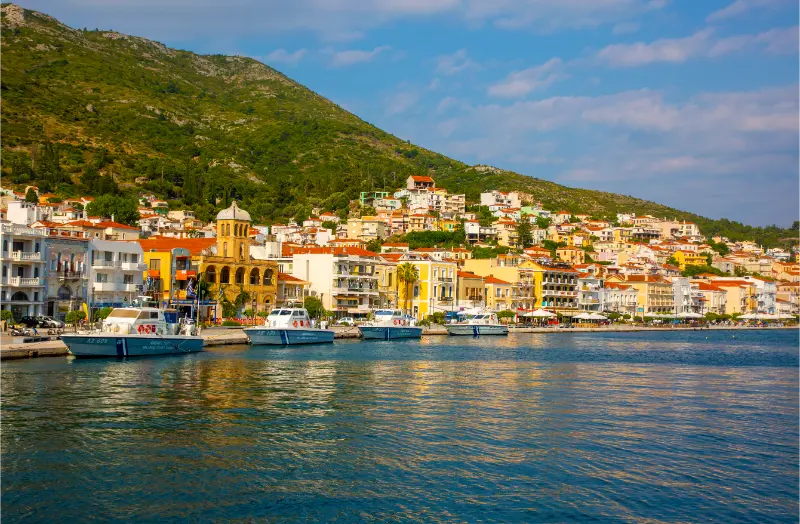
Samos Town—often called Vathy in transport information—does not deliver the instant beach-resort image that many visitors expect from a Greek island, but it is one of the most useful bases on Samos. The capital wraps around a large bay, combines a working town with neoclassical architecture, and gives you access to the island’s main bus hub, services, museums and the Malagari wine area.
It is especially useful for travellers without a car, history-focused visitors and anyone arriving or departing through Vathy port. The key is to stay in the right part of town and understand that the best beach days usually involve leaving the urban centre. In return, you gain the easiest logistics on the island.
The waterfront and central Samos Town
Start along the bayfront rather than trying to identify a single “old town” entrance. The harbour road, public squares, cafés and commercial streets show how the capital actually functions. Early morning is best for observing the town before traffic builds, while evening brings a more social atmosphere to the waterfront.
Samos Town suffered significant damage in the 2020 earthquake, and restoration has been an ongoing reality in parts of the island. That means individual buildings or routes can change status. Treat the town as a living place rather than an open-air museum frozen in one condition.
Ano Vathy
The older settlement climbs above the modern waterfront and rewards travellers who are comfortable with uphill walking. Narrow lanes, older houses and views over the bay create a different impression from the flat commercial centre below. Go early or late in summer because the climb can feel far hotter than its distance suggests.
If mobility is limited, use a taxi to gain elevation and walk downhill rather than forcing a steep ascent. Good travel planning is not about proving you can walk every hill; it is about saving energy for the parts you actually want to enjoy.
Archaeological Museum of Samos
The official Archaeological Museum of Samos page is one of the strongest reasons to spend real time in Vathy. The museum occupies two buildings and presents finds from the Heraion and the wider island, including major Archaic sculpture. The official museum page currently lists a general ticket of €10 and a Tuesday closure; opening arrangements can change, so verify again shortly before visiting.
The museum works particularly well before or after the Heraion and Pythagoreion sites. Seeing sculpture, votive objects and archaeological context turns the outdoor ruins from isolated stones into evidence of a wealthy and internationally connected ancient island.
Malagari and the Samos Wine Museum
Across the bay in Malagari, the Samos Wine Cooperative operates its wine museum and tasting experiences. In 2026 the cooperative lists the museum as open from 1 April with general admission of €5; reservations are available through the cooperative. This is one of the easiest ways to understand why Muscat is central to Samos rather than treating local wine as a souvenir bought at the airport.
Do not combine tasting with a driving-heavy afternoon. Use a taxi, designated driver or structure the visit around a return to town. The museum is close enough to Vathy that responsible planning is simple.
Using Vathy as a transport base
The KTEL station in Vathy is the island’s main public-transport hub, which makes the capital the strongest no-car base for travellers who want to reach several different areas. The trade-off is that not every beach or village has a frequent direct service, and evening returns can be limited outside peak season.
If you are relying on buses, build each day around the return time first. A beautiful beach is not useful if the last bus leaves before you planned to finish swimming. Buy or confirm tickets as instructed by the operator and arrive with enough time to locate the correct stop.
Where to stay in Samos Town
| Area | Best for | Trade-off |
|---|---|---|
| Central waterfront | No-car travel, restaurants, short stays | Traffic and urban feel |
| Side streets behind centre | Value and quieter nights | Less immediate view |
| Higher Vathy | Atmosphere and views | Steep walking |
| Malagari side | Wine museum, quieter setting | Less convenient for central evenings |
Who should choose Vathy?
- Travellers without a car who want the widest bus options.
- Visitors interested in archaeology and local museums.
- Short-stay travellers using Vathy port.
- People who prefer a working Greek town to a purpose-built resort.
- Digital nomads or longer-stay visitors who value services and supermarkets.
How Samos Town and Vathy fits into a wider Samos trip
Use this page together with the Samos travel guide, Pythagoreion and Heraion UNESCO guide, Kokkari, Samos Town and Vathy, Karlovasi and Potami, Manolates and Vourliotes, Marathokampos and Votsalakia, Samos wine, best beaches, hiking, Samos without a car and where to stay. The strongest Samos itineraries are built by geography: combine the north coast with mountain villages, the west with Karlovasi or Marathokampos, and the south-east with Pythagoreio and Heraion. That avoids spending the best part of the day repeatedly crossing an island whose roads are far more winding than its map distances suggest.

Vathy is the island’s most practical base for public transport, services and museums. It is less suitable for travellers whose only priority is stepping directly from the hotel onto a classic beach.
Getting around and checking transport
The capital is the main KTEL hub and the easiest place to combine buses with taxis. If your trip is built around remote west-coast beaches or daily mountain hiking, a rental car still saves substantial time.
For buses, use the official KTEL Samos website close to the day you travel. KTEL Samos operates from Vathy and publishes routes and online ticketing; seasonal frequency changes, so an old screenshot should never be treated as a permanent timetable. If one specific connection matters—for example a last bus after a beach day—verify it the same morning and have a taxi number as backup.
Heat, wind and realistic daily pacing
Samos rewards early starts. In July and August, use the cooler morning for village walks, archaeological sites or hiking, keep the hottest hours for swimming or shade, and return to sightseeing in late afternoon. The north coast can be breezy, while inland roads and trails may feel much hotter than the waterfront. A flexible plan works better than forcing a fixed beach or mountain day in poor conditions.
Tours and activities
Boat trips, wine experiences and guided excursions can be useful when they solve a transport problem or add local interpretation. Compare the real time spent at each stop, boat size, shade, swimming access, transfer arrangements and cancellation rules rather than choosing the excursion with the longest list of place names.
Common planning mistakes
- Expecting the capital to feel like a small beach resort.
- Skipping the archaeological museum because the major ruins are elsewhere.
- Driving after a wine tasting.
- Booking high in Ano Vathy without considering the climb.
- Assuming every village has a late evening bus back to town.
Frequently asked questions
Is Samos Town the same as Vathy?
Visitors often use the names interchangeably for the capital area, while Ano Vathy refers to the older settlement higher on the slope.
Is Samos Town good without a car?
Yes. It is the strongest base on the island for public buses and taxis, though remote beaches still require planning.
How long do you need for the Archaeological Museum?
Allow roughly one to two hours depending on your interest, then connect the visit with the Heraion/Pythagoreion UNESCO sites on another day.
Can you walk to the Wine Museum?
Malagari is close to the capital but road layout and heat can make a taxi more comfortable. Avoid walking back after drinking more than a tasting amount.
Is Vathy good for beaches?
Not as a classic beach base. Use it for logistics and culture, then travel to north-, east- or south-coast beaches.
Final practical advice
Samos feels most rewarding when you leave room for one unplanned stop each day: a roadside viewpoint, a village square, a swim at a smaller cove or a long lunch. The island has enough variety that you do not need to “complete” it. Pick a strong base, cluster nearby experiences, check time-sensitive transport and opening information again shortly before departure, and let weather decide which day becomes the beach day and which becomes the mountain day.
Market, services and practical errands
Vathy is the place to solve practical travel tasks: pharmacies, supermarkets, banking, phone accessories, medical needs and transport questions are easier here than in a small resort. If you are staying elsewhere, combine errands with the museum instead of making a separate trip. This is particularly useful on a longer island stay or if you are travelling with children and need supplies that a beach mini-market may not stock.
Port-day strategy
If your ferry uses Vathy, keep the final day deliberately light. Store luggage with your accommodation if possible, have lunch near the waterfront and arrive at the port with margin. Samos has multiple ports, so the most important check is not “what time is the ferry?” but “which port does this exact sailing use?” Confusing Vathy with Karlovasi or Pythagoreio can create an expensive last-minute transfer.
Leave a Reply