
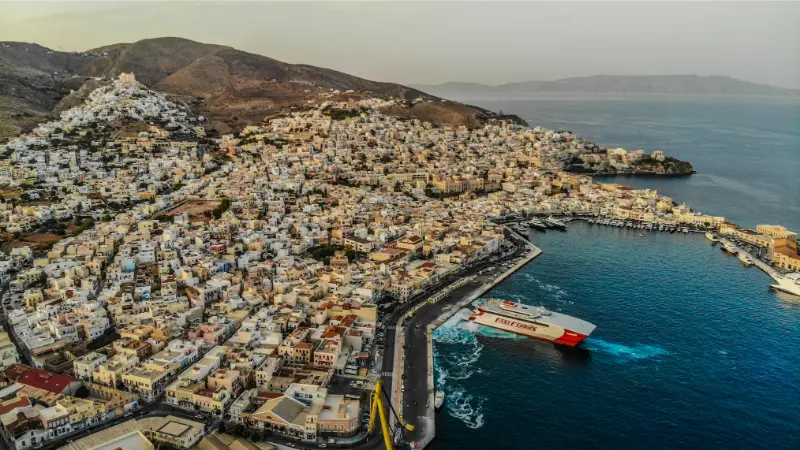
Ano Syros rises above Ermoupoli in a dense maze of steps, passages, arches and small squares. The settlement developed long before the neoclassical port below and retains a strong Catholic identity, with Saint George Cathedral crowning the hill. Visiting both towns on the same day is one of the best ways to understand how different historical layers coexist on a small island.
This is a place to explore on foot. Cars do not solve the steepest part of the visit, and navigation apps are less useful than simply following the lanes uphill and allowing time for wrong turns. The reward is a sequence of framed views over Ermoupoli, the port and surrounding islands rather than one single “must-see” viewpoint.
Ano Syros is also linked to rebetiko musician Markos Vamvakaris, whose life and music give the neighbourhood a cultural identity beyond architecture. Come for the lanes and sunset, but stay long enough to notice churches, courtyards, workshops and the sound of everyday village life.
At a glance
| Best for | History, walking, views, rebetiko, atmosphere |
| Allow | 2–4 hours; longer with dinner |
| Terrain | Steep steps and stone lanes |
| Best time | Late afternoon into evening |
| Combine with | Ermoupoli and Vaporia |
Understanding the hill town
Ano Syros was developed as a fortified medieval settlement, and its form still makes defensive sense: narrow lanes twist around the hill, houses press close together and passages open unpredictably. Rather than looking for a perfectly linear route, think of the visit as a slow spiral upward toward Saint George Cathedral.
The settlement’s Catholic heritage is one of its defining features. Syros has long had both Catholic and Orthodox communities, and this mixture is visible in churches, festivals and local identity. Respect active places of worship and avoid entering during private ceremonies simply to photograph interiors.
Saint George Cathedral
Saint George, often called San Tzortzis locally, occupies the highest point and is the natural destination of the climb. The terrace and surrounding lanes provide broad views toward Ermoupoli and the sea. Even if the interior is closed, reaching the upper part of the settlement gives the walk a satisfying structure.
Dress with church visits in mind and carry water because there are long stretches of steps with limited shade. The final climb feels more demanding in mid-afternoon heat than the distance suggests, so the late afternoon is ideal when summer temperatures are high.
Markos Vamvakaris and rebetiko
Markos Vamvakaris, born in Ano Syros in 1905, became one of the foundational figures of rebetiko. The small museum dedicated to him and references around the neighbourhood are a useful entry point into a musical tradition associated with urban working-class life, migration and the bouzouki.
Even travellers who know little about Greek music can get more from the visit by listening to a few Vamvakaris recordings beforehand. The connection turns the village from a beautiful backdrop into a place associated with a specific voice and social history. Check local opening information for the museum because small cultural sites can keep seasonal hours.
The best way to walk the lanes
Start from the lower entrance and resist the temptation to follow only the widest path. Small alleys reveal arches, staircases, cats sleeping in shade, tiny shops and glimpses of Ermoupoli below. Keep moving generally uphill, then choose a different sequence of lanes on the descent.
Photography is easiest when the sun drops lower and façades lose the harsh midday contrast. Do not block narrow passages for posed photos; these are residential streets. If you have mobility limitations, understand that the essential character of Ano Syros involves many steps and uneven surfaces, and plan your route accordingly.
Sunset and evening atmosphere
Ano Syros is a good sunset choice because the climb can end with a meal or drink rather than another transfer. Exact sunset visibility depends on the lane and season, but the wider appeal is watching Ermoupoli change colour as lights appear below. Give yourself time to choose a viewpoint rather than arriving five minutes before sunset.
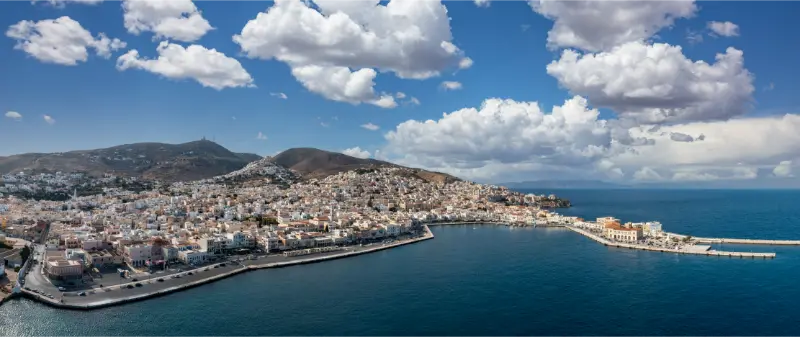
After dark the lanes become quieter and more atmospheric, but steps can be harder to judge. A phone torch is useful and shoes with grip are sensible. If you are not comfortable descending on foot, arrange a taxi connection from an accessible point rather than assuming one can reach every doorway.
Food and an unhurried dinner
Ano Syros works well for a dinner built around local products: Syros cheeses, louza, sausages, capers and simple plates to share. Restaurants in the hill town may have limited terraces and can fill on busy evenings, so reserve if you specifically want sunset views in peak season.
Do not rush down to Ermoupoli immediately after the last photograph. Sitting in a small square after day visitors leave is part of the experience. If you are staying in the port, check your return route before ordering another round, especially if you rely on a taxi rather than walking.
Combining Ano Syros with Ermoupoli
The two towns are visually and historically complementary. Start in neoclassical Ermoupoli with Miaouli Square, the Archaeological Museum or Apollo Theatre, break for lunch, then climb to Ano Syros later. This avoids doing the steepest walk in the hottest part of the day.
If you prefer to separate them, use one morning for museums and one late afternoon for Ano Syros. Travellers staying only two nights should still resist trying to add a distant beach between the two halves; the transition from port to hill is already a complete cultural day.
How much time to allow
Two to four hours works for the hill town alone; add dinner and sunset and it easily becomes a half-day experience. Syros is compact on a map, but steep streets, beach stops and meal times make a rushed schedule less enjoyable than it looks. Build the day around two or three meaningful anchors rather than a list of ten pins. That gives you room for a swim, a museum that takes longer than expected, or a bus connection that is less frequent outside the busiest summer weeks.
If you are visiting on a day trip, identify the one experience that matters most and protect time for the return to the port. If you are staying several nights, group places by coast: Ermoupoli and Ano Syros together, Galissas with the south-west, and Kini with the west. This simple geographic approach cuts backtracking and gives every stop a more relaxed rhythm.
Getting around and transport reality
Taxis and local access roads can reduce the initial climb, but the core lanes are pedestrian and involve many steps. The public bus network is useful for the main settlements and beaches, but timetables are seasonal. Check the official KTEL Syros schedule shortly before travelling rather than planning from an old screenshot. Taxis are valuable for early ferries, late dinners and combinations that do not line up neatly with buses.

A rental car gives more flexibility for remote coves and village combinations, but it is not automatically the best choice in Ermoupoli. Central streets can be steep, narrow and busy, and parking may be some distance from your accommodation. Travellers who stay centrally can often combine walking, buses and an occasional taxi and avoid driving every day.
Best time of day
Late afternoon is ideal in warm months because the climb is cooler and you can remain for sunset and dinner. In July and August, the middle of the day can feel much hotter on stone streets and exposed beaches than the air temperature suggests. Use morning for uphill walking, museums or uncrowded swimming, keep lunch unhurried, and save sunset-facing beaches or waterfront walks for later.
Wind matters as much as temperature in the Cyclades. A beach that looks perfect in a photograph may feel very different on a strong northerly day. Keep at least one flexible beach afternoon and ask locally which coast is calmer that day; this is more useful than locking every swim into the itinerary weeks in advance.
What to bring
Wear shoes with grip, carry water and keep a small light for the descent after dark. Add a refillable bottle, strong sun protection, a light layer for evening wind and offline maps. Shoes with grip are much more useful than smooth sandals in Ano Syros, on polished marble steps and on rough paths to quieter coves.
For beaches, pack a small dry bag or waterproof pouch for phones and ferry tickets. For churches and cultural sites, carry something that lets you dress respectfully without returning to your room. Families should add water shoes when children dislike pebbles and a compact shade solution for beaches with limited natural cover.
Costs and reservations
Walking the settlement is free; budget mainly for museum visits if open, food, drinks and possibly a taxi. Accommodation prices rise sharply around popular summer weekends, so lodging and ferry tickets deserve priority. Ordinary beach days and village walks do not need to be over-planned, and leaving some free time makes it easier to react to wind, heat and local events.
For paid museums and attractions, confirm opening hours on the official site on the day before your visit. Small Cycladic museums sometimes close one weekday or change seasonal hours. For restaurants with a specific sunset table in mind, reserving ahead is sensible in July and August; otherwise, eating a little earlier or later usually provides more flexibility.
How this fits into a wider Syros trip
Start with the Syros Travel Guide for the island overview, then use Vaporia & Asteria, Galissas & Kini, Posidonia & Agathopes, Syros Food Guide, Best Beaches in Syros for the parts of the trip that need more detail. Linking the guides by geography and travel style makes it easier to plan realistic days instead of zig-zagging across the island.
Tours and activities
If you want a guided experience, boat trip or organised activity, compare what is available for your exact dates. Check the meeting point, cancellation terms, language, duration and what is included before booking; on an island, wind can also affect marine activities.
Common mistakes to avoid
- Starting the steep walk at the hottest hour.
- Expecting a completely step-free route.
- Visiting only for a sunset photo and missing the cultural context.
- Blocking residential lanes for photographs.
- Assuming a taxi can stop beside every accommodation or restaurant.
Frequently asked questions
How long does Ano Syros take?
Allow at least two hours, and three to four if you want the museum, churches, photos and a relaxed meal.
Can you walk from Ermoupoli?
Yes if you are comfortable with a sustained uphill climb and many steps; a taxi can shorten the approach.
What is Ano Syros known for?
Its medieval hill-town form, Catholic heritage, Saint George Cathedral and connection with rebetiko musician Markos Vamvakaris.
Is it good for sunset?
Yes, especially when paired with dinner, although the exact view depends on the street and season.
Is it suitable with a stroller?
The many steps make a stroller impractical for much of the historic core.
Final practical advice
Treat Ano Syros as a living hill town, not just a viewpoint above Ermoupoli. Climb slowly, listen to some Vamvakaris before you go, step into the churches respectfully and stay into the evening if your schedule allows. The contrast with the grand port below is one of the clearest reasons to spend more than a beach weekend on Syros.
Leave a Reply