
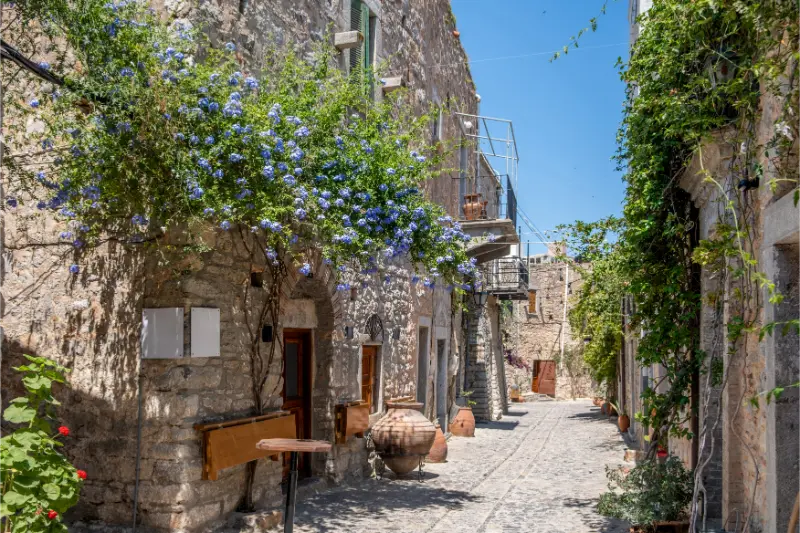
Southern Chios is shaped by mastic in a way that goes far beyond a souvenir product. The Mastichochoria—medieval mastic-producing villages—preserve fortified street patterns, stone houses and agricultural landscapes created around a crop that is still cultivated by hand. Pyrgi is famous for its black-and-white geometric façade decoration, Mesta for its maze-like medieval plan, and Olympi for another compact fortified settlement that rewards unhurried walking.

The Chios Mastic Museum adds the explanation that turns a pretty village circuit into a cultural journey. Visit Greece notes that traditional mastic cultivation was inscribed by UNESCO on the Representative List of the Intangible Cultural Heritage of Humanity in 2014. I would therefore build the day around both the villages and the museum: architecture shows how people lived, while the museum explains why this particular landscape and production system developed in southern Chios.
Where this fits in a Greece itinerary
For wider planning, continue with Chios Travel Guide; Nea Moni Guide. The most efficient Greece trips connect places geographically and leave enough time for delays, heat and spontaneous stops instead of chasing the largest possible number of destinations.
What makes this place worth your time
Walk Pyrgi before focusing on the façades
Pyrgi’s xysta decorations are the obvious visual hook: geometric black-and-white patterns cover many façades and make entire streets feel graphic. But the village is more than a backdrop. Walk toward the central square, look at how lanes connect, and notice the relationship between decorated surfaces and the dense medieval street plan.
Early morning is easier for photography and parking. If you arrive at the busiest time, move beyond the first picturesque corner; the village becomes more interesting once you stop competing for the same few façades.
Get deliberately lost in Mesta
Mesta is one of the most atmospheric fortified villages on Chios. Stone houses join together into a defensive urban fabric, and narrow passages were historically part of the protection system. A rigid map can spoil the experience, so use navigation only to find your way back when needed.
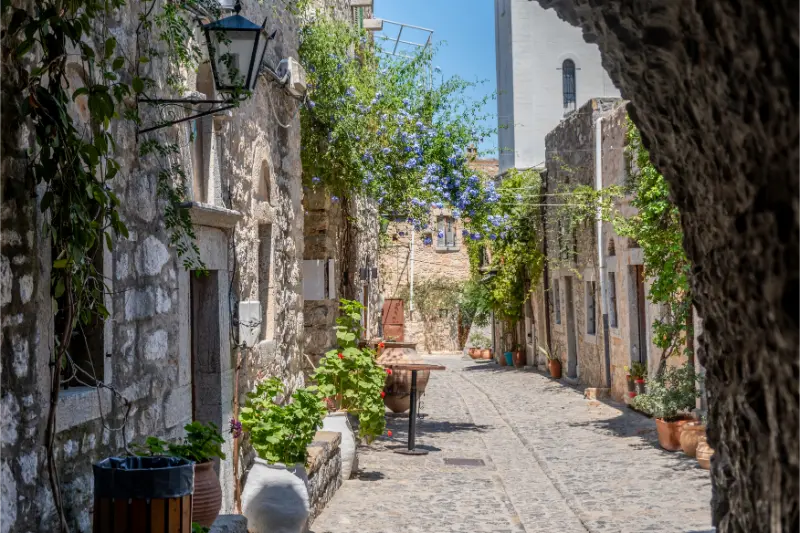
Keep voices low in residential lanes and remember that homes are still occupied. The best moments are often small—an archway, a shaded passage or a sudden square—rather than a single monument you can check off.
Add Olympi instead of only the two famous names
Olympi gets less attention than Pyrgi and Mesta, which is exactly why it deserves a place in a road-trip loop. Its compact medieval form helps you compare how the mastic villages share defensive logic while still having individual character.
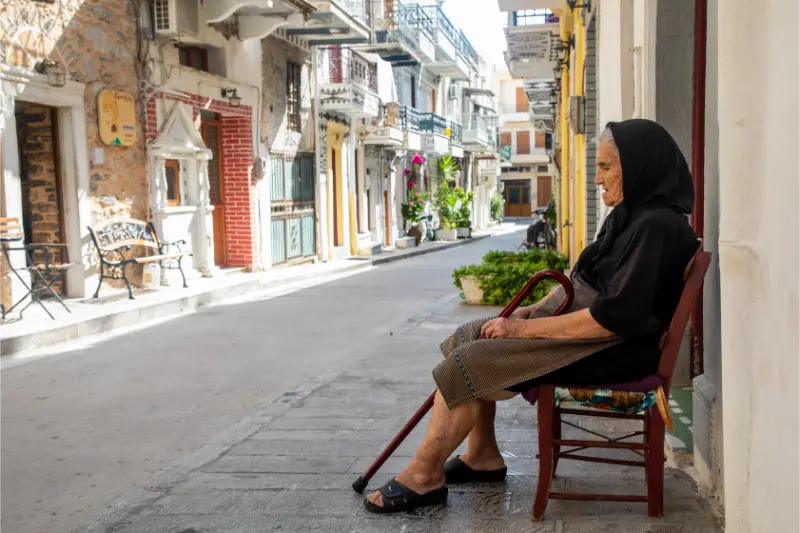
If the day is hot, use Olympi as a shorter walk rather than adding another distant beach. Three villages plus the museum are already enough for a substantial day.
Use the Mastic Museum to understand the product
The museum near Pyrgi explains the mastic tree, cultivation, cleaning, cooperative processing and the way production shaped the landscape. Visit Greece lists the museum as a key cultural stop in the Mastichochoria and notes that the crop is still harvested and cleaned through labour-intensive traditional processes.
I prefer visiting the museum before the final village of the day. Once you understand the cultivation cycle, agricultural plots and products in shops have more meaning and are less likely to feel like generic tourism branding.
Taste mastic without turning it into a shopping mission
Mastic appears in sweets, liqueurs, baked goods and other products, but the goal is not to buy every variation. Taste a few things, ask where they were produced and choose what you will actually use. Visit Greece also highlights other Chios products, including citrus and local drinks, so a food stop can show a wider island identity.
If you buy liqueur or another alcoholic product, leave tasting until the car is parked for the day. The mastic-village route involves narrow roads where full attention matters.
Planning and getting around
A small car is the easiest way to link Pyrgi, the Mastic Museum, Olympi and Mesta. Do not try to drive into every medieval core; park where signs direct visitors and walk the final section. Start early in high season because parking pressure grows around midday. If you want to add a beach, choose one southern stop rather than crossing the island afterward. The stronger route is compact and coherent, not geographically ambitious.
Before travel, I save offline maps, check fuel or public-transport options, and confirm the exact opening hours of any archaeological site or museum that anchors the day. Island schedules change seasonally, and the fact that a bus, ferry or ticket existed last year is not enough reason to assume it works the same way now. A flexible backup plan is part of good Greece travel planning, not a sign that the itinerary is incomplete.
A realistic itinerary
This is the pacing I would use for a first visit. It deliberately leaves space for weather, meals and local advice rather than treating every hour as a booking slot.
- Morning: drive south and start in Pyrgi before the main heat, then visit the Mastic Museum.
- Lunch: eat in or near one of the Mastichochoria rather than returning toward Chios Town.
- Afternoon: walk Olympi and Mesta slowly, with coffee or a shaded break between them.
- Late afternoon: add one nearby coastal stop only if everyone still has energy; otherwise return without forcing another sight.
Best time to go
Spring is excellent because the countryside is greener and village walking is comfortable. Summer gives the full holiday atmosphere but makes midday stone lanes hot, so begin early. September is particularly good for a road trip, while late autumn and winter can be rewarding for culture-focused travel if you verify museum schedules and restaurant openings.
Wind is especially important in the Aegean. A sunny forecast does not automatically mean calm sea conditions, comfortable boat travel or an easy exposed walk. I check the same-day wind and marine forecast before committing to ferries, boat excursions, rock pools or long coastal hikes.
Food and the rhythm of the day
Mastic is the signature flavour, but southern Chios also rewards travellers who look for local cheese, vegetables, seafood, spoon sweets and citrus products. Try mastic in one or two forms rather than assuming more is better. Its resinous aroma is distinctive, and simple preparations often show it more clearly than heavily flavoured desserts.
I also try to avoid driving long distances immediately after a heavy lunch or alcohol. On islands with winding roads, the safer and more enjoyable pattern is to finish the main driving first, then settle into dinner. It sounds obvious, but it is one of the easiest ways to make a road trip feel less tiring.
Practical mistakes to avoid
- Visiting only Pyrgi and assuming all Mastic Villages are the same
- Driving into medieval lanes instead of parking outside the core
- Skipping the museum and missing the agricultural context
- Trying to add too many beaches to the same cultural day
- Photographing residents or doorways intrusively
- Buying mastic products without checking whether they are locally produced
The recurring lesson is to choose depth over accumulation. These destinations are rewarding because landscape, history and daily life overlap; rushing between famous names usually removes exactly the context that makes them interesting.
Accessibility and comfort
Accessibility varies widely in old villages, archaeological sites and natural landscapes. Stone paving, stairs, steep slopes, heat and limited shade can matter more than the straight-line distance shown on a map. Travellers with reduced mobility should contact the specific site or accommodation for current access details. Families with small children should also plan around shade, toilets and safe parking rather than assuming every scenic stop has full visitor infrastructure.
Responsible travel
Stay on marked paths, respect temporary closures and never remove archaeological, geological or natural material. Use refillable water bottles where practical, keep noise low in residential and religious areas, and avoid intrusive photography. On beaches and natural sites, take every item you brought back out with you. Small island communities absorb visitor pressure quickly, so simple behaviour has a visible impact.
Frequently asked questions
Which Mastic Villages should I visit first?
Pyrgi, Mesta and Olympi form an excellent first circuit, with the Mastic Museum adding essential context.
How much time do I need?
Allow a full day for three villages and the museum if you want to walk rather than rush.
Do I need a car?
A car is the simplest way to connect the villages and museum independently.
Is mastic cultivation UNESCO-listed?
Yes. The traditional know-how of cultivating mastic on Chios was inscribed on UNESCO’s Intangible Cultural Heritage list in 2014.
Can I combine the villages with a beach?
Yes, but choose one nearby southern beach and keep it optional so the cultural route does not become rushed.
Check current information before your visit
For official background and current destination information, see Visit Greece – Chios Mastic Museum. I recommend checking transport, tickets, opening hours and any temporary access restrictions again shortly before travel, especially outside July and August.
A small planning detail that makes a big difference
Keep one flexible hour in the middle or at the end of the day. On Greek islands, that buffer absorbs a late meal, a parking delay, a longer museum visit, a change in wind or simply the discovery of a place you want to enjoy for longer. Without that margin, even a good itinerary can start to feel like a timetable. With it, the same route becomes calmer and usually produces better decisions about what to skip and what deserves more time.
I also keep a screenshot or offline note with the address, opening time and phone number of the day’s most important stop. Mobile signal is usually fine in towns, but remote roads, archaeological areas and mountain sections are exactly where you do not want the entire plan to depend on a live connection. This takes a minute before leaving and can save a surprising amount of frustration later.
Final thoughts
The best version of this trip is not the one with the most saved pins. It is the one that leaves enough time to understand why the place looks and feels different from the last stop. Build the day around one or two essential experiences, keep a buffer for heat or transport changes, and let a meal, swim or village walk remain unscheduled. That is usually where the trip starts to feel personal rather than processed.