
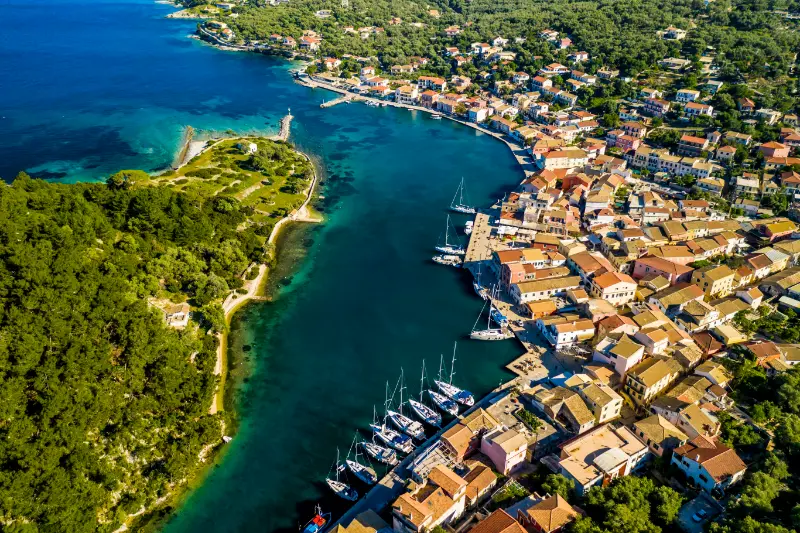
Walk Paxos on historic paths through olive groves, with route ideas from Gaios to Lakka, Loggos to Orkos, Erimitis viewpoints, Tripitos and practical summer safety advice.
Paxos is compact, but it rewards precise planning. Villages sit close together on a map while olive-grove lanes, steep western cliffs, irregular buses and boat-dependent sights can make two apparently simple days feel very different. This guide focuses on practical choices: where to base yourself, when walking is realistic, what changes with wind, and how to combine beaches, villages and sea excursions without turning the trip into a checklist.
Quick planning notes
- Visit Greece highlights a roughly 12 km Gaios–Lakka route and a shorter Loggos–Orkos–Lakka route of about 5 km.
- The old path network passes through olive groves and settlements, but waymarking quality can vary; carry offline navigation.
- Summer heat is a bigger difficulty than altitude. Start early and avoid long exposed sections around midday.
- Western cliff viewpoints are spectacular but require conservative behavior near edges, especially in wind.
Why Paxos is a walking island
Paxos’s road map makes the island look simple, but the old footpaths reveal a much richer landscape. Lanes weave between centuries-old olive trees, stone walls, chapels and small settlements that are easy to miss from a scooter. Walking also shows how close the villages really are when measured through traditional routes rather than modern road bends.
Visit Greece describes an extensive network of footpaths and specifically promotes routes around Loggos, Lakka and the cross-island walk between Gaios and Lakka. You do not need to be a serious hiker to enjoy them, but good shoes and a realistic heat strategy are essential. The terrain is low, not effortless.
Gaios to Lakka: the long island walk
Visit Greece gives the distance between Gaios and Lakka at around 12 km and suggests roughly 2.5 hours of walking, with a maximum elevation around 241 m. Treat that as a fit-walker estimate rather than a promise. Navigation stops, photographs, heat and detours can easily extend the day.
The route is most satisfying if you treat it as a landscape journey rather than a race. Olive groves, inland hamlets and occasional sea views build a gradual picture of the island. Arrange a taxi or bus return in advance if you do not want to walk back. In summer, carry substantially more water than you think a 12 km route should require.
Loggos to Orkos and Lakka
The shorter route from Loggos toward Orkos and Lakka is a better introduction for many visitors. Visit Greece describes a distance of about 5 km with modest elevation gain. The walk links village lanes with olive woodland and brings you close to Orkos, where a swim can turn the route into a relaxed half-day.
Do not hike in beach sandals just because a swim is included. The paths can be stony, dry and uneven. Pack lightweight water shoes separately if you need them. If you plan to continue into Lakka for lunch, check the bus or taxi situation before leaving Loggos so the return does not become an improvised roadside wait.
Erimitis, Kastanida and west-coast viewpoints
The cliffs around Erimitis show the wild side of Paxos. Paths and lanes in the Magazia and Kastanida area reach viewpoints where the sunset drops beyond pale rock into open Ionian water. These are outstanding evening walks, but they demand more caution than the sheltered east coast.
Keep well back from cliff edges, especially after rain, earthquakes or visible erosion. The beach below Erimitis formed through a landslide, which is a reminder that the geology is active rather than decorative. Carry a torch for the return and never rely on a phone screen as your only light source.
Tripitos Arch on foot
Tripitos Arch can be reached by paths from the southern interior, giving hikers a land-based alternative to seeing it by boat. The final approach is rougher than a village stroll and can be hot, so use offline mapping and ask locally about current path conditions. Do not climb onto the arch or approach unstable edges for photographs.
This walk pairs naturally with a swim closer to Gaios or Mongonissi afterward. Trying to combine the arch with a long north-island hike on the same summer day adds unnecessary heat exposure. Paxos is small enough to divide experiences across several mornings.

Heat, navigation and trail etiquette
The safest summer rhythm is to begin early, carry at least enough water for delays and keep the hottest hours for lunch or swimming. Olive shade helps, but many connecting roads and western sections are exposed. A hat and sunscreen matter even when the route looks green on satellite imagery.
Close gates, respect private land, avoid picking fruit from cultivated trees and keep dogs controlled around livestock. Download maps before leaving your accommodation because signal can be inconsistent near cliffs and in dense groves. If a path looks abandoned or unsafe, turn back rather than creating a new track across private ground.
Best seasons for hiking
April, May, late September and October are generally more comfortable for longer walks than the hottest part of summer, assuming services and weather suit your trip. Spring adds flowers and fresher vegetation; autumn brings warm sea temperatures and softer light. Winter can be wet and some tourism infrastructure closes, so it is a different kind of visit.
If you travel in July or August, walking is still worthwhile—just shorten the routes. A dawn loop, beach morning and evening viewpoint gives you the same sense of landscape without treating midday heat as a test of endurance.
Accommodation and booking strategy
Paxos has a limited accommodation supply compared with Corfu, and the most attractive village-centre rooms, waterfront apartments and family villas can sell early in July and August. Compare the exact location rather than only the property name: a room described as “Gaios” may sit well above the harbour, while a villa near Lakka may require a car or taxi after dinner. Check current Paxos accommodation on Booking.com.
For a short first visit, prioritize convenience over a dramatic view. For a longer stay, a quieter villa can work well if you already know how you will reach groceries, beaches and evening restaurants. If mobility is limited, ask the host about gradients, stairs and the nearest point a taxi can reach; the island’s beautiful old lanes are not always stroller- or suitcase-friendly.
Frequently asked questions
Is Paxos good for hiking?
Yes. The island has an extensive historic path network through olive groves, villages and coastal viewpoints, with both short walks and longer cross-island routes.

How long is the Gaios to Lakka walk?
Visit Greece describes the route as roughly 12 km and around 2.5 hours for a fit walker, but allow extra time for heat, navigation and stops.
Do I need hiking boots?
Light hiking shoes or trail shoes are usually enough for the main routes. Avoid flip-flops on stony paths and exposed viewpoints.
Useful official resources
For information that can change after publication, check the Visit Paxos tourism portal, the official Paxos travel-information page and, for sea connections, the official getting-to-Paxos page. Hiking information is also available from Visit Greece. Ferry times and local transport can change with season, weather and operator, so verify the exact date before committing to a tight connection.
Related Paxos guides
- Loggos Paxos Guide: Harbour, Levrechio, Marmari and Where to Stay
- Lakka Paxos Guide: Harbour, Harami, Lighthouse and Where to Stay
- Best Beaches in Paxos: Monodendri, Kipiadi, Orkos, Marmari and More
- Paxos Without a Car: Buses, Taxis, Boats, Walking and the Best Base
A practical way to plan the day
Build each day around one anchor rather than several fixed appointments. On a calm day, make the boat trip or exposed west-coast walk the anchor and keep the afternoon flexible. When wind is stronger, choose an east-coast beach, village lunch or short olive-grove walk. This approach suits Paxos because distances are small enough to change direction, while the most memorable experiences—clear water, cliff light, quiet lanes and village evenings—depend more on conditions than on an ambitious schedule.
Keep water, sun protection, offline maps and a small cash reserve in your day bag. Mobile reception can vary near cliffs and remote coves, and not every beach has a bar or a reliable taxi pickup point. If you are using buses, photograph the current timetable after arrival and confirm the final return of the day. If you are using boats, ask what happens if wind forces a route change. Those simple checks remove most of the stress from an otherwise very easy island to enjoy.
A final rule is to leave some room for repetition. Paxos is not an island where every hour needs a new attraction. Returning to the same waterfront for breakfast, repeating a beach that was exceptionally calm, or walking the same olive lane at sunset often produces a stronger sense of place than collecting ten different stops. The island is small enough that familiarity becomes part of the experience rather than a sign that you have run out of things to do.