
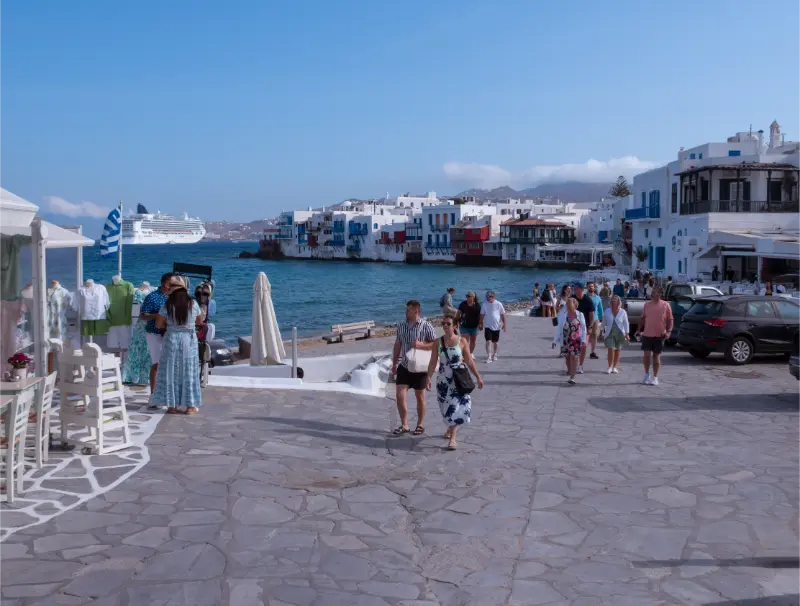
You can visit Mykonos without renting a car, and for many first-time travellers that is actually the easier choice. The island has two main bus departure areas around Chora, frequent seasonal routes to several major beaches, airport and port links, plus a SeaBus between Tourlos New Port and the town waterfront. The limitation is not whether public transport exists; it is whether your hotel and daily plans align with the routes.
The two bus hubs you need to understand
Fabrika, on the south side of Chora, is the key departure point for routes toward Ornos, Agios Ioannis, Platis Gialos, Paradise, Paraga and the airport. The Old Port/New Peripheral side serves routes toward Ano Mera, Elia, Kalafatis, Panormos, Agios Stefanos and the New Port. You do not need to memorise every route, but you do need to know which side of town your bus uses.
2026 public-bus network
The official Mykonos Bus timetable for 2026 lists services to major destinations including Ornos, Agios Ioannis, Paradise, Paraga, Super Paradise, Ano Mera, Elia, Kalafatis, Panormos, Agios Stefanos, the airport and ports. Some services are very frequent in high season; others have only a handful of departures. Use both the timetable page and route search for the exact travel date.
New Port to Chora: SeaBus
The Mykonos SeaBus publishes a frequent New Port–Old Port/Mykonos Town connection and notes that luggage and baby strollers can be carried. For ferry passengers staying in or near Chora, this can remove the need to sit in road traffic immediately after arrival.
Airport connections
The seasonal bus timetable includes Fabrika–Airport services and Airport–New Port services on published dates. Flights outside the active schedule, very early departures or late arrivals may still require a taxi or pre-arranged transfer. Never assume a public bus will match a 6 a.m. flight just because there is an airport route during the day.
Best beaches without a car
- Ornos and Agios Ioannis: straightforward from Fabrika and useful for families.
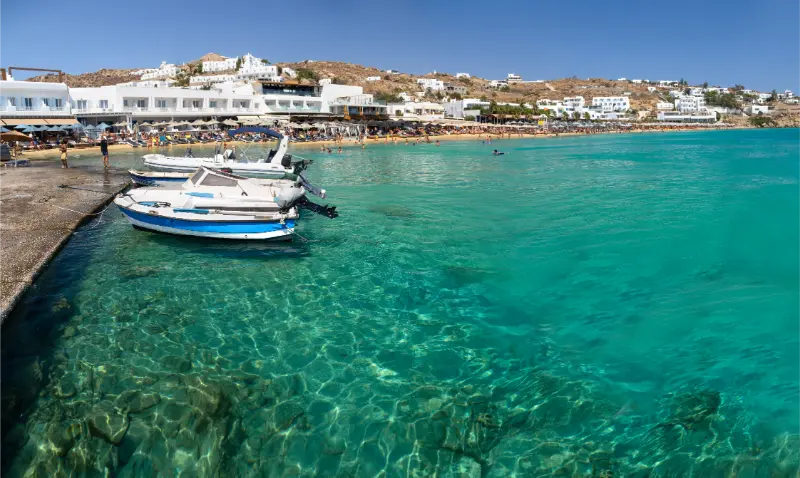
- Platis Gialos: practical beach base and a useful starting point for south-coast boat services.
- Paradise and Paraga: frequent seasonal buses during the active summer schedule.
- Elia: served from the Old Port/New Peripheral side in season.
- Panormos: possible on seasonal routes, but check frequency carefully.
Places that are harder without a car
Armenistis Lighthouse, Agios Sostis, Fokos and scattered rural viewpoints are less convenient by scheduled bus. That does not mean you need a rental car for the entire holiday. A one-day rental, taxi tour or small-group island tour can cover the places where public transport is weakest while the rest of the trip remains car-free.
Where to stay for a car-free trip
Chora is the most flexible base because you can walk to both the old town and bus hubs, but it may be noisy and expensive in high season. Ornos and Platis Gialos are strong alternatives if beach time matters more than late-night old-town wandering. Always check the walking route to the bus stop, not just the straight-line distance shown by a booking site.
A sample 4-day car-free structure
- Day 1: Mykonos Town on foot and the Archaeological Museum.
- Day 2: Delos excursion from the town harbour, followed by Little Venice at sunset.
- Day 3: Bus to Ornos/Agios Ioannis or Paradise according to your travel style.
- Day 4: Bus to Ano Mera and Elia, or join an island tour for the lighthouse and remote coast.
Getting around Mykonos in practice
Mykonos looks small on a map, but summer traffic, limited parking and the shape of the road network can make short distances take longer than expected. Public buses are genuinely useful when your route matches the network. The operator currently publishes seasonal services from Fabrika and the Old Port/New Peripheral toward Ornos, Agios Ioannis, Platis Gialos, Paradise, Super Paradise, Ano Mera, Elia, Kalafatis, Panormos, the airport and the ports. Check the official Mykonos Bus timetable shortly before every journey because schedules change during the season rather than staying fixed for the whole year.
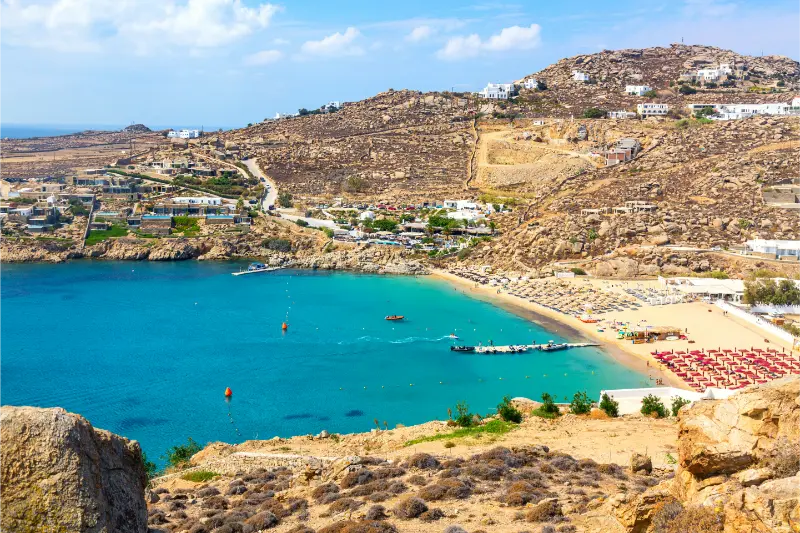
For ferry arrivals at Tourlos, the Mykonos SeaBus is often simpler than joining road traffic: its published service connects the New Port with the Old Port/Mykonos Town area and is designed to carry luggage and pushchairs. If you rent a car, treat it as a tool for selected days—Ano Mera, remote beaches, lighthouse viewpoints—rather than assuming you need it every day. Staying near a bus corridor can save money and reduce the stress of parking close to Chora.
Accessibility and comfort
Accessibility changes dramatically from one part of Mykonos to another. Waterfront promenades and some modern beach facilities may be relatively straightforward, while Chora lanes, monastery steps, rocky coves and lighthouse ground can be difficult for wheelchairs, pushchairs or anyone with limited mobility. Ask hotels and attractions for the exact route, surface and number of steps rather than relying on the phrase “close to the centre”.
The SeaBus specifically notes easy wheelchair access on its main connection, but onward routes and old-town streets still require individual assessment. Heat is another accessibility issue: even a short exposed walk can be demanding in mid-summer. Morning visits, shaded breaks and realistic taxi or bus transfers can make a major difference.
Budget and booking strategy
Mykonos can be expensive, but the biggest costs are usually accommodation, private transport, premium beach seating and nightlife—not the act of walking through Chora, visiting a monastery or laying a towel on public beach space. Decide which experiences matter enough to pay for and keep the rest simple. A hotel on a useful bus route can be better value than a cheaper room that forces several taxis every day.
During the busiest weeks, reserve accommodation, high-demand restaurants and any tour with limited capacity in advance. For ordinary beach time, keep some flexibility so you can change coast when the wind changes. Prices, minimum spends and sunbed policies at commercial venues change quickly, so verify them directly rather than building a budget around an old screenshot or social-media post.
How to plan the day without rushing
A common mistake on Mykonos is to schedule too many famous places in a single day. The island is compact, but parking, buses, lunch reservations, beach access and slow pedestrian streets add hidden time. A better formula is one major objective in the morning, one nearby beach or village in the afternoon and one evening area. That leaves space for a swim, a long meal and the delays that are normal in peak season.
In July and August, start cultural visits and scenic drives earlier than you think. Use the hottest hours for lunch, shade or the beach rather than exposed walking. In June and September the same itinerary feels much easier, and May or October can be excellent for sightseeing if you accept that some seasonal beach businesses and late services operate at reduced levels.
Wind, swimming conditions and the meltemi
Mykonos is known as the Island of the Winds for good reason. During summer, the meltemi often blows from the north and can transform the character of a beach. South-facing bays are usually the safer default for a calm swimming day, while north-coast beaches can be magnificent when the wind is light and uncomfortable when it is strong. Do not decide purely from photographs or a general island forecast: look at the water, ask locally and keep a second beach in mind.
Wind matters even when you are not swimming. It increases dehydration, can make an exposed viewpoint feel much cooler than town and can turn an umbrella into a hazard. For families, older travellers and anyone who wants a relaxed sea day, flexibility is more useful than a rigid itinerary. One of the easiest ways to enjoy Mykonos is to treat the wind as a planning variable instead of trying to force the same beach plan in every condition.
Tours and activities
For one day outside the bus network, a guided island tour can be more efficient than keeping a rental car for the entire stay. Compare pickup points carefully if your hotel is outside Chora.
Frequently asked questions
Do I need a car in Mykonos?
No. A first trip focused on Chora, Delos and major beaches can work very well with buses, SeaBus and occasional taxis.
Where do buses leave from?
Main routes use Fabrika or the Old Port/New Peripheral area, depending on destination.
Can I get from the New Port to town without a taxi?
Yes. The SeaBus connects Tourlos New Port with the Old Port/Mykonos Town waterfront.
Can I reach Paradise by bus?
Yes. Seasonal Fabrika–Paradise services are among the island’s better-served beach routes.
What is the hardest place without a car?
Remote north and north-west locations such as Agios Sostis and Armenistis Lighthouse are less convenient on scheduled public transport.
More Mykonos guides for the same trip
Continue planning with Ano Mera, Armenistis Lighthouse, Ornos and Agios Ioannis, Paradise and Super Paradise, Elia and Agrari, plus the main Mykonos travel guide, the Mykonos Town guide and the Mykonos beaches guide.
Final thoughts
A car-free Mykonos trip works when accommodation and daily geography are chosen together. Stay near a useful bus corridor, use the SeaBus for the port and buy private transport only for the places that genuinely need it. You avoid parking stress without giving up the island’s most important experiences.