
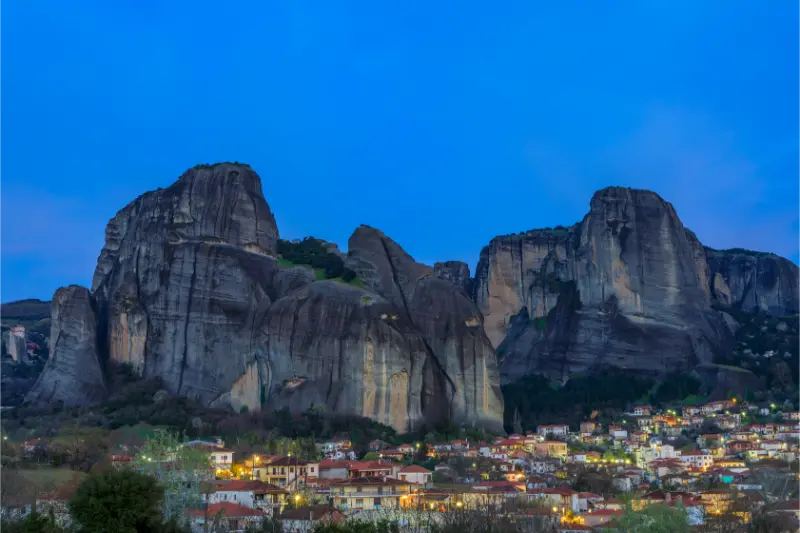
Kastraki is the village that gives Meteora its most intimate human scale. The rock towers rise directly behind houses, gardens and tavernas, and several old paths begin close to the settlement. Compared with larger Kalambaka, Kastraki feels quieter and more immediately connected to the landscape, which is why many hikers and photographers prefer to sleep here even though services are more limited.
The village works best when you do not treat it as a scenic backdrop. Walk the lanes around Mesochori, notice how the rocks shape the street plan, and leave time for the small religious sites embedded in cliffs. The official Kalambaka–Kastraki destination page describes Kastraki as the settlement most directly embraced by Meteora’s stone towers and highlights its role as a base for hiking.
Quick planning summary
- Best for: hikers, couples, photographers and travellers who prefer a village base.
- Allow: one relaxed half day for the village in addition to monastery time.
- Signature experience: walking directly from the village into the Meteora landscape.
- Tradition: the feast associated with Agios Georgios Mandilas.
- Alternative: Kalambaka for a wider range of shops and services.
A village inside the landscape
Kastraki is not separated from Meteora by a long access road; the rocks form its immediate horizon. That changes the rhythm of a stay. Early in the morning and after sunset, when tour coaches have gone, you can walk a few minutes and find yourself beneath cliffs that feel dramatically different from the roadside panoramas.
The settlement expanded from older neighbourhoods that were gradually joined together. Today tourism is central to the local economy, but traces of the older village survive in the lanes, churches and relationship between houses and cultivated ground. Look beyond hotel signs and you will still find a living community rather than a purpose-built resort.
Mesochori and the village walk
Mesochori, literally the middle of the village, is the natural focus for an unhurried walk. From here, short lanes branch toward tavernas, churches and the foot of the rocks. The point is not to follow a rigid sightseeing route but to understand the settlement’s scale before heading to the monasteries.
Walk in the morning or late afternoon, when the light on the rocks is softer. Respect residents’ privacy and do not enter courtyards for photographs. Kastraki is heavily photographed, but it remains a home for people who should not have to treat every doorway as a public viewpoint.
Agios Georgios Mandilas
One of the most distinctive local traditions is associated with the small chapel of Agios Georgios Mandilas, set in the rock. During the saint’s feast, local climbers traditionally replace scarves or cloth offerings placed high on the cliff. The custom is spectacular to watch but should not be imitated by untrained visitors.
Outside the festival, view the site from safe ground and appreciate how religious practice adapted to the vertical landscape. The chapel is part of a wider network of hermitages and rock shelters that preceded or complemented the large monasteries on the summits.
Hiking from Kastraki
Kastraki is a strong starting point for the paths covered in our Meteora hiking guide. Walking gives you a very different understanding of the rock formations because you move through forest, old tracks and gaps between towers rather than simply driving from parking area to parking area.

Trail conditions vary with rain, maintenance and season. Use a current map or local guide, carry water and start early in hot weather. A route that looks short in horizontal distance may include steep ascent, stone steps and loose surfaces.
Planning the monasteries from the village
The main monastery circuit is close, but a realistic day still needs planning. Read our guide to the active Meteora monasteries and choose a limited number rather than racing through all six. Opening days differ, dress rules apply, and stairs make the physical load larger than the driving distance suggests.
Kastraki’s advantage is that you can break the experience into pieces. Visit monasteries early, return for lunch and rest, then head out again for a viewpoint or short walk when the light improves.
Sunrise, sunset and photography
The village itself is excellent for blue-hour and early-morning photography because lights, roofs and cliffs sit in the same frame. For sunset, use established roadside viewpoints rather than scrambling onto rocks. Popular lookouts can become crowded, so arrive early and never park in a way that narrows the mountain road.
After sunset, carry a light if walking back on unlit sections. The rocks disappear quickly into darkness, and uneven verges can be harder to see than they appear in daylight.
Eating in Kastraki
Kastraki has tavernas and cafés oriented to visitors, but the atmosphere becomes noticeably calmer once day-trippers leave. That makes dinner one of the pleasures of staying overnight. Choose a place where the menu and kitchen fit your appetite rather than chasing a single ‘best’ restaurant.
If you are hiking the next morning, buy water and snacks in advance. Small shops can have limited hours compared with Kalambaka, especially outside the main season.
How much time to allow
For Kastraki, the right amount of time depends on whether you are treating it as a destination or as part of a wider Thessaly route. A rushed stop can cover the headline sights, but the character of the area appears in the quieter details: a village square, a short walk, a local museum, a stretch of coast or a meal that is not squeezed between two long drives. Two nights allow one full monastery day plus village walks, hiking or a second sunrise/sunset session without constantly moving the car.
Build the day around one or two priorities rather than a checklist. Thessaly is geographically compact on a map but mountain roads, river valleys and agricultural traffic can slow travel. If a visit starts feeling hurried, remove the least important detour rather than cutting time from the place you actually came to see.
Getting there and getting around
Kastraki is only a short distance from Kalambaka and can be reached easily by road or taxi. The village centre is walkable, but gradients increase quickly toward trails and monastery roads. If arriving without a car, confirm the current local transfer options before booking a property high above the centre.
A car gives the most flexibility, especially if you want to combine Kastraki with Kalambaka, Theopetra and Trikala. Public transport can work for larger towns, but small villages, trailheads, archaeological sites and remote beaches are harder to connect efficiently. Recheck road conditions after severe weather and never assume a mountain shortcut is faster than the signed main route.
Where to stay
Stay in Kastraki if immediate rock views and trail access matter more than a large choice of shops. Choose central accommodation for easier dinners on foot; hillside properties can have exceptional views but may involve steep walks or narrow access.
For a broader trip, Kastraki or nearby Kalambaka is the most practical reference point. Choose accommodation for parking, realistic driving time and the kind of evenings you want, not only for a low room rate. In rural Thessaly, a beautiful guesthouse can be excellent, but confirm check-in arrangements, heating or air conditioning, stairs and food options if you are arriving late.
Check accommodation in Kastraki and Meteora on Booking.com.
Best time to visit
Spring and autumn are ideal for hiking and village walks. Summer works well if you start before the heat and use the middle of the day for lunch or indoor visits. Winter can be beautiful and quiet but may bring ice, snow or fog.
Spring and autumn generally reward travellers who want walking, archaeology and village life without peak heat. Summer is best when swimming or high mountain air is part of the plan, while winter can be atmospheric but requires more conservative driving and more attention to daylight, frost and snow. Always check the short-range forecast rather than planning only from seasonal averages.
Food and local stops
Village tavernas generally focus on familiar mainland Greek cooking: pies, meat, vegetables, cheese and seasonal dishes. Ask about local mushrooms when available, but do not expect the same menu year-round.
Treat food as part of the route rather than a final obligation at the end of a long day. In smaller places, lunch may be the most reliable meal, while evening choice can be limited outside weekends or summer. Ask what is local and in season, and avoid assuming that every regional speciality is available in every taverna.
Families and different travel styles
Children who like walking may enjoy Kastraki more than a purely road-based visit because the rocks feel close and immediate. Families with strollers should choose accommodation carefully and remember that monastery stairs and old paths are not stroller-friendly.
Travellers who prefer slow travel should reduce the number of stops and spend more time in a compact village enclosed by Meteora’s stone towers. Photographers benefit from early and late light, while hikers need a separate time budget for route-finding and weather changes. Older travellers or anyone with limited mobility should verify gradients, steps and surface conditions at monasteries, old villages and archaeological sites before committing to a long circuit.
Safety and responsible travel
Never climb cliffs, enter hermitages or approach edges because you have seen others do so online. Rockfall, loose stone and steep drops are genuine hazards. Use established paths and qualified guides for any technical activity.
Carry water, keep a charged phone and respect closures, barriers, private land and protected habitats. Do not enter unstable ruins or damaged buildings for photographs. In summer, wildfire restrictions can affect forest access; on the coast, wind and waves can change quickly; in mountain areas, fog and thunderstorms can reduce visibility far faster than on the plain.
How to combine it with a Thessaly itinerary
Pair the village with Kalambaka, then add Theopetra if you have a second day. Trikala makes a good low-stress stop before or after Meteora if you need a flatter urban day.
If you are building a longer regional trip, connect this article with our Thessaly road-trip itinerary, where to stay in Thessaly and Thessaly with kids. Those guides help decide which stops belong in the same travel day and which are better treated as separate bases.
Final advice
Kastraki rewards travellers who sleep beneath the rocks rather than arriving only for the monastery circuit. Dawn, dinner and the quiet hours between tours reveal a side of Meteora that is difficult to experience on a rushed day trip.
The best version of a visit to Kastraki is the one that leaves enough margin for the unexpected: a viewpoint, a conversation, a local product, changing weather or a road that takes longer than expected. That flexibility is not wasted time; it is often what turns a technically efficient itinerary into a trip that actually feels like Thessaly.
Official information and planning checks
Use Visit Thessaly for destination context and verify individual monastery schedules with official monastery or tourism information shortly before your visit.
Leave a Reply