
Visit Paxos without a car using buses, taxis, walking and boat transfers, with realistic advice on the best base, beaches you can reach and where car-free travel becomes difficult.
Paxos is compact, but it rewards precise planning. Villages sit close together on a map while olive-grove lanes, steep western cliffs, irregular buses and boat-dependent sights can make two apparently simple days feel very different. This guide focuses on practical choices: where to base yourself, when walking is realistic, what changes with wind, and how to combine beaches, villages and sea excursions without turning the trip into a checklist.
Quick planning notes
- Gaios is the easiest car-free base because ferries, the main bus stop, taxis, shops and excursion boats are concentrated there.
- Public buses connect the principal villages and some beaches, but official tourism information warns that services are not very frequent.
- Book taxis ahead for early ferries, dinner transfers and peak-August days rather than assuming one will be waiting.
- Boat trips solve access to Antipaxos, the Blue Caves and remote coves more effectively than any road vehicle.
Is a car necessary on Paxos?
No. Paxos is small enough to enjoy without driving, particularly if you choose Gaios, Lakka or Loggos as a base and accept that you will combine several transport modes. The official tourism portal lists buses, taxis, boats, bicycles and walking as practical ways to move around. The limitation is frequency, not absence of transport.
A car becomes useful when you want to visit multiple remote beaches in one day, stay in an isolated villa or return from sunset viewpoints after buses have finished. Car-free travel works best when your itinerary is slower: one village or coastline per day rather than five stops scattered around the island.
Why Gaios is the easiest base
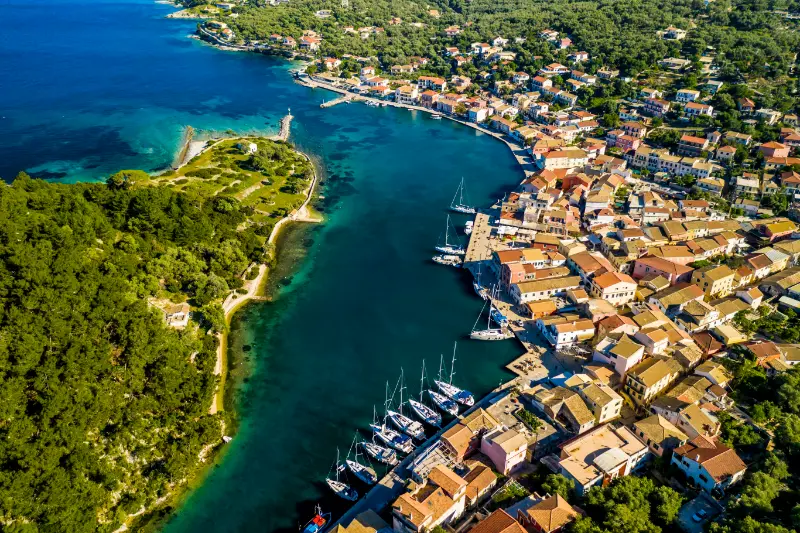
Gaios concentrates the ferry harbour, the largest selection of groceries and restaurants, taxi availability and many excursion departures. You can walk to several nearby coves, take a bus north, join a boat to Antipaxos and return to dinner without arranging a vehicle. For a first car-free trip, this reduces the number of moving parts.
The compromise is that Lakka and Loggos feel more intimate. If your priority is village atmosphere rather than transport efficiency, staying there is still possible. Just confirm how you will handle luggage on arrival and an early-morning departure, because the bus timetable may not align with your ferry.
Using the public bus
The public bus links the main settlements and selected beaches, but schedules change with season and are not dense enough to treat like an urban service. Photograph the timetable after arrival and identify the final return before leaving for the day. Build margin around ferry connections rather than planning to arrive at the port minutes before departure.
Buses are most useful for straightforward village trips: Gaios to Loggos or Lakka, then walking locally. They are less effective for a custom beach-hopping day. If two people would otherwise make several taxi trips, compare the price of a one-day rental before deciding that car-free travel is automatically cheaper.
Taxis: where they make the biggest difference
Taxis fill the gaps left by buses and are especially valuable for luggage, evening meals in another village and one-way hiking routes. Official tourism information recommends booking ahead in peak season. Save several taxi numbers on your phone and ask your accommodation to arrange critical transfers such as an early ferry.
Costs add up if you use taxis for every beach. A better strategy is to spend whole days in one area: taxi to Lakka, walk and swim around the north, then return once. This turns a potentially expensive sequence of short journeys into one useful transfer.
Walking between villages and beaches
Walking is a major part of car-free Paxos because the historic path network often feels more pleasant than the road. Loggos to nearby beaches is particularly easy to build into a day, and longer walkers can tackle sections toward Lakka or Gaios. Visit Greece describes a 12 km Gaios–Lakka route and a shorter 5 km Loggos–Orkos–Lakka option.

Heat changes the calculation. A 3 km midday road walk with no shoulder can be worse than a longer shaded path at 8 a.m. Use offline maps, carry water and do not assume every apparent shortcut is public. For evening walks, take a torch.
Boats as transport, not just excursions
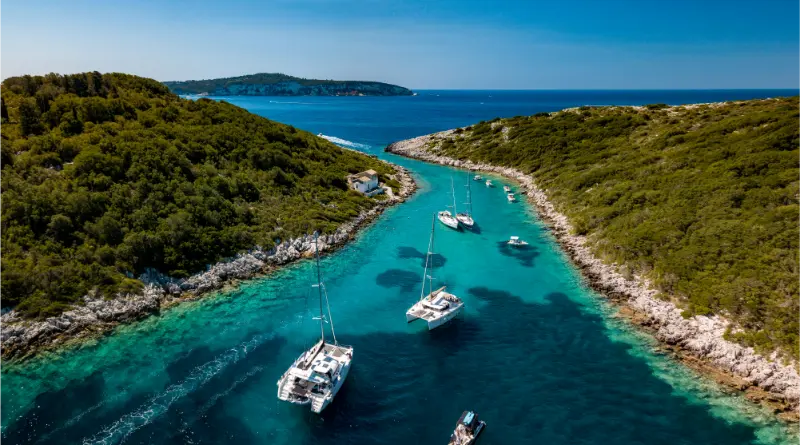
Boats are essential if you want Antipaxos, Blue Caves or inaccessible west-coast coves. Local transfers to Antipaxos function almost like seasonal sea buses, while excursion boats combine sightseeing and swimming. Renting a small boat can also expand freedom, but only if you are comfortable with the operator’s safety requirements.
For car-free travellers, a boat day is especially efficient because it replaces the one category of attractions a car cannot reach anyway. Schedule it early in the stay so weather cancellations leave room to rebook.
A sample four-day car-free plan
Day one can stay around Gaios and nearby coves. Day two: bus to Lakka, swim at Harami and walk toward the lighthouse. Day three: Antipaxos and Blue Caves by boat. Day four: bus or taxi to Loggos, walk to Levrechio and Marmari, then return for dinner. This already covers the island’s main character without driving.
If you have a fifth day, add a one-way hike or taxi to a west-coast sunset viewpoint. The key is not trying to reproduce a rental-car itinerary with slower transport. A car-free plan should use fewer bases and longer blocks of time.
Accommodation and booking strategy
Paxos has a limited accommodation supply compared with Corfu, and the most attractive village-centre rooms, waterfront apartments and family villas can sell early in July and August. Compare the exact location rather than only the property name: a room described as “Gaios” may sit well above the harbour, while a villa near Lakka may require a car or taxi after dinner. Check current Paxos accommodation on Booking.com.
For a short first visit, prioritize convenience over a dramatic view. For a longer stay, a quieter villa can work well if you already know how you will reach groceries, beaches and evening restaurants. If mobility is limited, ask the host about gradients, stairs and the nearest point a taxi can reach; the island’s beautiful old lanes are not always stroller- or suitcase-friendly.
Frequently asked questions
Can I visit Paxos without renting a car?
Yes. Base yourself in Gaios, Lakka or Loggos and combine buses, taxis, walking and boats. Gaios is the simplest for a first trip.

Are buses frequent on Paxos?
No. The official tourism portal notes that public buses connect main villages and beaches but are not very frequent, so always check the current timetable.
What is hardest without a car?
Remote villas, multiple beaches in one day and late sunset viewpoints are the main challenges. Taxis or a one-day rental can solve those specific gaps.
Useful official resources
For information that can change after publication, check the Visit Paxos tourism portal, the official Paxos travel-information page and, for sea connections, the official getting-to-Paxos page. Hiking information is also available from Visit Greece. Ferry times and local transport can change with season, weather and operator, so verify the exact date before committing to a tight connection.
Related Paxos guides
- Where to Stay in Paxos: Gaios, Lakka, Loggos or Mongonissi?
- Paxos Hiking Guide: Gaios to Lakka, Loggos Trails and Olive Groves
- Gaios Paxos Guide: Harbour, Castle, Mongonissi and Where to Stay
- How to Get to Paxos in 2026: Ferries from Corfu and Igoumenitsa
A practical way to plan the day
Build each day around one anchor rather than several fixed appointments. On a calm day, make the boat trip or exposed west-coast walk the anchor and keep the afternoon flexible. When wind is stronger, choose an east-coast beach, village lunch or short olive-grove walk. This approach suits Paxos because distances are small enough to change direction, while the most memorable experiences—clear water, cliff light, quiet lanes and village evenings—depend more on conditions than on an ambitious schedule.
Keep water, sun protection, offline maps and a small cash reserve in your day bag. Mobile reception can vary near cliffs and remote coves, and not every beach has a bar or a reliable taxi pickup point. If you are using buses, photograph the current timetable after arrival and confirm the final return of the day. If you are using boats, ask what happens if wind forces a route change. Those simple checks remove most of the stress from an otherwise very easy island to enjoy.
A final rule is to leave some room for repetition. Paxos is not an island where every hour needs a new attraction. Returning to the same waterfront for breakfast, repeating a beach that was exceptionally calm, or walking the same olive lane at sunset often produces a stronger sense of place than collecting ten different stops. The island is small enough that familiarity becomes part of the experience rather than a sign that you have run out of things to do.