

Tinos is one of the best Cycladic islands for travellers who want more than beaches and nightlife. It has a major pilgrimage tradition, dozens of distinctive villages, an exceptional marble-working heritage, terraced hills, hundreds of ornate dovecotes, walking paths and a food culture that rewards slow exploration. The island can look austere from the ferry, but inland Tinos is full of detail.
Because nearby Mykonos is much more famous internationally, Tinos is sometimes treated as a side trip. I would do the opposite: give Tinos several days and let the villages shape the itinerary. If you are comparing islands, read the best Greek islands guide and the guides to Naxos and Paros.
What makes Tinos different
Visit Greece calls Tinos the “hand-crafted” island, and the phrase fits. The island’s identity is shaped by marble architecture, artists, stone walls, terraces and elaborate dovecotes as much as by sea and sun. It is also one of Greece’s most important Orthodox pilgrimage destinations because of the Church of Panagia Evangelistria in Chora.
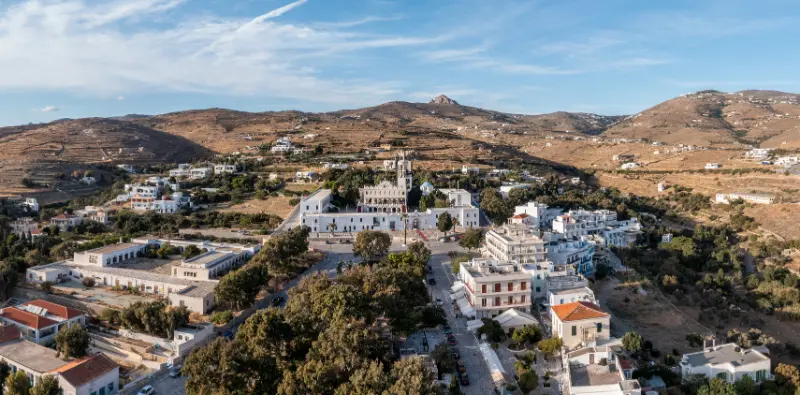
The result is an island with several parallel identities: religious, artistic, agricultural, gastronomic and beach-oriented. A good Tinos trip samples all of them rather than spending five days on one coast.
Tinos Chora
Chora is the ferry port and main town. The broad route leading toward Panagia Evangelistria is central to the pilgrimage experience, while side streets hold cafes, restaurants and everyday island life.
Staying in Chora is practical if you do not have a car because ferries and many buses are close. It is also convenient for evening meals after day trips inland.
Pyrgos and marble tradition
Pyrgos is one of the essential villages, known for marble craftsmanship, elegant architectural details and a strong artistic tradition. Spend time looking at doorways, fountains, lintels and the surfaces of the village rather than treating it as a twenty-minute photo stop.
Nearby Panormos adds a coastal contrast and can turn the village visit into a relaxed half-day. Museums and workshops related to marble art deepen the experience for travellers interested in craft and design.
Volax and the interior villages
Volax is famous for the rounded granite boulders scattered through the landscape. The village itself is compact, but the surrounding terrain makes it one of the most distinctive places on Tinos.
Other villages reward wandering for dovecotes, Catholic and Orthodox churches, squares and traditional houses. Instead of trying to “complete” a list of forty villages, choose a cluster each day and travel slowly between them.
Hiking on Tinos
Tinos is unusually strong for walking. Visit Greece reports more than 150 kilometres of stone-paved roads and paths connecting villages, valleys, dovecotes, monasteries and beaches. Routes range from easy village walks to more demanding terrain.
A popular approach is to combine a walk with a village meal so you are not dependent on a circular hiking route. In warm weather, start early and carry more water than the distance alone suggests because shade can be limited.
Best beaches
Tinos has beaches on several coasts, from organised stretches near Chora to more exposed coves. Kolymbithra is among the better-known choices and can feel very different depending on wind. Agios Ioannis and Agios Sostis are convenient for visitors who want easier access and services.
Wind is a major planning factor in the Cyclades. Ask locally which beach is most sheltered on the day rather than insisting on one famous name when conditions are poor.
Food to try
Tinos has an excellent food reputation built on local cheeses, sausages, capers, artichokes, honey and produce from a rugged agricultural landscape. Look for dishes that use what grows on the island rather than only standard Greek-menu classics.
Village tavernas are part of the travel experience. I often plan the day around lunch in the interior, then choose a beach for late afternoon when the light softens and temperatures drop.
Getting around
A car gives the most flexibility because the villages are spread across mountainous terrain. Buses serve key settlements and beaches, especially in season, but a vehicle makes it easier to link small villages and trailheads.
Roads can be narrow and winding. Drive slowly, expect local traffic in both directions and do not stop in the road for photographs. Parking outside small villages is often better than trying to squeeze into the historic centre.
Where to stay
Chora is best for ferry convenience, restaurants and travellers without a car. A village stay offers a quieter atmosphere and immediate access to the interior landscape, while beach areas suit visitors who want swimming to dominate the trip.
For a first five-night visit, I prefer one base near Chora or centrally located with a car. Tinos is compact enough that changing hotels is rarely necessary.
A five-day Tinos itinerary
Day 1: Arrive in Chora, visit the main church respectfully, explore town and have a slow dinner.
Day 2: Drive to Pyrgos and Panormos, visit marble-related sights and spend the late afternoon by the sea.
Day 3: Explore Volax and a cluster of nearby villages, including time for a short hike or village-to-village walk.
Day 4: Beach day chosen according to wind, with a long lunch and no major sightseeing target.

Day 5: Choose a longer hike, more villages or a food-focused loop, then return to Chora early enough to pack without rushing.
Pilgrimage and respectful visiting
Panagia Evangelistria is not merely a tourist landmark; it is a place of deep devotion. Dress appropriately, keep voices low and do not obstruct worshippers for photographs. Around major religious dates, Chora can become extremely busy and accommodation should be booked well in advance.
If you are not religious, the pilgrimage culture is still an important part of understanding Tinos. Observe it with the same respect you would bring to an active mosque, synagogue, cathedral or monastery elsewhere.
Tinos versus Mykonos, Paros and Naxos
Tinos is less oriented toward nightlife and international luxury than Mykonos, more village-and-hiking focused than Paros, and smaller in scale than Naxos. It suits travellers who enjoy food, walking, craft and quiet exploration.
Island choice is about matching personality, not ranking beauty. If your ideal day is beach club followed by late-night clubs, Tinos may feel too quiet. If your ideal day is a village walk, long lunch, swim and sunset, it can be one of the most rewarding Cycladic choices.
Frequently asked questions
How many days do I need in Tinos?
Four to five days is ideal for a first visit because the best experiences are spread across villages, beaches and walking routes rather than concentrated in one town.
Do I need a car?
A car is very useful for exploring the interior efficiently, but travellers based in Chora can use seasonal buses for key villages and beaches.
Is Tinos only a religious destination?
No. Pilgrimage is central to its identity, but Tinos is equally compelling for marble art, architecture, food, villages, beaches and hiking.
Is Tinos windy?
It can be, like much of the Cyclades. Wind direction should influence beach choice and ferry-day expectations, especially in midsummer.
How to slow down on Tinos
Tinos rewards travellers who choose one geographic area each day. A village that looks tiny on the map can absorb an hour once you notice marble doorways, dovecotes, churches and small workshops. Add a coffee and a long lunch and the schedule naturally becomes slower than an itinerary designed around beach hopping.
Walking is another way to reduce the urge to collect sights. A village-to-village path reveals terraces, dry-stone walls and agricultural land that disappear when you drive between parking areas. Even a short section can change your understanding of how communities are connected across the island.

Leave one day partly unplanned. Use the morning wind and local advice to decide whether it becomes a beach day, a hiking day or another village loop. That flexibility is especially valuable in the Cyclades, where weather can make one coast uncomfortable while another remains calm.
Additional practical notes
Tinos has both Orthodox and Catholic traditions, visible in churches and villages. Respect local services and religious events, and ask before photographing people at worship.
For ferry planning, leave enough time between Tinos and a flight from Athens. Meltemi winds can disrupt schedules in the Cyclades, so a same-day tight connection is unnecessary risk.
Planning around villages and wind
Each morning on Tinos, check wind direction before choosing the coast. This small habit prevents the common mistake of driving across the island to a famous beach only to find it uncomfortable. Local hotel staff and taverna owners are often excellent sources because they know which coves are sheltered under the day’s conditions.
For village days, I group places geographically. Pyrgos and Panormos belong naturally together, while Volax can be combined with nearby interior villages and a short walking route. This approach leaves time for coffee, museums and lunch instead of turning every village into a ten-minute parking stop.
If you enjoy photography, morning and late afternoon are especially good for marble details, dovecotes and narrow streets. Midday light can be harsh, but it is perfect for a long shaded meal. Tinos becomes much easier when the itinerary follows the light and temperature instead of fighting them.
A final practical point is footwear. Even travellers who are not planning formal hikes spend a surprising amount of time on stone lanes, steps and uneven village paths. Comfortable shoes will be used far more than elegant sandals, especially if you want to explore beyond Chora.
More Attica guides for your trip
Continue with Rafina Port for more detailed planning.
More in-depth Tinos guides
Continue planning Tinos with Tinos Chora Guide; Pyrgos and Panormos Tinos Guide; Volax Tinos Guide; Kardiani and Isternia Tinos Guide; Panagia Evangelistria Tinos Guide; Best Beaches in Tinos; Tinos Hiking Guide; Tinos Without a Car; Tinos with Kids; Where to Stay in Tinos.
Related itinerary: Andros and Tinos in 7 Days: Hiking, Villages and Beaches Itinerary.
Related itinerary: Syros, Tinos and Mykonos in 10 Days: Northern Cyclades Island-Hopping Itinerary.
Related festival or event guide: August 15 in Greece: Dormition, Island Festivals, Pilgrimages, Crowds and Travel Tips.