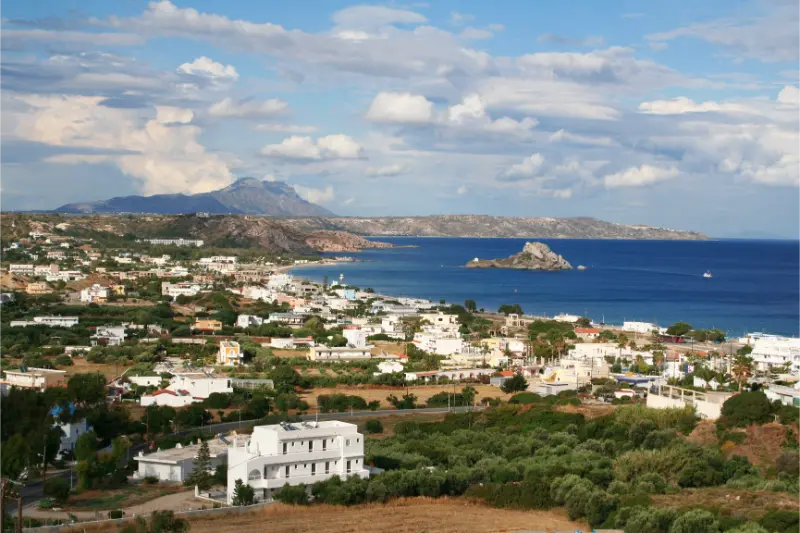
Author: Jessica

  • Lefkada Town Guide: Old Streets, Marina, Lagoon and a 2-Day Stay

    Lefkada Town Guide: Old Streets, Marina, Lagoon and a 2-Day Stay

    Lefkada Town is more than the place you drive through after crossing the floating bridge. The capital is compact, colourful and unusually connected to the mainland, with a lagoon on one side and the Ionian Sea nearby. It works especially well as the first or last base on the island because you can explore on foot and still reach beaches quickly.

    I would give the town at least one evening rather than immediately driving south. The Lefkada Travel Guide covers the whole island, while the Porto Katsiki and Egremni guide is better for the famous west-coast beach day. This article focuses on how to enjoy the capital itself.
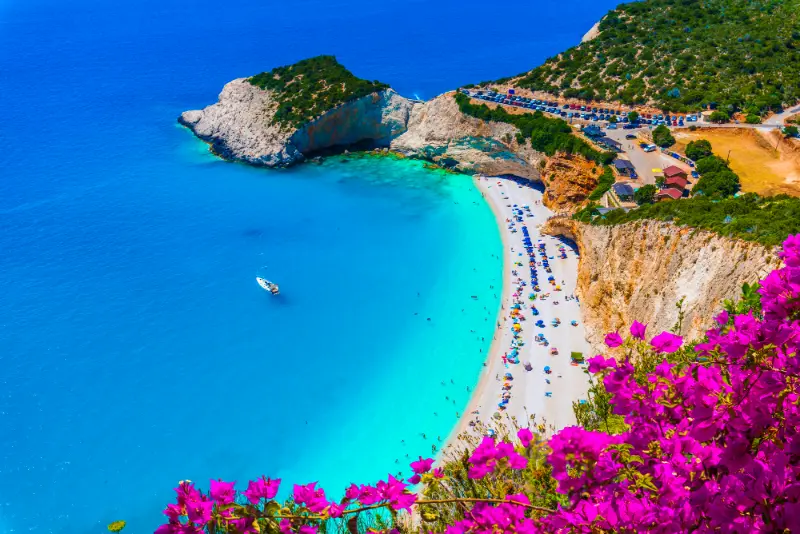
    Lefkada Beach Of Port Katsiki On Ionian Sea Greece

    Where this fits in your Greece itinerary

    For wider planning, continue with Lefkada Travel Guide; Porto Katsiki and Egremni Guide. I use these pages together so the day-level advice stays connected to a realistic island route rather than becoming an isolated list of attractions.

    What makes this experience worth your time

    Walk the central streets without a checklist

    The centre is best explored slowly. Narrow streets, small squares, churches, cafés and shops create a lived-in atmosphere that differs from the beach settlements. The point is not to collect monuments but to notice the architecture and the way the town functions around local life.

    My practical approach is to give this stop enough time to absorb the setting rather than treating it as another pin to clear. I look at heat, parking, walking surface and the next drive before deciding how long to stay. That simple check prevents a beautiful place from becoming the stressful middle of an overfilled day.

    Spend time by the lagoon

    The lagoon gives Lefkada Town a different setting from most Greek island capitals. A walk near the water is especially pleasant early or late in the day. Birdlife varies by season, so use binoculars or a camera rather than approaching animals or entering sensitive areas.

    My practical approach is to give this stop enough time to absorb the setting rather than treating it as another pin to clear. I look at heat, parking, walking surface and the next drive before deciding how long to stay. That simple check prevents a beautiful place from becoming the stressful middle of an overfilled day.

    Use the marina and waterfront as orientation

    The marina and waterfront make the town easy to understand on foot. Sailing is a major part of Lefkada’s identity, and the harbour area is a useful place to see how island tourism connects with the wider Ionian sailing network.

    My practical approach is to give this stop enough time to absorb the setting rather than treating it as another pin to clear. I look at heat, parking, walking surface and the next drive before deciding how long to stay. That simple check prevents a beautiful place from becoming the stressful middle of an overfilled day.

    Reach nearby beaches without a long road trip

    Agios Ioannis and the northern beaches are close enough to combine with a town day. This is a good option when you arrive late, do not want a mountain or west-coast drive, or need a flexible day before departure.

    My practical approach is to give this stop enough time to absorb the setting rather than treating it as another pin to clear. I look at heat, parking, walking surface and the next drive before deciding how long to stay. That simple check prevents a beautiful place from becoming the stressful middle of an overfilled day.

    Stay here for logistics

    Because Lefkada is connected to the mainland by road, the capital is convenient for travellers arriving from Preveza, Ioannina or mainland Greece. It also has a broad range of services. A night here can simplify a route before moving to Nydri, Vasiliki or the west coast.

    Many Sailing Vessels Bay Hazy Lefkada Coast Panorama Nydri Greece Ionian Sea

    My practical approach is to give this stop enough time to absorb the setting rather than treating it as another pin to clear. I look at heat, parking, walking surface and the next drive before deciding how long to stay. That simple check prevents a beautiful place from becoming the stressful middle of an overfilled day.

    Enjoy the town after beach traffic fades

    The centre becomes more enjoyable in the evening when the heat drops and day-trip traffic eases. Dinner, a walk and a late gelato or drink create a calmer final chapter to a beach-heavy day.

    My practical approach is to give this stop enough time to absorb the setting rather than treating it as another pin to clear. I look at heat, parking, walking surface and the next drive before deciding how long to stay. That simple check prevents a beautiful place from becoming the stressful middle of an overfilled day.

    Planning and getting around

    You do not need a car for central Lefkada Town, but most travellers will have one for the island. Ask accommodation about parking and avoid assuming you can stop directly outside a central property. If you are flying through Aktion/Preveza, leave a generous buffer for the bridge, traffic and rental-car procedures. For the island interior and west coast, start early because short distances can involve slow roads.

    Before leaving, save the exact parking or departure point offline and confirm any ticket, ferry or archaeological schedule that matters to the day. Island travel is forgiving when you build in buffers, but it becomes fragile when one late boat or full car park affects every later reservation.

    A realistic itinerary

    This is the pacing I would use on a first visit. It keeps one main objective in each part of the day and leaves enough room for meals, weather and unexpected stops.

    • Day 1: arrive, walk the centre and waterfront, explore the lagoon side in softer light and have dinner in town.
    • Day 2: spend the morning at a nearby beach or on a short coastal outing, then return for lunch and a final town walk before moving to your next Lefkada base.

    Best time to go

    May, June and September are ideal for combining town walks with beach weather. July and August are lively but hotter and busier. Spring and autumn are especially good if sailing, food and slow travel matter more than swimming.

    Wind matters throughout the Ionian even though the region often feels more sheltered than the Cyclades. For boats, exposed viewpoints and mountain roads, check the same-day forecast rather than relying only on a general weekly icon. In shoulder season, also verify whether seasonal businesses and transport are operating on your exact dates.

    Food and the rhythm of the day

    Lefkada has its own food identity, including local salami and lentils from Eglouvi. In town, mix traditional tavernas with bakeries and simple cafés. The marina area is convenient, but I would also walk inland before choosing dinner rather than eating only where boats are most visible.

    I normally place the longest drive or hike before the main meal, then slow the schedule down. This is safer if you are driving and also makes the afternoon more enjoyable. A local lunch followed by one nearby stop usually creates a better day than eating quickly and crossing the island again.

    Small details that improve the visit

    The town is particularly useful for a rainy or windy half-day. Museums, cafés, shopping and a slower lunch can replace a cancelled boat or beach plan without wasting the day. I always keep one urban option like this in an island itinerary because weather flexibility reduces frustration.

    Photographers should walk both sides of the centre: the colourful streets give detail and texture, while the lagoon and marina provide wider scenes. Morning is best for calmer water and fewer people; evening adds atmosphere but also more movement around restaurants and boats.

    Practical mistakes to avoid

    • Driving through without spending an evening
    • Assuming parking is easy in the historic centre
    • Crossing the island for a famous beach on arrival day
    • Ignoring the lagoon because it is not a swimming beach
    • Booking a tight airport transfer with no traffic buffer
    • Using the town only for shopping and missing its evening atmosphere

    The pattern behind most of these mistakes is overplanning. The Ionian Islands are easy to underestimate because road distances look short and the sea is often calm, but parking, narrow roads, boat timings and heat can still consume time. Plan around one or two strong experiences per day and let the rest stay optional.

    Accessibility, families and comfort

    Accessibility varies widely between old towns, fortresses, mountain trails and boat landings. Stone steps, uneven paths and limited shade can matter more than the distance shown online. Travellers with reduced mobility should contact the specific site, operator or accommodation for current access details. Families should prioritise shade, toilets, safe parking and realistic transfer times rather than assuming every famous stop has full infrastructure.

    Responsible travel

    Stay on marked routes, respect temporary closures and never remove archaeological, geological or natural material. Keep noise low in villages and religious spaces, avoid blocking residents with parked cars and give wildlife a wide buffer. On beaches and boats, take every item you brought with you back out. Small island communities and sensitive coastal environments absorb visitor pressure quickly, so basic behaviour has a visible effect.

    Frequently asked questions

    How many nights in Lefkada Town?

    One or two nights work well, especially at the start or end of an island road trip.

    If this point is central to your trip, confirm the latest local information shortly before travel because seasonal services and access conditions can change.

    Can I stay here without a car?

    Yes for the town and nearby areas, although a car makes the wider island much easier.

    If this point is central to your trip, confirm the latest local information shortly before travel because seasonal services and access conditions can change.

    Is Lefkada Town close to the airport?

    It is relatively convenient for Aktion/Preveza Airport, but transfer time still depends on traffic and rental-car logistics.

    If this point is central to your trip, confirm the latest local information shortly before travel because seasonal services and access conditions can change.

    Are there beaches near town?

    Yes. Northern beaches such as Agios Ioannis are easy to combine with a town stay.

    If this point is central to your trip, confirm the latest local information shortly before travel because seasonal services and access conditions can change.

    Is the town worth visiting if I stay in Nydri?

    Yes. It offers a different atmosphere and is worth at least an evening or half-day.

    If this point is central to your trip, confirm the latest local information shortly before travel because seasonal services and access conditions can change.

    Check current information before your visit

    For official destination background and current information, see Visit Greece – Lefkada. I recommend checking opening hours, ferry schedules, weather and temporary access restrictions again shortly before the trip rather than relying on an old screenshot or last year’s timetable.

    Lefkada Egremni Greece

    Final thoughts

    The strongest Ionian itineraries are not the ones that cover the most kilometres. They combine coast, landscape and local life without forcing every famous stop into the same day. Give the main experience time to breathe, keep one backup plan for weather and leave a little room for an unplanned swim, meal or village stop. That is usually where the trip starts to feel like your own rather than a checklist copied from everyone else.

    More Lefkada in-depth guides

    Continue planning Lefkada with Lefkada Without a Car; Where to Stay in Lefkada; Karya and Eglouvi; Lefkada 7-Day Itinerary.

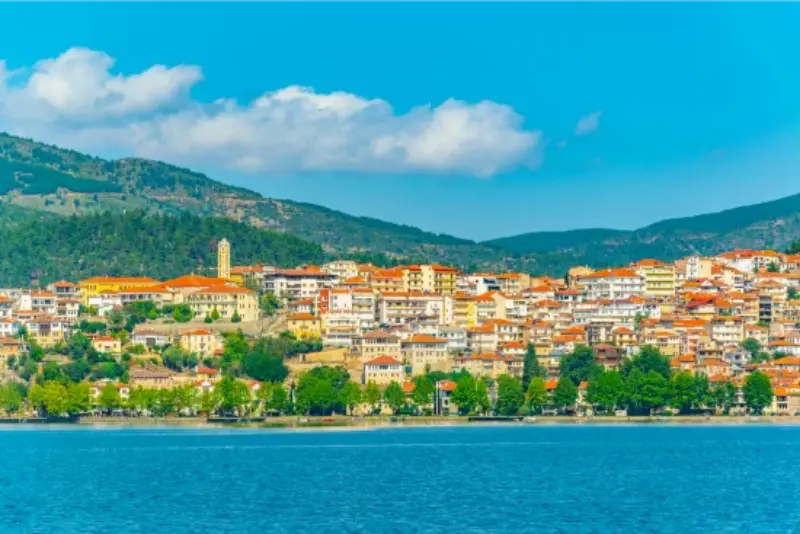
  • Kastoria Travel Guide: Lake Orestiada, Byzantine Churches and a 3-Day Itinerary

    Kastoria Travel Guide: Lake Orestiada, Byzantine Churches and a 3-Day Itinerary

    Kastoria is one of northern Greece’s most distinctive city breaks: a lakeside settlement where Byzantine churches, merchant mansions and mountain scenery sit within an easy walking radius. It is ideal for travellers who want a different side of Greece and are willing to slow down for the lake, the old quarters and the surrounding villages.

    Why Kastoria deserves more than a quick stop

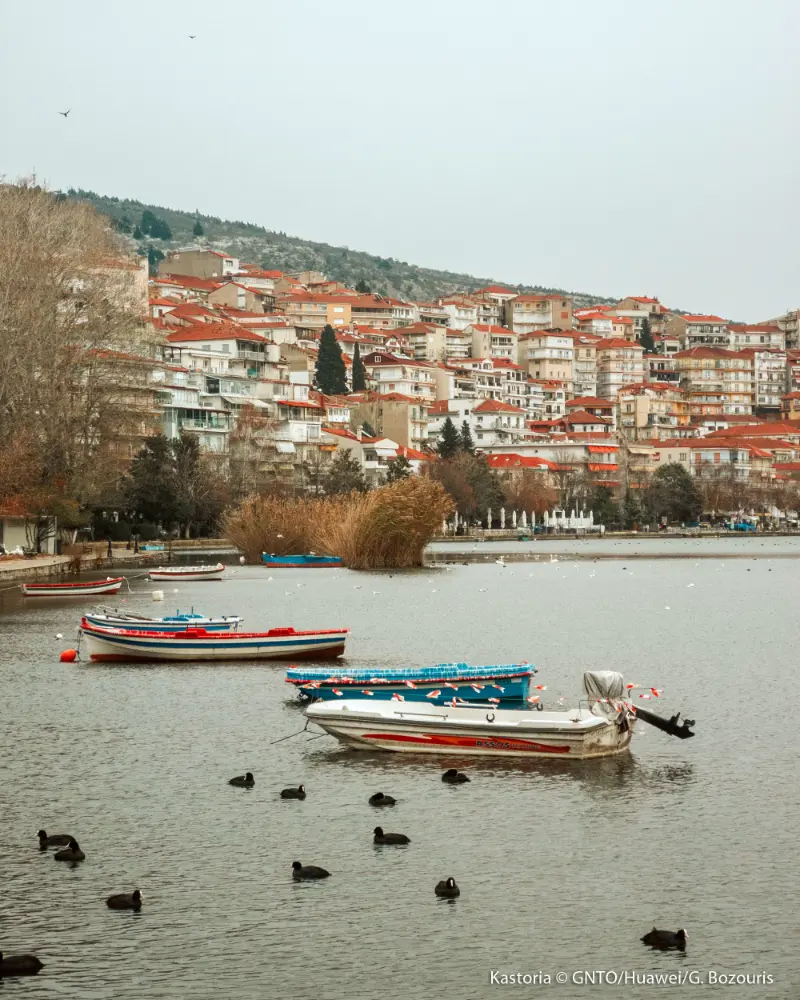
    Kastoria is one of those mainland Greek cities that immediately feels different from the classic island image. The old town wraps around a narrow peninsula on Lake Orestiada, and the water is never just a backdrop: it shapes the walks, the light, the birdlife and the pace of the city. The result is a destination that works equally well for a romantic weekend, a northern Greece road trip or a slower cultural break between larger stops.

    The city also rewards travellers who enjoy architecture and history. The Doltso and Apozari quarters preserve mansions linked to Kastoria’s commercial past, while Byzantine and post-Byzantine churches appear throughout the historic fabric. Instead of rushing from monument to monument, the best approach is to alternate short cultural visits with long lakeside walks and meals in neighbourhood tavernas.

    Lake Orestiada: the heart of the city

    Lake Orestiada is the organising principle of Kastoria. A full circuit by car or bicycle reveals quiet viewpoints, reed beds, small chapels and changing perspectives of the peninsula. If you prefer to stay on foot, the promenade around the old quarters is enough to understand why Kastoria is considered one of the most atmospheric cities in northern Greece. Early morning is especially calm, while late afternoon brings softer light over the water.

    The lake supports rich birdlife, so binoculars are useful even if you are not a dedicated birdwatcher. More than 200 bird species have been recorded in the wider wetland environment according to the Greek tourism authority. Treat the shore as a living ecosystem rather than simply a scenic park: keep to paths, avoid disturbing nesting birds and give yourself time to stop rather than turning the circuit into a checklist.

    Doltso and Apozari: walking through old Kastoria

    Doltso is the quarter I would prioritise on a first visit. Its narrow streets, stone walls and surviving mansions show the prosperity that once came through trade and the fur industry. Several buildings are not open as conventional attractions, but the pleasure is in the urban texture: courtyards, churches, lake views and details that make the area feel lived-in rather than staged for visitors.

    Apozari, on the other side of the peninsula, offers a similarly elegant but quieter atmosphere. Linking Doltso and Apozari on foot gives you a natural half-day route and prevents the common mistake of seeing Kastoria only from the waterfront. Wear comfortable shoes because the historic streets include slopes and uneven surfaces.

    Byzantine churches and museums

    Kastoria has an unusually dense collection of Byzantine and post-Byzantine churches for a city of its size. Opening hours can vary, so it is more realistic to choose a few that fit your route than to expect to enter every church you pass. The Byzantine Museum is the best context-setting stop because its icons help explain the artistic importance of the city and the region.

    If you enjoy local history, pair the religious heritage with one of the mansion museums in the old quarters. This combination explains both sides of Kastoria’s identity: a city shaped by Orthodox culture and by wealthy merchant families whose houses still define the old neighbourhoods.

    Kastoria Greece

    The Dragon’s Cave and the lakeside route

    A short distance from the centre, the Dragon’s Cave adds a natural stop to a mostly urban visit. The cave is known for underground chambers, lakes and formations, and it sits on the scenic road that follows the peninsula. Because access arrangements and visiting hours can change seasonally, check locally before building your day around a specific time slot.

    The same side of the peninsula is ideal for a relaxed drive or cycle. Combine the cave with lakeside viewpoints and a stop at the Monastery of Panagia Mavriotissa. The point is not to cover maximum distance; it is to experience the transition from city streets to water, woodland and religious sites within a very compact area.

    Where to stay in Kastoria

    For a first visit, staying near the lake or in the old quarters gives you the strongest sense of place. Doltso is atmospheric and works especially well for couples, while the modern centre is practical for parking, cafés and services. Properties on the outer lake road can offer views and easier car access but may require more driving for evening meals.

    If Kastoria is one stop in a longer road trip, prioritise easy parking over a romantic lane that is difficult to reach with luggage. In winter, also check whether the property has reliable heating and whether access roads are straightforward in bad weather. The city can be cold, and mountain conditions nearby are very different from coastal Greece.

    What to eat and when to linger

    Northern Greek cuisine is one of the reasons to slow down here. Look for bean dishes, pies, grilled meats, lake fish when available, local cheeses and seasonal mountain ingredients. Rather than searching for one famous restaurant, choose places that are busy with local diners and ask what is seasonal that day.

    Kastoria suits long lunches especially well in colder months. In summer, the rhythm shifts toward shaded cafés and evening walks by the water. If you are combining Kastoria with the wider Macedonia region, compare this food culture with the markets and urban dining of the Thessaloniki guide.

    A practical 3-day Kastoria itinerary

    • Day 1: settle in, walk the lakefront, explore Doltso and Apozari, and finish with dinner near the historic centre.
    • Day 2: visit the Byzantine Museum, selected churches, the Dragon’s Cave and the lakeside road around the peninsula.
    • Day 3: make a regional excursion to Nymfaio, Prespa or another western Macedonia stop, depending on season and road conditions.

    Three days gives Kastoria breathing room. With only one night, you can still enjoy the waterfront and old town, but you will miss the wider landscape that makes the city such a useful base. If you have four or five days, combine it with the new guides to Prespa Lakes and Nymfaio.

    Best time to visit Kastoria

    Spring and autumn are excellent for walking, birdlife and road trips without the heat of southern Greece. Summer is warm but generally less oppressive than lowland Athens, and evenings by the lake can be pleasant. Winter is the most atmospheric season if you enjoy fireplaces, mountain food and the possibility of snow in the surrounding region.

    Do not treat winter weather casually. Frost, fog and mountain road conditions can affect excursions even when central Kastoria is clear. If you are driving, check forecasts and local advice before heading toward higher villages.

    How to get there and get around

    A car is the most flexible option for Kastoria because the city is far from the main tourist corridors and the surrounding destinations are spread across western Macedonia. Kastoria also has a small airport, while intercity buses link the region with larger Greek cities; schedules should always be checked close to travel because frequencies can change.

    Inside the city, you can do most sightseeing on foot if you stay centrally. Use the car for the full lake circuit and regional day trips. If Kastoria is part of a longer northern Greece itinerary, read the Driving in Greece guide before planning mountain routes.

    Kastoria Huawei G Bozouris

    Frequently asked questions

    How many days do you need in Kastoria?

    Two full days are enough for the city and lake, while three days allow a relaxed regional excursion.

    Is Kastoria worth visiting without a car?

    Yes for the city itself, but a car makes day trips to Prespa, Nymfaio and mountain villages much easier.

    Is Kastoria good in winter?

    Yes. It is especially atmospheric in winter, but cold temperatures, fog and snow can affect surrounding roads.

    Can you walk around Lake Orestiada?

    You can walk long scenic sections from the city, while a full circuit is more practical by bicycle or car for most visitors.

    What is Kastoria known for?

    It is known for Lake Orestiada, Byzantine churches, historic mansions, old neighbourhoods and its long connection with the fur trade.

    Extra practical planning note

    One final planning point is to keep the lake and the old town on separate halves of the day. Kastoria looks compact, but photography stops, church visits and meals quickly stretch the schedule. If you are continuing to another mountain destination, refuel before leaving the city and avoid planning a long arrival drive after dark in winter.

    Final advice

    Give Kastoria at least two nights and let the lake set the pace. The city becomes much more memorable when you combine architecture and museums with unstructured walks, regional food and one excursion into western Macedonia.

  • Pyli and Porta Panagia Guide: Stone Bridge, Byzantine Church, Koziakas and Trikala Day Trip

    Pyli and Porta Panagia Guide: Stone Bridge, Byzantine Church, Koziakas and Trikala Day Trip

    Pyli is perfectly named: in Greek the word means “gate,” and the town stands at the transition from the Trikala plain into the mountains of southern Pindos. Most travellers drive through on the way to Elati or Pertouli, but stopping reveals one of the most concentrated combinations of Byzantine architecture, stone-bridge engineering and river scenery in Thessaly.

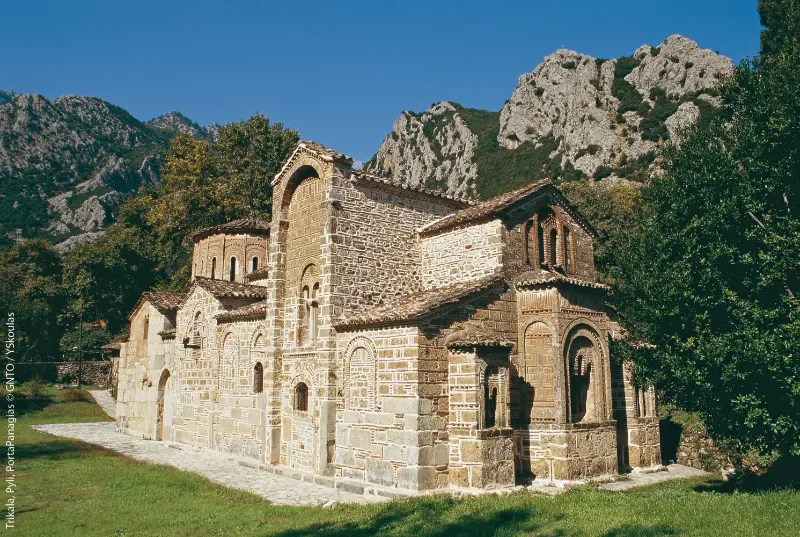
    The highlight is Porta Panagia, a remarkable medieval church on the opposite side of the Portaikos River, close to the old stone bridge. Together with the riverside setting and the road climbing toward Koziakas, it makes Pyli an ideal half-day or overnight stop rather than only a petrol-and-coffee break.

    Quick planning summary

    • Best for: Byzantine art, stone bridges, river walks and mountain-road itineraries.
    • Time needed: half a day for Pyli itself; a full day if adding Dousiko, Elati or Pertouli.
    • Main monuments: Porta Panagia and the arched bridge over the Portaikos.
    • Access: monument opening may require arrangement; check before travelling.
    • Road trip role: Pyli is the natural gateway from Trikala to Koziakas and southern Pindos.

    Why stop in Pyli

    Pyli sits where the landscape changes abruptly. East lies the plain and Trikala; west the road enters the Portaikos valley and climbs toward fir forests, Elati and Pertouli. This geography explains both the name and the strategic importance of the crossing.

    The modern town is practical and lived-in rather than heavily touristified. Give it time for coffee or lunch, then walk toward the river where the historic monuments concentrate.

    Porta Panagia

    Porta Panagia stands on the northern bank of the Portaikos where the Byzantine settlement of Megalai Pylai once developed. Visit Thessaly dates the monastic foundation to 1283 under John Angelos Komnenos Doukas. The surviving church is notable for its masonry, marble iconostasis and large mosaic images of Christ and the Virgin.

    One unusual feature is the reversed placement of the two mosaic icons compared with the standard Orthodox arrangement. Do not count on finding the church open simply because you arrive during daytime; Ministry of Culture information has noted access by arrangement, so check current conditions.

    The stone bridge of Pyli

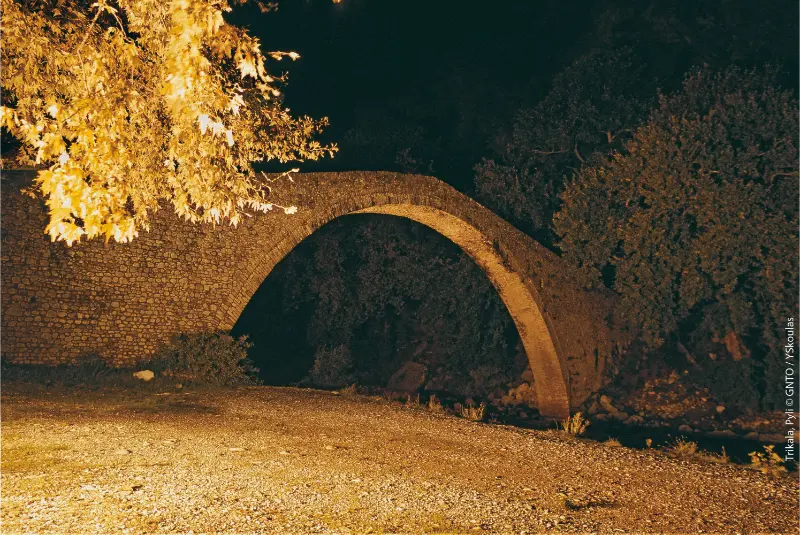
    A short distance away, the single-arch stone bridge associated with Saint Vissarion crosses the river in a dramatic narrow setting. It is one of the area’s defining pieces of infrastructure and shows how important bridge building was in connecting mountain communities with the plain.

    Photograph it from safe riverbank viewpoints rather than climbing on wet stones below. After heavy rain the river environment can change quickly, and polished rock near water is far more slippery than it looks.

    Dousiko and Saint Vissarion

    The Monastery of Saint Vissarion, known as Dousiko, lies higher on the slopes. Visit Thessaly records its foundation in the 16th century and describes its fortress-like character. The monastery traditionally observes an avaton restricting women from entering, so all visitors should verify current access rules before making the detour.

    Even if the monastery does not fit your group, the mountain road itself explains how Pyli connects the plain with the Pindos interior.

    Continue to Elati and Pertouli

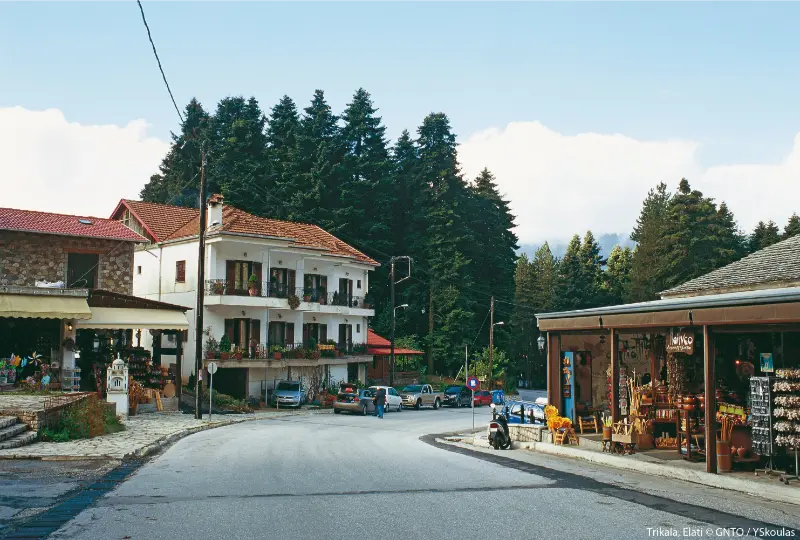
    Pyli is the logical first stop on the way to Elati and Pertouli. Rather than driving straight through, use the morning for Porta Panagia and the bridge, have lunch, then continue into the mountains for forest scenery and an overnight stay.

    This sequencing also prevents a common mistake: trying to combine central Trikala, Pyli, Elati, Pertouli and Meteora in one day. The distances are possible, but the result is mostly driving.

    Trikala Elati

    A half-day walking plan

    Park in the modern town, cross toward the historic riverbank area, visit Porta Panagia if open, walk to the bridge and allow time for the river scenery. Return for lunch before continuing west.

    If you are travelling with children or older relatives, choose stable river paths and avoid scrambling on embankments. The major sights can be appreciated without turning the visit into a hike.

    Where to stay

    Pyli has small-town accommodation and works if you want an early start into the mountains. Elati offers a stronger mountain-resort atmosphere, while Trikala provides the broadest hotel and restaurant choice.

    For a road trip, choose the base that reduces the next day’s driving. Staying in Trikala and repeatedly commuting into Pindos wastes the peaceful early-morning hours that make mountain villages special.

    Getting there and getting around

    Pyli is best reached by road from Trikala. A car is strongly recommended if you plan to continue to Elati, Pertouli or the monasteries and bridges of the mountain region.

    Mountain weather can make the road west of Pyli very different from conditions in Trikala. In winter check snow, ice and tyre-chain requirements; after storms check for local road disruptions.

    Trikala Pyli Gefyri

    Best time to visit

    Spring and autumn are excellent for river and village walking. Summer is pleasant when combined with higher Koziakas villages. Winter turns the route into a mountain trip and can bring snow.

    If a church interior is essential, confirm access in advance rather than choosing a day solely on weather.

    What to eat and drink

    Pyli is a good place for a taverna meal before or after the mountain road: grilled meats, pies, cheeses and seasonal dishes fit the inland setting. In colder months, warming soups and slow-cooked meat are more satisfying than trying to reproduce an island menu.

    If continuing to Elati, you can also save your main meal for the mountain villages and use Pyli for coffee or a light lunch.

    Practical safety and responsible travel

    Keep away from fast water after storms and do not climb onto historic masonry for photographs. Stone bridges are cultural monuments, not adventure equipment.

    At monasteries, follow access restrictions exactly. Clothing, gender-related rules and photography policies should be checked with the site or monastery rather than guessed.

    How to plan the day without rushing

    A useful rule for inland Thessaly is to choose one main anchor for the day and treat everything else as optional. An anchor might be an archaeological site, a village, a winery appointment, a thermal-bath session, a beach or a mountain walk. Give that activity the best part of the day, then add one or two nearby stops only if time, weather and energy allow. This sounds conservative, but it produces a much better trip than building an itinerary from driving times alone. Parking, coffee stops, mountain-road bends, museum opening patterns and long Greek lunches all consume time that route planners do not show. If you have several days, group places geographically instead of repeatedly crossing the Thessalian plain.

    Before setting out, check three things again even if you researched them when booking the trip: the day’s weather, the current access or opening status of the main attraction, and the final road approach. Smaller museums, monasteries, thermal facilities and wineries can change hours seasonally or close for local reasons. Mountain roads can be perfectly straightforward in dry conditions and much slower after heavy rain, snow, maintenance work or wildfire restrictions. Download an offline map, start with enough fuel, carry water and keep some cash for small village businesses. When a road becomes narrow, unpaved or clearly unsuitable for your vehicle, do not continue simply because a navigation app draws a line through it; turn back and use the established route.

    Pacing also matters for mixed-interest groups. If one traveller loves archaeology while another prefers food, nature or photography, pair a focused cultural stop with a relaxed square, viewpoint or meal rather than forcing everyone through several similar monuments. Families usually benefit from the same approach: shorter visits, shade breaks and a clear place to eat are more valuable than one extra attraction. In summer, put exposed ruins and walks early, reserve the hottest hours for lunch or a shaded stop, and move again later in the afternoon. In spring, autumn and winter, preserve daylight for mountain roads and outdoor sites. Finally, keep a backup plan close to the same area—another village, a local museum, a long lunch or a lower-elevation walk—so bad weather changes the shape of the day rather than ruining it.

    If you are travelling by rental car, photograph the vehicle before entering rough parking areas and avoid assuming that standard insurance covers damage on unpaved roads. Keep the next fuel stop in mind in mountain districts, where stations are less frequent than around Larissa, Trikala or Volos. These small precautions make it easier to explore independently while still leaving room for spontaneous stops.

    Frequently asked questions

    How long do I need in Pyli?

    Three to five hours is comfortable for Porta Panagia, the bridge, a river walk and food.

    Can I combine Pyli with Elati and Pertouli?

    Yes. It is one of the best combinations, especially with an overnight stay in the mountains.

    Is Porta Panagia always open?

    No. Current access may require arrangement, so verify before travelling.

    Is Pyli a good day trip from Trikala?

    Yes. It is close enough for an easy day, and you can extend the route into Koziakas if weather and daylight allow.

    Continue planning your Thessaly trip

    Continue with Trikala, Elati and Pertouli and, on a separate day, Meteora.

    Official information to check before you go

    For opening arrangements, seasonal events, road conditions and local updates, use the official sources rather than relying on an old timetable: Visit Thessaly – Pyli and Koziakas · Visit Thessaly – Porta Panagia · Greek Ministry of Culture – Trikala Ephorate.

    Accommodation

    For a practical base, compare location, parking and cancellation conditions rather than choosing on price alone. Check accommodation in Pyli, Trikala, Greece on Booking.com.

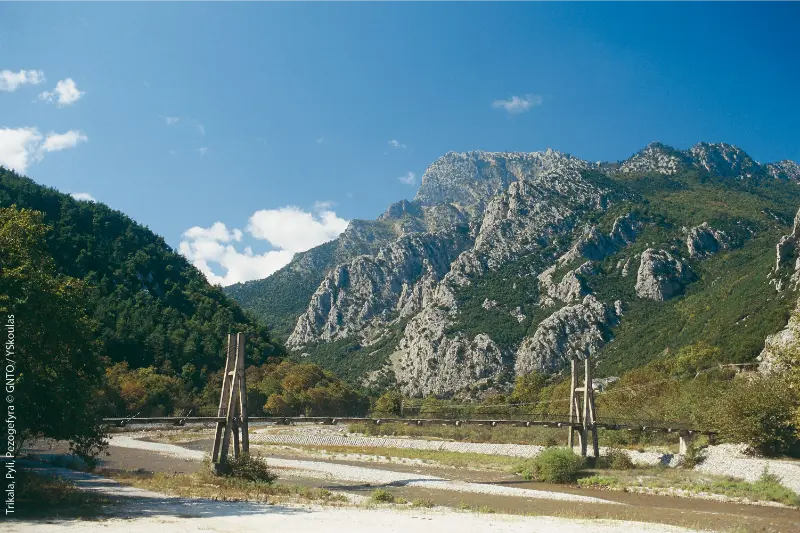
    Trikala Pyli Pezogefyra

    Final advice

    Leave a little unscheduled time in the day. Thessaly is at its best when a planned archaeological stop or village walk can expand into a slow meal, an unexpected viewpoint or a conversation in a square without forcing the rest of the itinerary to become a race.

    \n\n

    For more detailed Thessaly planning, continue with Paleokarya and Ropoto and Mesochora.

    \n
  • Chios Road Trip: A Realistic 7-Day Itinerary for Mastic Villages, Beaches and North Chios

    Chios Road Trip: A Realistic 7-Day Itinerary for Mastic Villages, Beaches and North Chios

    Chios is one of the Greek islands where a road trip genuinely improves the holiday. The south is shaped by mastiha villages, the centre by Byzantine and medieval heritage, the west by coves and sunsets, and the north by mountain settlements and quieter beaches.

    Seven days is enough to see those contrasts without turning every day into a long drive. The itinerary below is deliberately regional: each day stays mostly in one part of the island, and one flexible period is built in for wind, weather or a place you decide to revisit.

    Quick planning summary

    QuestionPractical answer
    Best forfirst-time visitors with a rental car
    Ideal time7 days / 6–7 nights
    Best base4–5 nights Chios Town or Kampos plus 2 nights Volissos or Mesta
    Driving styleregional loops rather than crossing the island repeatedly

    Day 1 – Chios Town and the castle

    Use arrival day for the waterfront, Aplotaria and the inhabited castle. This gives you food, practical orientation and history without committing to a long drive after a flight or ferry. If the Archaeological Museum is still closed for repair, substitute the Maritime Museum, Koraes Library or a longer castle walk.

    For cultural sites, confirm opening hours close to the visit because seasonal schedules, conservation work and religious observances can change access. Modest clothing is appropriate for active churches and monasteries, and sturdy shoes are more useful than sandals on stone steps and uneven ground.

    Day 2 – Kampos and an east-coast swim

    Spend the morning walking or cycling through Kampos, visit the Perivoli citrus museum and have lunch in or near the estates. In the afternoon choose Karfas or Agia Fotini for an easy swim. This day keeps driving minimal and lets you recover before the longer south-island routes.

    For beach planning, check the wind on the day rather than assuming the most famous name will be the most comfortable choice. Chios has enough coastline to switch regions when conditions change. Carry water and shade for remote beaches, and keep valuables simple when you expect to move between swimming and village stops.

    Day 3 – Mastiha Museum, Pyrgi, Olympi and Mesta

    This is the essential south-Chios cultural day. Start with the Mastic Museum, walk Pyrgi’s xysta lanes, pause in Olympi and finish in Mesta. If you love village atmosphere, stay in Mesta; otherwise return to Chios Town after dinner. Do not add Mavra Volia unless you are comfortable shortening one village.

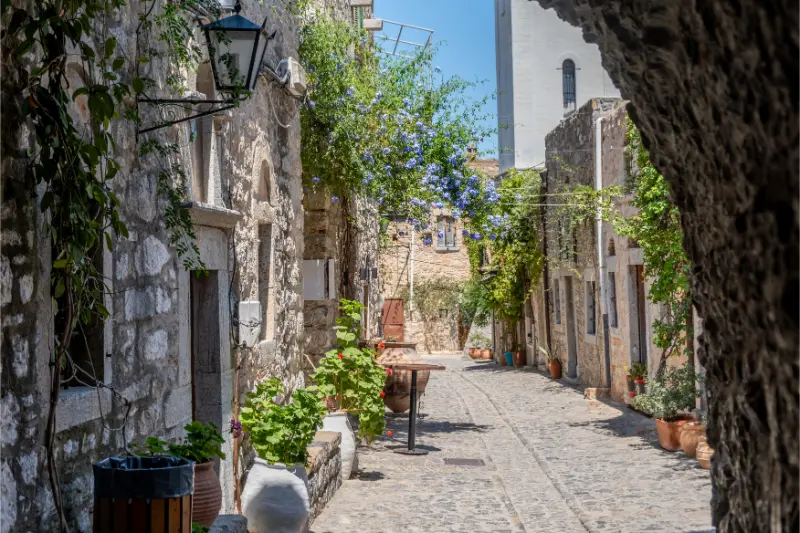
    Narrow Medieval Alley Mesta Village Chios Island Greece

    For cultural sites, confirm opening hours close to the visit because seasonal schedules, conservation work and religious observances can change access. Modest clothing is appropriate for active churches and monasteries, and sturdy shoes are more useful than sandals on stone steps and uneven ground.

    Day 4 – Mavra Volia and the south coast

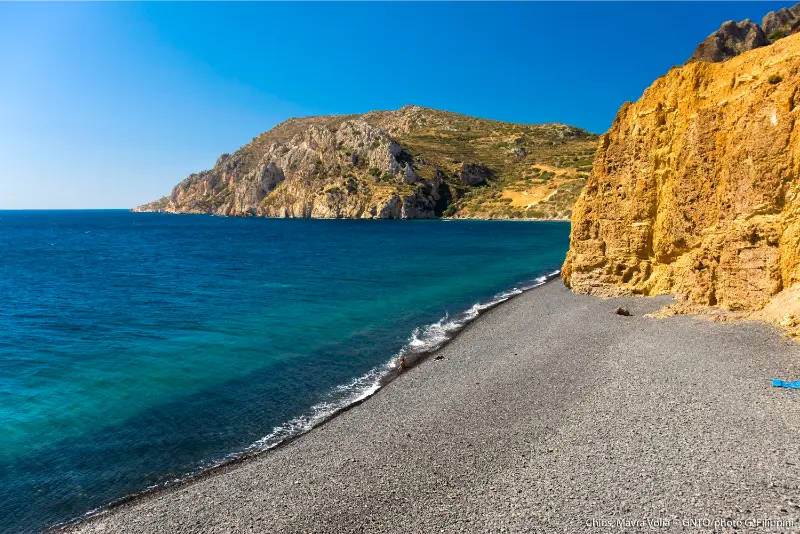
    Make this the beach-focused day. Swim at Mavra Volia early, have lunch at Emporios, then choose Komi, Vroulidia or Kato Fana based on wind and energy. Because the cultural sights were handled yesterday, you can let the sea conditions control the schedule instead of forcing a fixed checklist.

    The practical approach is to keep this stop connected to the surrounding region rather than crossing the island for one item on a checklist. Build the day around nearby villages, food and coastline, then leave enough space for an unplanned coffee, swim or viewpoint when conditions are good.

    Day 5 – Nea Moni, Anavatos and Avgonyma

    Drive into central Chios for Nea Moni, then continue to Anavatos and finish in Avgonyma. If you want a swim, Elinda fits the geography. Sunset dinner in Avgonyma gives the day a natural endpoint. Hikers can replace one driving stop with a marked central-Chios trail.

    For cultural sites, confirm opening hours close to the visit because seasonal schedules, conservation work and religious observances can change access. Modest clothing is appropriate for active churches and monasteries, and sturdy shoes are more useful than sandals on stone steps and uneven ground.

    Day 6 – Volissos and Amani

    Move north-west. Explore Volissos and its castle, then choose beaches or an Amani drive depending on heat. Staying overnight in Volissos is strongly preferable to a late return to town because the region feels best when you are not watching the clock.

    The practical approach is to keep this stop connected to the surrounding region rather than crossing the island for one item on a checklist. Build the day around nearby villages, food and coastline, then leave enough space for an unplanned coffee, swim or viewpoint when conditions are good.

    Day 7 – Flexible north day and return

    Use the final day for Managros, Agiasmata, a Volissos trail or a slow return through the island. If your ferry or flight is same-day, come back toward Chios Town with generous margin. If you depart the following morning, this is the perfect day to leave partially unplanned.

    The practical approach is to keep this stop connected to the surrounding region rather than crossing the island for one item on a checklist. Build the day around nearby villages, food and coastline, then leave enough space for an unplanned coffee, swim or viewpoint when conditions are good.

    How much time should you allow?

    Seven days is the sweet spot for a first Chios road trip; five days requires dropping either the far north or some south-coast detail. Chios is larger and more varied than it looks on a simple island map, and the most enjoyable days usually combine one main cultural area with one beach or meal stop rather than several distant targets. Driving times, village walks and slow lunches add up quickly, so leave enough margin to enjoy what you came to see.

    If you are building a week-long trip, keep at least one flexible half-day. Wind direction can change which beach feels best, a museum or monastery may have seasonal hours, and a village that looks like a thirty-minute stop can easily become the place where you want to stay for lunch. That flexibility is especially valuable on Chios because north, centre and south have very different characters.

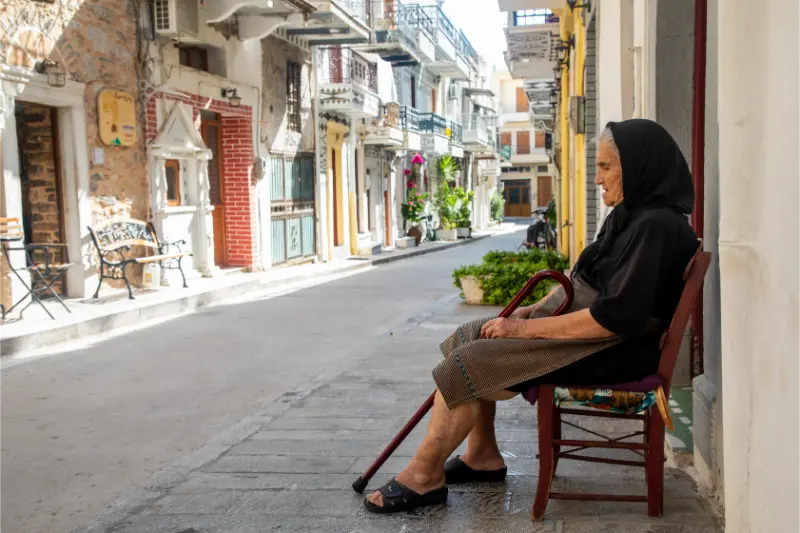
    Chios Greece Street View From Pyrgi Chios Island Geece With Woman Which Sitting Chair

    Getting there and getting around

    Rent a car for the regional loops, but keep the vehicle parked during Chios Town walks and village exploration whenever possible. Chios has an airport close to Chios Town and ferry connections with Piraeus and other Aegean destinations. For a short break, flying can save time; for a longer North Aegean route, ferries can make more sense. Always check the exact service for your dates because frequencies and vessel types change by season.

    A rental car is the easiest way to connect the mastic villages, west-coast viewpoints and northern settlements. If you prefer not to drive, base yourself in Chios Town, use buses for the most useful corridors and book an organised excursion for the south or central villages. Do not assume that every small beach or mountain village has frequent public transport, especially outside July and August.

    Best time to visit

    Late May, June and September are ideal road-trip months because sightseeing temperatures are easier and beach days still fit naturally. May, June and September are particularly comfortable for combining sightseeing with swimming. July and August provide the widest choice of seasonal services but bring stronger heat and more demand. Spring is excellent for walking, flowers and village exploration; autumn can be rewarding for food and slower travel as long as you accept a little more weather uncertainty.

    Whatever the month, plan archaeological sites, castles and exposed village walks for the cooler part of the day. The Aegean wind can make one coast much more comfortable than another, so ask locally before driving across the island purely for a beach. In high summer, carry water and do not rely on shade at remote coves.

    Who this part of Chios suits best

    This route suits couples, friends, solo drivers and families comfortable with road trips; it is less suitable for travellers who dislike driving or changing daily plans. The island rewards travellers who enjoy mixing cultural detail with everyday village life. It is less about rushing from one headline sight to another and more about noticing architecture, food, working landscapes and the relationship between inland settlements and the sea.

    Families can enjoy Chios too, especially with a sensible base and shorter drives, but the island is not uniformly stroller-friendly: medieval lanes, cobbles and steep viewpoints appear often. Couples and solo travellers usually appreciate the freedom to linger in villages, while photographers and food-minded visitors will find material well beyond the classic beach season.

    Olympoi Medieval Village Chios Island Greece Traditional Architecture Narrow Alley Stone Walls Arch

    Budget and booking strategy

    Chios can be good value compared with the most internationally famous Greek islands, but the total cost still depends heavily on transport. A cheaper room far from your planned sights can be false economy if it creates long daily drives. Compare parking, breakfast, beach access and evening dining options as part of the accommodation price rather than looking at the room rate alone.

    In peak summer, reserve well-located accommodation, rental cars and any must-do guided experience earlier. In shoulder season, you can often keep more flexibility, but confirm whether smaller museums, tavernas and beach services are operating on your travel dates. For cultural attractions, always check current hours rather than relying on an old blog post.

    What to pack

    • Shoes with grip for stone lanes, castle paths and uneven archaeological ground.
    • A refillable water bottle, hat and high-SPF sunscreen for exposed summer days.
    • A light layer that covers shoulders and knees for monasteries and churches.
    • Water shoes if you prefer them on Chios’s pebble and volcanic beaches.
    • Offline maps or downloaded route information for rural areas with weaker signal.

    Common mistakes to avoid

    • Treating Chios as a tiny island and planning north and south on the same rushed day.
    • Assuming every museum, monastery or cave follows the same seasonal opening pattern.
    • Choosing a famous beach without checking wind, shade and the needs of your group.
    • Driving long distances for lunch when the village already in front of you has good local food.
    • Leaving fuel, water or return transport decisions until late in the day in quieter areas.

    More Chios guides

    Chios Town Guide: Castle, Museums, Waterfront, Food and Where to Stay; Pyrgi, Mesta and Olympi Chios Guide: Mastic Villages, Xysta, Caves and Medieval Streets; Nea Moni, Anavatos and Avgonyma Chios Guide: UNESCO Monastery, Medieval Villages and Sunset; Kampos Chios Guide: Citrus Estates, Mansions, Cycling and Museum; Volissos and Amani Chios Guide: Castle, Villages, Beaches and North-West Road Trip; Mavra Volia and South Chios Beaches Guide: Emporios, Komi, Vroulidia and Swimming; Chios Mastiha Guide: Museum, Villages, Harvest, Products and What to Buy; Best Beaches in Chios: 15 Beaches for Black Pebbles, Families, Snorkelling and Quiet Coves; Chios Road Trip: A Realistic 7-Day Itinerary for Mastic Villages, Beaches and North Chios; Where to Stay in Chios: Chios Town, Karfas, Mesta, Volissos or South Coast?. Start with the Chios Travel Guide for the island overview.

    Frequently asked questions

    Do I need a car for this Chios trip?

    A car is strongly recommended for most village, beach and north-island itineraries. Chios Town can be explored without one, and organised tours are a useful alternative for the Mastichochoria or central heritage routes.

    How many days should I spend on Chios?

    Five days gives you a useful introduction, but seven is much better for combining the south, centre and north without spending every day in the car. Beach-focused or hiking trips can easily justify longer.

    Is Chios good in September?

    Yes. September often combines warm sea temperatures with easier sightseeing than peak August. Seasonal services are still active in many places, but ferry, bus and attraction schedules should be checked for the exact dates.

    What should I check before leaving the hotel?

    Check wind, heat, current opening hours, fire-risk restrictions if you plan to hike, and return transport if you are not driving. Keep one nearby alternative so a closure or rough sea does not waste the day.

    Can I combine Chios with another North Aegean island?

    Yes when ferry schedules align, especially with Lesvos or Samos, but connections vary by season. Build the route from real timetables rather than assuming geographically nearby islands connect every day.

    Check official information before you go

    For current destination information use the official source for this Chios area or attraction and the official Chios tourism portal. Opening hours, transport and seasonal services can change, so verify the specific detail you need shortly before travel.

    Final planning advice

    Chios is most rewarding when you plan by region and leave room for local decisions. Use the major sights as anchors, not as a race. A village lunch, a sudden change of beach because the wind shifts, or an extra hour in a quiet square can become the part of the trip you remember most.

    If this is your first visit, resist the urge to see the whole island in three days. Chios has enough depth for a week, and the contrast between mastiha country, central Byzantine heritage, the west coast and the north is exactly what makes the island worth exploring slowly.

  • Mount Kissavos Hiking Guide: Spilia, Anatoli, Mountain Refuge and Prophet Elias Summit

    Mount Kissavos Hiking Guide: Spilia, Anatoli, Mountain Refuge and Prophet Elias Summit

    Mount Kissavos, also known as Ossa, rises opposite Olympus above the Vale of Tempe and the Aegean coast of Larissa. Its 1,978-metre summit gives hikers a very different experience from the famous mountain across the valley: forests, village access, a mountain refuge and routes that can be combined with Agia, Spilia, Anatoli or the beaches below.

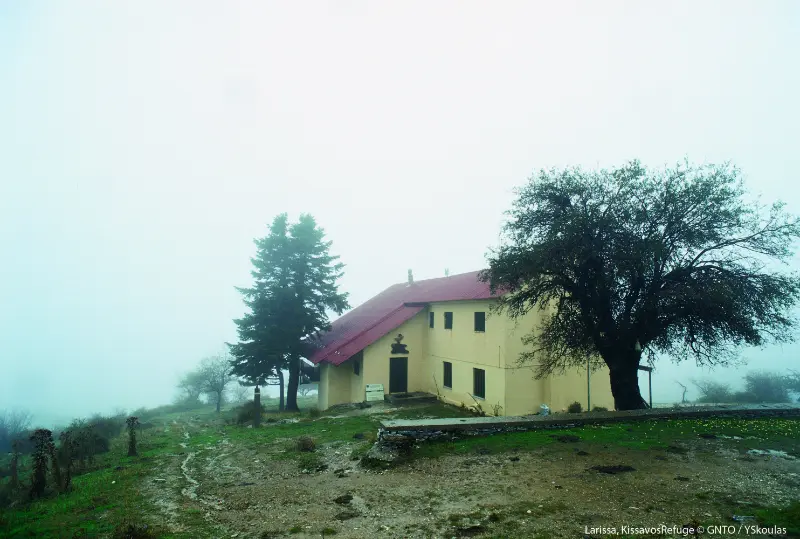
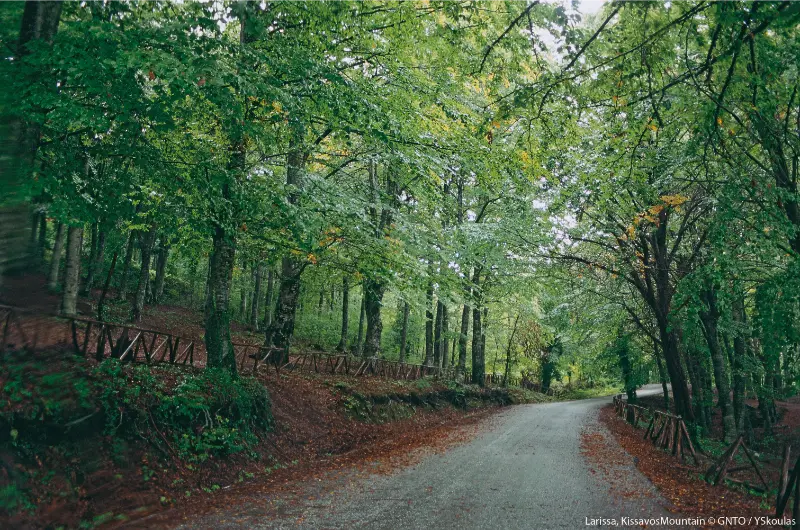
    Larissa Kissavos Mountain

    Kissavos is accessible enough to attract casual outdoor travellers, but the upper mountain still deserves serious respect. A drive close to the refuge can reduce walking distance, yet rough roads, sudden fog, thunderstorms and alpine exposure mean that “short” does not automatically mean “easy.”

    Quick planning summary

    • Summit: Prophet Elias, 1,978 m.
    • Main bases: Spilia on the western side and Anatoli on the southern side.
    • Refuge: the Kissavos Mountain Refuge sits below the summit and is a common starting point for the upper route.
    • Roads: some approaches include dirt sections; check condition and vehicle suitability.
    • Weather: summit conditions can differ sharply from Larissa, Agia or the Aegean coast.

    Understanding the mountain

    Kissavos is heavily forested at lower and middle elevations, while the summit zone becomes more open and alpine. Visit Thessaly describes an Aesthetic Forest of Ossa covering around 20,000 hectares, which helps explain the diversity between beech, fir and chestnut landscapes and the exposed upper slopes.

    The mountain’s position between the Thessalian plain and Aegean produces rapid weather changes. Clouds can form even when Larissa is hot and clear, so check mountain conditions rather than relying on a city forecast.

    Spilia

    Spilia is one of the classic western gateways. Taverns, mountain atmosphere and road access toward the refuge make it a practical place to pause before or after hiking. The village also connects naturally with Ambelakia and Tempe on a multi-day itinerary.

    If you are not summiting, Spilia still works as a destination for forest drives and short walks. Do not feel obliged to reach the top simply because the road gets you high on the mountain.

    Anatoli

    Anatoli sits at about 1,000 metres and provides broad views across the Larissa plain toward Mavrovouni, Pelion and the Aegean. Visit Thessaly highlights its forests, orchards and connection to the Monastery of Saint John the Baptist.

    A rough dirt road continues from the village toward old telecommunications facilities relatively near the summit zone. Road condition matters: ordinary passenger cars and rental agreements may not be suitable, especially after storms.

    The mountain refuge and summit route

    From the refuge area, Visit Thessaly describes the summit as roughly a two-hour relatively straightforward hike under normal conditions. That description assumes suitable weather, basic fitness and competent route finding.

    Carry a map or reliable offline track and do not depend on mobile coverage. If fog closes in, turn around early. The summit plateau can become confusing when visibility disappears because obvious visual reference points vanish.

    Canyoning and advanced activities

    Kissavos and nearby Mavrovouni are also known for canyoning, including Kalypso and Kryoneri. These are technical activities that require appropriate equipment and, for most visitors, a qualified local operator.

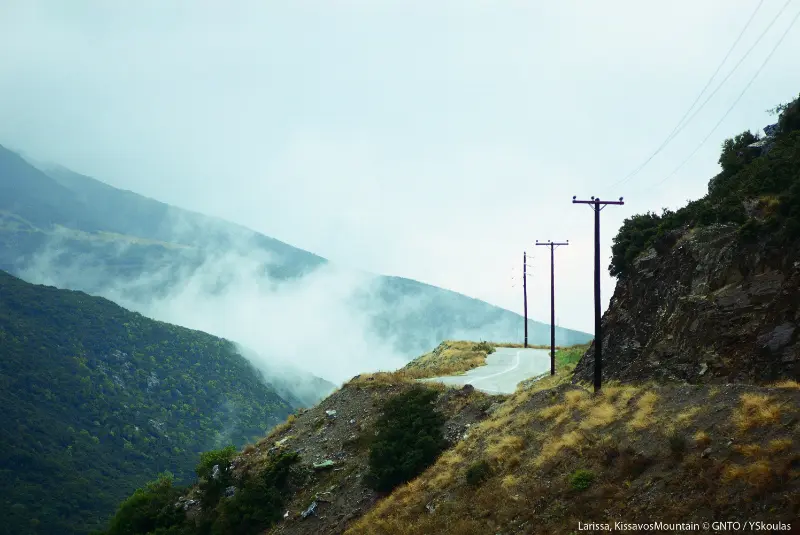
    Larissa Kissavos Mountain

    Do not improvise a canyon descent after seeing photos online. Water flow, anchors and access can change, and jumps that are safe under one water level can be dangerous under another.

    Combining mountain and coast

    One of the joys of eastern Thessaly is the ability to hike on Kissavos and later reach Aegean villages such as Kokkino Nero, Stomio or the Agiokampos coast. This works best over two days, not by rushing from summit to beach.

    After a serious hike, driving winding mountain roads while tired is a real risk. Stay in a village, have a long meal and move to the coast the next morning if the group is fatigued.

    Who should hire a guide?

    A guide is a good investment for winter conditions, unfamiliar high routes, canyoning, families attempting longer hikes or anyone who wants natural-history interpretation rather than simple navigation.

    Independent experienced hikers can manage established summer routes in good weather, but should still leave a route plan with someone and carry layers, water, navigation and basic emergency equipment.

    Where to stay

    Spilia and Anatoli offer mountain-village bases, while Agia provides easier road access and more services. Larissa is practical for a day trip but adds driving at both ends of the hike.

    If you want to combine mountain and sea, spend one night in the mountain zone and another on the Larissa coast instead of commuting repeatedly.

    Getting there and getting around

    A car is the most flexible option. Confirm the final road surface before taking a rental car beyond paved village roads. If the road becomes rougher than your vehicle can safely handle, park legally and continue on foot or change the route.

    In winter, snow equipment and local advice may be essential. Roads near the refuge can be entirely different from those in the plain.

    Best time to visit

    Late spring through early autumn is the usual hiking season, with the important caveat that thunderstorms and heat still matter. Start early in summer.

    Winter and early spring can involve snow, ice and navigation hazards. Treat the mountain as winter terrain when conditions require it, regardless of what the calendar says.

    What to eat and drink

    Spilia is known for tavernas and makes an excellent post-hike meal stop. In Agia and nearby villages you can also find local fruit, pies, meats and cheeses.

    Carry enough water and food for the hike itself. Do not assume springs will always be flowing or safe to drink without treatment.

    Practical safety and responsible travel

    Tell someone your route and expected return. Carry a charged phone, offline map, warm layer, waterproof shell and basic first aid even on a warm day.

    Wildfire restrictions can close forest areas in summer. Thunderstorms on exposed summit terrain are a reason to turn around, not wait under a lone tree.

    A realistic way to plan the visit

    For a first summer hike, sleep near Spilia or Agia, start early, reach the refuge area and assess weather before committing to the summit. Keep a fixed turnaround time.

    After returning, eat in the village and avoid a long night drive. If weather blocks the summit, use a lower forest walk, Anatoli village or Ambelakia instead.

    Experienced hikers can build a longer traverse, but only with transport logistics and route knowledge arranged in advance.

    Choosing a route that matches your real experience

    Route choice on Kissavos should start with the least experienced person in the group. A party that includes a beginner, a child or someone uncomfortable on loose ground should select a lower or shorter objective even if stronger hikers could continue to the summit. Splitting a group on an unfamiliar mountain creates communication and transport problems, so agree on the day’s ceiling before leaving the village.

    Equipment should match elevation, not the temperature in Larissa. A warm plain morning can still mean strong wind and low cloud near 2,000 metres. Carry a waterproof layer, an insulating layer, sun protection, at least one navigation method that works offline and more water than the shortest route seems to require. Trekking poles can help on loose descents, but they do not replace suitable footwear.

    If the summit route is unsuitable, Kissavos still offers excellent alternatives. Forest roads near Spilia, walks around Anatoli, monastery visits and lower viewpoints preserve the character of the mountain without forcing exposure to poor visibility or thunderstorms. This flexibility is especially useful for families and mixed-interest groups, because the day can remain successful even after a summit plan is abandoned.

    Canyoning deserves a separate note because it is sometimes marketed beside hiking. Entering a gorge requires knowledge of water conditions, anchors, rope technique and escape options. Book a qualified operator rather than assuming a hiking background is enough. Heavy rain upstream can change a canyon rapidly even when the weather at the entry point appears acceptable.

    Frequently asked questions

    Is Kissavos easier than Olympus?

    Some common Kissavos routes are shorter and less technical than major Olympus ascents, but mountain weather and navigation still require respect.

    Can I drive to the refuge?

    Road access varies by approach and condition. Dirt sections may be unsuitable for ordinary rental cars, so verify before setting out.

    How high is the summit?

    Prophet Elias reaches 1,978 metres.

    Can beginners hike Kissavos?

    Yes on suitable lower routes and in good weather. Beginners attempting the summit should choose a clear, well-established route and consider a guide.

    Continue planning your Thessaly trip

    Combine the mountain with Agia and Metaxochori, Tempe and Ambelakia and the Larissa Aegean coast.

    Official information to check before you go

    Opening hours, road access, trail conditions and seasonal services can change. Before travelling, verify the latest information with: Visit Thessaly – Kissavos · Visit Thessaly – Anatoli · Visit Thessaly – Canyoning in Kissavos and Mavrovouni.

    Accommodation

    Choose the base that best matches the next day’s route rather than simply the cheapest room. Check accommodation in Agia, Larissa, Greece on Booking.com.

    Final advice

    On Kissavos, the smartest summit decision is often made before the summit is visible. Start early, read the weather and be willing to turn around while the day is still enjoyable.

    \n\n

    For more detailed Thessaly planning, continue with Melivoia and the eastern Kissavos coast.

    \n
  • Where to Stay in Leros: Panteli, Alinda, Agia Marina, Lakki or Vromolithos?

    Where to Stay in Leros: Panteli, Alinda, Agia Marina, Lakki or Vromolithos?

    Choosing where to stay in Leros matters more than choosing the “best hotel” in isolation. A room with a beautiful view can still create a frustrating trip if every dinner requires a car, while a simpler property in Panteli, Alinda or Agia Marina can make the whole holiday easier.

    Marina Of Agìa Marina Leros Island In Dodecanese Greece

    The island is compact, so there is no single area you must use. The goal is to match your base to the trip: Panteli for atmosphere, Alinda for an easy beach routine, Agia Marina and Platanos for central sightseeing, Lakki for ferry logistics and twentieth-century history, or a quieter southern base when you have a car.

    Quick comparison of the best bases

    AreaBest forMain trade-off
    PanteliCouples, evenings, views, compact beach staySlopes and seasonal popularity
    Agia Marina / PlatanosSightseeing, services, central locationLess of a resort feel
    Alinda / KrithoniFamilies, beach routine, relaxed staysMore spread out along the bay
    LakkiFerries, architecture, WWII historyFunctional rather than romantic
    VromolithosBeach stay near PanteliFewer town services at the door
    XirokamposQuiet southern escapeCar or taxis more useful

    Panteli: best for atmosphere and evenings

    Panteli is the easiest choice if you picture a small bay, waterfront tavernas and windmills above you. Couples often prefer it because the evening is built into the location: you can swim, shower and walk to dinner without getting back in the car.

    The trade-off is terrain. Many properties climb the hillside, so a sea view may come with steps. Ask specifically about access if luggage, strollers or mobility are concerns.

    Agia Marina and Platanos: best for central sightseeing

    Choose Agia Marina or Platanos if the castle, everyday town life and practical services matter more than waking directly beside a holiday beach. This is a good base for first-time visitors who want to walk between the central settlements and use taxis for more distant coves.

    Platanos is hillier and more residential; Agia Marina keeps you closer to the water. Staying between them can work very well if you find accommodation with straightforward road access.

    Alinda and Krithoni: best for families and an easy beach routine

    Alinda is my default recommendation for travellers who want the beach to be available without planning. The bay has accommodation and restaurants, while Krithoni gives a smaller-scale alternative closer to Agia Marina. Families benefit from being able to return to the room during the hottest hours.

    The downside is that the area stretches along the coast. Check exactly where the property is relative to the beach, restaurants and current bus stops rather than relying on the general label “Alinda.”

    Lakki: best for ferry logistics, architecture and history

    Lakki is the most practical base for a late arrival, early departure or a trip focused on Italian architecture and WWII history. The ferry port and taxis simplify logistics, and the War Museum sits nearby.

    I would not automatically choose Lakki for a romantic beach week. It is a working harbour town with a unique architectural story. Travellers who value sunset tavernas may prefer Panteli and simply visit Lakki.

    Vromolithos and Xirokampos: when quieter is better

    Vromolithos gives you more of a beach focus while remaining close to Panteli. Xirokampos, farther south, is better for repeat visitors or travellers who deliberately want a quiet base and do not mind driving. These are excellent choices when your priorities are clear, but less forgiving if you expect to walk everywhere.

    Best area by travel style

    • First trip: Panteli or Agia Marina/Platanos.
    • Families: Alinda/Krithoni or Vromolithos after checking beach entry.
    • Couples: Panteli.
    • Without a car: Panteli, Agia Marina/Platanos or Alinda near transport.
    • WWII history and architecture: Lakki.
    • Quiet road-trip stay: Xirokampos or another southern base.
    • Late ferry arrival: Lakki.

    One base or split stay?

    For four or five nights, I would use one base. Leros is compact enough that changing hotels usually creates more work than it saves. A split stay becomes interesting at a week or more if you want two genuinely different moods, such as three nights in Lakki for history followed by four in Panteli or Alinda for beach time.

    Village And Beach Of Panteli Leros Island Greece

    When to go and how to use the day

    Choosing where to stay in Leros works differently by season. In July and August I would put walks, castle visits, museums and exposed viewpoints early in the day, then use the hottest hours for lunch, a shaded rest or swimming. Late afternoon is when the villages and waterfronts become more enjoyable again. May, June, September and early October are easier for travellers who want to combine sightseeing with walking rather than organising the entire day around heat.

    Wind matters on Leros because the coastline is deeply indented. A beach that feels exposed one day may be pleasant the next, while another bay can stay relatively calm. I would keep one flexible afternoon rather than assigning every beach to a fixed date. Pick the area that makes your ordinary morning easy; use taxis or a car for the exceptional day rather than the other way around.

    Transport and realistic pacing

    Ferry logistics favour Lakki, while the central settlements and Alinda reduce the need for daily driving. Always check the real walk from the hotel to beach, dinner and bus stop. The island is not huge, but short map distances do not always mean a quick, flat walk. Hills, summer heat and the shape of the bays make route planning important. If you are relying on buses, confirm the current timetable locally rather than building the day around an old online schedule.

    For most visitors, two substantial experiences plus a good meal and a swim create a better day than five rushed stops. This is especially true around your chosen base, where it is easy to underestimate how much time disappears into viewpoints, photographs, museum rooms and unplanned waterfront breaks.

    What to pack

    • Shoes with useful grip for castle approaches, stone lanes and uneven coastal paths.
    • A refillable water bottle; exposed hills and quieter beaches may have limited services.
    • High-SPF sunscreen, a hat and a light shoulder cover for strong summer sun.
    • Swim shoes if you prefer them for pebble or mixed-surface beaches.
    • A light layer for breezy evenings and boat rides outside peak summer.
    • Offline maps or saved pins if your plan includes minor roads, remote coves or walking routes.

    Who this plan suits best

    It suits every travel style once the base matches the trip; the main mistake is choosing purely by room view and ignoring hills, road access and evening logistics. Leros rewards travellers who leave space in the schedule. The island is not about racing between a long list of blockbuster sights; its appeal comes from the combination of small bays, layered twentieth-century history, low-key villages and evenings that still feel local.

    Common mistakes to avoid

    • Treating every beach as equally sheltered regardless of wind direction.
    • Assuming a short distance on the map is automatically an easy walk in midday heat.
    • Using old museum or bus hours without checking them again for the current season.
    • Planning only beaches and missing the island’s unusually important Italian and Second World War heritage.
    • Changing accommodation unnecessarily on a short stay instead of using one practical base.
    • Trying to fit a museum, a castle, a remote beach and a long dinner into one tightly timed afternoon.

    How I would make the plan more reliable

    The most useful way to plan where to stay in Leros is to separate fixed commitments from flexible ones. A museum opening time or ferry departure is fixed; a swim, café stop or sunset viewpoint is flexible. Put the fixed element first, then keep the beach or meal that follows adjustable. This prevents a small timetable change from collapsing the entire day.

    I would also avoid judging travel time from distance alone. Leros has bays, hills and narrow roads, and a route that looks very short can include parking, a climb or a wait for a taxi. Add buffer time, especially when you have a ferry later that day. On a holiday this small adjustment is more valuable than adding one extra attraction.

    Finally, use local conditions as information rather than an inconvenience. If wind makes your planned beach uncomfortable, switch bay. If the castle is closed, spend longer in the villages and return another morning. If a museum hour changes, move the swim forward. Leros works best when the itinerary responds to the island instead of trying to force the island to follow a spreadsheet.

    Budget and booking notes

    Leros is generally easier to manage financially than islands dominated by luxury resorts, but summer accommodation and transport still reward early planning. Book the room that solves the most daily problems: walkable dinner, acceptable beach access, manageable steps and a sensible route from the ferry. Spending slightly more on the right base can save repeated taxi fares and wasted time.

    For tours and activities, compare the cancellation terms, exact meeting point and whether transport is included. For independent days, keep small cash available for local services that may not fit a fully digital routine. Prices and opening periods change, so treat any old blog total as a reference rather than a promise.

    Accessibility and slower travel

    Travellers with limited mobility should ask unusually specific questions on Leros: number of steps from the road to the room, whether the restaurant route is level, where a taxi can actually stop and whether a beach has a stable entry. Historic lanes and hillside accommodation can be beautiful but demanding. A well-chosen base and a few taxi transfers can make the same island much easier.

    Slow travel also improves the experience for everyone else. Staying longer in one bay, returning to the same taverna and walking a village twice at different times of day reveals more than a fast island checklist. Leros has enough detail for this approach, especially when history, swimming and local life are all part of the reason you came.

    Continue planning Leros

    Start with the Leros Travel Guide for the island-wide overview, then use these dedicated guides: Agia Marina, Platanos and Panteli Leros Guide; Lakki Leros Guide; Leros War Museum and WWII Guide; Alinda and Krithoni Leros Guide; Best Beaches in Leros; Leros Diving Guide; Leros Hiking Guide; Leros Without a Car; Leros with Kids.

    Village Of Agia Marina On Leros Island In Greece

    Where to Stay in Leros FAQ

    What is the best area for a first trip to Leros?

    Panteli is the easiest all-round choice for atmosphere, while Agia Marina/Platanos is stronger for sightseeing and services. Alinda is best if beach convenience dominates.

    Where should families stay?

    Alinda and Krithoni are strong family bases because beach time is easy to build into the day. Vromolithos can also work well near Panteli.

    Where is best without a car?

    Panteli, Agia Marina/Platanos and central Alinda are the safest choices, provided your accommodation is near the routes and services you intend to use.

    Is Lakki a good place to stay?

    Yes for ferry convenience, architecture and WWII history. It is less suited to travellers whose main priority is a romantic beach atmosphere.

    Should I split my stay?

    Usually not for four or five nights. With a week or more, a short Lakki plus Panteli/Alinda split can create two different moods.

    Useful official information

    For current local information I check the Municipality of Leros and Visit Greece – Leros. Before booking, verify the current ferry arrival port, local transport and any seasonal road or service changes that affect your chosen base. Opening hours, local transport, boat services and seasonal businesses can change, so recheck anything time-sensitive shortly before the day you plan to use it.

  • Kos Travel Guide: Beaches, Ancient Sites, Cycling and a 5-Day Itinerary

    Kos Travel Guide: Beaches, Ancient Sites, Cycling and a 5-Day Itinerary

    Kos is one of the most versatile islands in the Dodecanese. It combines a lively main town, long beaches, archaeological sites, mountain villages and unusually good conditions for cycling. Unlike smaller islands where one village dominates the trip, Kos gives you several possible bases and enough variety for a full week without feeling repetitive.

    The island is associated with Hippocrates, the ancient physician, and history appears throughout the landscape. At the same time, this is an easy beach destination with organized resorts and family-friendly stretches of sand. That combination makes Kos a strong first Greek island for travellers who want more than one type of holiday.

    Kos Town: the best first base for many travellers

    Kos Town mixes harbour life, archaeological remains, bike lanes, cafés and restaurants. You can move between ancient ruins and modern streets within minutes, then cycle along the waterfront in the evening. The Castle of the Knights dominates the harbour area, while traces of ancient and Roman Kos appear around the centre.

    Staying here works well without a car. You have the widest choice of transport, boat trips and restaurants, and the town is lively enough for evening walks without needing a resort entertainment program.

    The Asklepieion

    The Asklepieion is the island’s most important archaeological site and is traditionally connected with the medical legacy of Hippocrates. It sits on terraces above Kos Town with views toward the coast. The setting is part of the experience, so give yourself time to walk through the levels rather than treating it as a quick stop.

    Visit earlier in the day in summer and bring water. Opening hours and ticket prices for archaeological sites can change seasonally, so confirm official information before travel.

    Cycling is genuinely useful here

    Kos has a strong cycling culture, and the flatter terrain around Kos Town makes bikes practical rather than purely recreational. Dedicated paths cover significant parts of the urban and coastal area. For short distances, a bicycle can be more enjoyable than repeatedly using taxis.

    Choose a properly maintained bike, use lights when needed and remember that not every road on the island has dedicated cycling infrastructure. Families should select protected or low-traffic routes rather than assuming the entire island is equally bike-friendly.

    Tigaki and Marmari

    Northwest of Kos Town, Tigaki and Marmari are popular for long sandy beaches and resort accommodation. They are good choices for families and travellers who want easy beach access every day while remaining close enough to visit the capital.

    The shoreline can be breezy, which feels refreshing in summer but may create choppier conditions on certain days. Check local conditions before planning water sports with children.

    Kefalos and the southwest

    Kefalos lies on the opposite side of the island and gives access to some of Kos’s most attractive beaches and a different atmosphere from the capital. The village sits above the coast, while Kamari and nearby beach areas provide accommodation and tavernas by the sea.

    Beach Kefalos With Sea Resort Greece Island Kos

    This side works well for travellers who plan to rent a car and prioritize beaches. The trade-off is longer travel to Kos Town, so decide whether you want to split your stay or make day trips.

    Agios Stefanos and island views

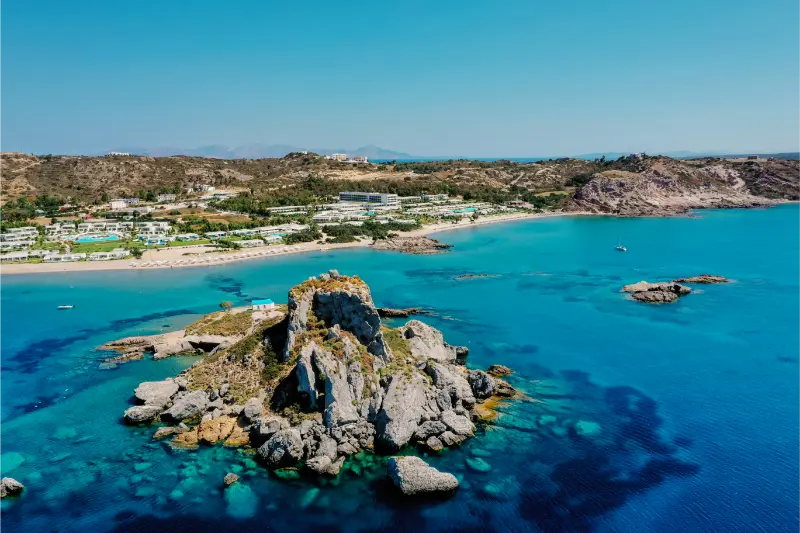
    Agios Stefanos is one of the most photogenic beach-and-history combinations on Kos, with ruins near the shore and views toward the small islet of Kastri. It is a good example of why Kos feels varied: the island rarely forces you to choose between swimming and sightseeing on the same day.

    Arrive outside peak hours if you want a quieter experience, and respect archaeological remains rather than treating them as beach furniture.

    Zia and the mountain interior

    Zia is a well-known village on the slopes of Mount Dikeos and attracts visitors for sunset, food and views. It can become busy in the evening, particularly when organized excursions arrive. The village is still worth seeing, but I prefer to arrive earlier, walk beyond the main souvenir streets and stay after some groups leave.

    A drive through the interior reveals a greener and more rural side of Kos than the beach-resort strip. Combine Zia with nearby villages rather than making a long journey for sunset alone.

    Therma and natural hot water

    On the southeastern coast, Therma is known for warm thermal water mixing with the sea in a rocky cove. Conditions and access can change after storms or road works, so check locally before making a special trip. The experience is very different from a formal spa: expect a natural coastal setting, uneven ground and seasonal variation.

    Visit with suitable footwear and avoid overcrowding the hottest area. If you have medical concerns related to heat or mineral water, seek appropriate advice rather than assuming every thermal pool is suitable for everyone.

    Where to stay

    **Kos Town** is best for first-time visitors without a car, nightlife and cultural sights. **Tigaki** and **Marmari** suit families and beach-focused travellers. **Kardamena** has a stronger resort and nightlife atmosphere on the south coast. **Kefalos** works for quieter beach days and road-trip exploration.

    For a five-night trip, I would usually choose one base rather than moving hotels. For seven to ten nights, splitting between Kos Town and the southwest can make the island feel more varied.

    Do you need a car?

    Not for the entire trip. Buses connect the main settlements, and cycling handles many local journeys around Kos Town. A rental car becomes valuable if you want to explore the interior, Kefalos, isolated beaches and villages on your own schedule.

    Kardamena Kos Greece

    If you rent, plan one or two full exploration days rather than paying for a vehicle that sits unused while you relax on the beach. For general advice, see my guide to transport in Greece.

    Boat trips and nearby islands

    Kos Town and other ports offer excursions to nearby islands and coastal areas, with routes varying by season. Boat trips can be fun, but read the itinerary carefully: some tours spend more time in transit than swimming. Small-group options often provide a calmer experience than large party boats.

    If island hopping is part of your holiday, check scheduled ferries separately from day tours. Excursion boats and public ferries serve different purposes.

    A five-day Kos itinerary

    Day 1: Kos Town

    Explore the harbour, central archaeological areas and old streets. Rent bikes for a short waterfront ride, then have dinner in town.

    Day 2: Asklepieion and inland villages

    Visit the Asklepieion early. Continue toward the interior and Zia later in the day. Stop in smaller villages rather than driving directly back.

    Day 3: Tigaki or Marmari

    Make this a simple beach day. If you are staying in Kos Town, cycle part of the route only if conditions and distance suit you; otherwise use a bus or car.

    Day 4: Kefalos and southwest beaches

    Drive or use a suitable transfer to explore Agios Stefanos and the Kefalos area. Stay for dinner before returning if you are comfortable with the journey after dark.

    Day 5: boat trip or Therma

    Choose a boat excursion if you want another island perspective, or spend a slower day visiting Therma and a nearby beach. Keep the final hours flexible around your flight or ferry.

    Kos with children

    Kos is one of the easier Greek islands for families because it offers long beaches, flat cycling areas and a range of accommodation styles. The challenge is summer heat at archaeological sites, so schedule culture early and swimming later.

    Tigaki and Marmari are obvious family bases, but Kos Town also works well for older children who enjoy bikes, boats and evening walks. Check beach depth and wind conditions each day rather than relying on a general description.

    Food to look for

    Kos has traditional Dodecanese and island cooking alongside international resort menus. Seek out local cheeses, honey, simple grilled dishes and seasonal vegetables. In the villages, lunch can be a good reason to slow down instead of rushing between viewpoints.

    Dodecanese Kos Kamari

    As always in busy tourist areas, compare menus before sitting at a prime waterfront table. A sea view is pleasant, but it is not automatically a sign of the best kitchen.

    Best time to visit

    May, June and September are excellent for sightseeing and beach time with lower heat than peak summer. July and August provide the liveliest resort atmosphere and warmest evenings but also the highest demand. April and October can be attractive for cycling and culture, though beach weather and seasonal services are less predictable.

    Kos versus Rhodes

    Kos feels flatter, easier for cycling and generally more compact for a mixed beach-and-history holiday. Rhodes has a larger UNESCO-listed medieval city and a broader range of monumental sights. Both work well for families and first-time visitors. Compare my Rhodes travel guide before choosing.

    Common mistakes

    • Staying in a resort and never seeing Kos Town or the interior.
    • Renting a car for the entire week when you only need it for two days.
    • Visiting archaeological sites at midday in extreme summer heat.
    • Assuming every cycling route is separated from traffic.
    • Planning a day trip without checking how much time the boat actually spends at each stop.

    Frequently asked questions

    How many days do you need in Kos?

    Five days gives a strong overview. A week is better for families and travellers who want several pure beach days.

    Is Kos good without a car?

    Yes, especially if you stay in Kos Town or a well-connected resort. A car adds flexibility for the southwest and inland villages.

    Is Kos mostly a resort island?

    No. Resorts are important, but archaeology, villages, cycling and the capital give the island a much broader identity.

    Which area is best for first-time visitors?

    Kos Town is the easiest all-round base. Beach-focused families may prefer Tigaki or Marmari.

    Why Kos works for so many travellers

    Kos does not ask you to build the holiday around one signature sight. You can cycle in the morning, visit ancient ruins before lunch, swim in the afternoon and eat in a mountain village at sunset. That flexibility is its greatest strength, especially for groups or families whose members do not all want the same kind of day.

    More detailed Dodecanese guides

    Continue with Kos Town; Asklepieion of Kos; Nisyros for more detailed planning.

    More in-depth Kos guides

    Continue planning Kos with Tigaki and Marmari Kos Guide; Kefalos and Kamari Kos Guide; Kardamena Kos Guide; Zia and Mount Dikeos Kos Guide; Therma Beach Kos Guide; Kos Cycling Guide; Best Beaches in Kos; Kos Without a Car; Kos with Kids; Where to Stay in Kos.

    Related itinerary: Kos, Nisyros and Kalymnos in 10 Days: Dodecanese Island-Hopping Itinerary.

  • Nydri Lefkada Guide: Dimosari Waterfalls, Boat Trips and a 3-Day Stay

    Nydri Lefkada Guide: Dimosari Waterfalls, Boat Trips and a 3-Day Stay

    Nydri is one of Lefkada’s busiest bases, but its value is not only convenience. It sits opposite the small islands and sheltered eastern waters, making it a natural hub for boat trips, sailing and water sports. A few kilometres inland, the Dimosari Gorge and waterfalls offer a green counterpoint to the waterfront.

    Nydri Or Nidri On Coast Eastern Of Island Of Lefkada In Greece

    I would choose Nydri if your priorities are easy excursions, evening activity and access to the east side of Lefkada. If your dream is mostly Porto Katsiki and Egremni, another base may reduce driving. Use the Lefkada Travel Guide for island-wide planning and the Vasiliki guide for the south-coast windsurfing alternative.

    Where this fits in your Greece itinerary

    For wider planning, continue with Lefkada Travel Guide; Vasiliki Guide. I use these pages together so the day-level advice stays connected to a realistic island route rather than becoming an isolated list of attractions.

    What makes this experience worth your time

    Walk to Dimosari Waterfalls

    The Dimosari Gorge is one of the easiest ways to add a nature walk to a beach holiday. Visit Greece describes a relatively easy route of roughly 20–30 minutes from the parking area, with the larger waterfall around 12 metres high. Water levels vary through the season, so do not expect the same flow in late summer as in spring.

    My practical approach is to give this stop enough time to absorb the setting rather than treating it as another pin to clear. I look at heat, parking, walking surface and the next drive before deciding how long to stay. That simple check prevents a beautiful place from becoming the stressful middle of an overfilled day.

    Use Nydri for island boat trips

    The sheltered eastern side is ideal for excursions toward the nearby islets and Meganisi. Compare routes, vessel size, swim stops and total duration instead of choosing only by price. A smaller boat may feel more relaxed, while larger day cruises often cover more places but follow a tighter timetable.

    My practical approach is to give this stop enough time to absorb the setting rather than treating it as another pin to clear. I look at heat, parking, walking surface and the next drive before deciding how long to stay. That simple check prevents a beautiful place from becoming the stressful middle of an overfilled day.

    Try water sports selectively

    Nydri has organised water-sports options, including water skiing and other activities. The important part is matching the activity to your ability and the day’s conditions. Use reputable operators, listen to safety instructions and do not assume calm-looking water means there is no wind or boat traffic.

    My practical approach is to give this stop enough time to absorb the setting rather than treating it as another pin to clear. I look at heat, parking, walking surface and the next drive before deciding how long to stay. That simple check prevents a beautiful place from becoming the stressful middle of an overfilled day.

    Enjoy the east-coast evening atmosphere

    Nydri becomes busier after beach hours. The waterfront is lively, with restaurants, excursion desks and boats returning to harbour. If you prefer quiet, stay a little outside the centre and walk in for dinner. If you enjoy energy and convenience, the centre is exactly the point.

    My practical approach is to give this stop enough time to absorb the setting rather than treating it as another pin to clear. I look at heat, parking, walking surface and the next drive before deciding how long to stay. That simple check prevents a beautiful place from becoming the stressful middle of an overfilled day.

    Use Nydri as a launch point, not a prison

    It is tempting to book every day from the same harbour, but Lefkada deserves road time too. Set aside at least one day for the west or south coast so the trip is not limited to organised excursions.

    My practical approach is to give this stop enough time to absorb the setting rather than treating it as another pin to clear. I look at heat, parking, walking surface and the next drive before deciding how long to stay. That simple check prevents a beautiful place from becoming the stressful middle of an overfilled day.

    Keep one weather-flexible day

    Boat trips depend on conditions, while the waterfall walk can be more pleasant on a cloudy or cooler morning. By not pre-booking every day, you can move the sea excursion to the calmest forecast and use the other day for inland or road-trip activities.

    My practical approach is to give this stop enough time to absorb the setting rather than treating it as another pin to clear. I look at heat, parking, walking surface and the next drive before deciding how long to stay. That simple check prevents a beautiful place from becoming the stressful middle of an overfilled day.

    Planning and getting around

    Nydri is easy to reach by road from Lefkada Town. Central parking can be busy in summer, so check accommodation parking before arrival. For Dimosari, drive toward the gorge parking area and continue on foot. The trail is not technically difficult, but shoes with grip are better than smooth beach sandals. For boat trips, confirm departure time and return time the day before and ask what is included.

    Resort Of Nydri On Coast Eastern Of Lefkada Island In Greece

    Before leaving, save the exact parking or departure point offline and confirm any ticket, ferry or archaeological schedule that matters to the day. Island travel is forgiving when you build in buffers, but it becomes fragile when one late boat or full car park affects every later reservation.

    A realistic itinerary

    This is the pacing I would use on a first visit. It keeps one main objective in each part of the day and leaves enough room for meals, weather and unexpected stops.

    • Day 1: arrive, walk the waterfront and settle into the town rhythm.
    • Day 2: take a full or half-day boat excursion toward Meganisi or nearby islands, depending on conditions.
    • Day 3: visit Dimosari Waterfalls early, then spend the afternoon on a nearby beach or drive toward another part of Lefkada.

    Best time to go

    June and September give a good balance of active boat schedules and manageable crowds. July and August are busiest and hottest. Spring is particularly good for the waterfall because water flow can be stronger, although sea activities are more weather-dependent.

    Wind matters throughout the Ionian even though the region often feels more sheltered than the Cyclades. For boats, exposed viewpoints and mountain roads, check the same-day forecast rather than relying only on a general weekly icon. In shoulder season, also verify whether seasonal businesses and transport are operating on your exact dates.

    Food and the rhythm of the day

    The waterfront has plenty of choice, but walk one or two streets back before deciding where to eat. Grilled fish, local Lefkada salami, vegetable dishes and simple meze suit the setting. If you are taking an early boat, keep breakfast light and bring water rather than relying entirely on onboard service.

    I normally place the longest drive or hike before the main meal, then slow the schedule down. This is safer if you are driving and also makes the afternoon more enjoyable. A local lunch followed by one nearby stop usually creates a better day than eating quickly and crossing the island again.

    Small details that improve the visit

    Waterfall photography depends on season. Long-exposure images look better when flow is stronger, but late summer may produce much less water. Do not climb wet rocks or step into closed areas to improve a composition. The easiest safe viewpoint is usually enough.

    If you are prone to seasickness, choose a shorter excursion, sit where the operator recommends and avoid a heavy breakfast. The sheltered east coast is often calmer than exposed western waters, but no boat route is guaranteed to be smooth. A flexible booking policy is worth more than saving a few euros.

    Practical mistakes to avoid

    • Expecting strong waterfall flow in every month
    • Booking every boat day before checking weather
    • Choosing Nydri for a quiet isolated holiday
    • Ignoring parking arrangements
    • Using Nydri only for excursions and never exploring inland Lefkada
    • Doing the gorge walk in slippery beach footwear

    The pattern behind most of these mistakes is overplanning. The Ionian Islands are easy to underestimate because road distances look short and the sea is often calm, but parking, narrow roads, boat timings and heat can still consume time. Plan around one or two strong experiences per day and let the rest stay optional.

    Accessibility, families and comfort

    Accessibility varies widely between old towns, fortresses, mountain trails and boat landings. Stone steps, uneven paths and limited shade can matter more than the distance shown online. Travellers with reduced mobility should contact the specific site, operator or accommodation for current access details. Families should prioritise shade, toilets, safe parking and realistic transfer times rather than assuming every famous stop has full infrastructure.

    Responsible travel

    Stay on marked routes, respect temporary closures and never remove archaeological, geological or natural material. Keep noise low in villages and religious spaces, avoid blocking residents with parked cars and give wildlife a wide buffer. On beaches and boats, take every item you brought with you back out. Small island communities and sensitive coastal environments absorb visitor pressure quickly, so basic behaviour has a visible effect.

    Frequently asked questions

    How many days do I need in Nydri?

    Three days is a useful minimum if you want a boat trip, the waterfalls and time for the waterfront.

    If this point is central to your trip, confirm the latest local information shortly before travel because seasonal services and access conditions can change.

    How long is the Dimosari waterfall walk?

    The final walk from the access area is relatively short and generally low in technical difficulty, though conditions vary.

    If this point is central to your trip, confirm the latest local information shortly before travel because seasonal services and access conditions can change.

    Is Nydri good without a car?

    Yes for local activities and boat trips, but a car is useful for exploring the rest of Lefkada.

    Lighthouse Cliff Seascape Cape Lefkatas With Old Lighthouse Lefkada Island Greece Views Azure Sea Water Nature With Cliffs

    If this point is central to your trip, confirm the latest local information shortly before travel because seasonal services and access conditions can change.

    Is Nydri very busy?

    It is one of the island’s livelier bases, especially in July and August.

    If this point is central to your trip, confirm the latest local information shortly before travel because seasonal services and access conditions can change.

    Can I combine Nydri with Meganisi?

    Yes. It is one of the most natural bases for trips toward Meganisi and the nearby islets.

    If this point is central to your trip, confirm the latest local information shortly before travel because seasonal services and access conditions can change.

    Check current information before your visit

    For official destination background and current information, see Visit Greece – Dimosari Gorge. I recommend checking opening hours, ferry schedules, weather and temporary access restrictions again shortly before the trip rather than relying on an old screenshot or last year’s timetable.

    Final thoughts

    The strongest Ionian itineraries are not the ones that cover the most kilometres. They combine coast, landscape and local life without forcing every famous stop into the same day. Give the main experience time to breathe, keep one backup plan for weather and leave a little room for an unplanned swim, meal or village stop. That is usually where the trip starts to feel like your own rather than a checklist copied from everyone else.

    More Lefkada in-depth guides

    Continue planning Lefkada with Meganisi from Lefkada; Lefkada Without a Car; Lefkada with Kids; Where to Stay in Lefkada; Sivota and Mikros Gialos.

  • Crete Road Trip: A Realistic 10-Day Itinerary from Chania to Heraklion

    Crete Road Trip: A Realistic 10-Day Itinerary from Chania to Heraklion

    Crete is large enough that a road trip makes more sense than trying to see the island from one hotel. The route I would recommend for a first 10-day trip is not a race from beach to beach; it is a sequence of three bases—Chania, Rethymno and Heraklion—with one or two carefully chosen excursions from each. That keeps packing manageable while still showing how different western, central and northern Crete can feel.

    This itinerary builds on the individual guides to Chania, Rethymno and Heraklion. If you only have seven days, use the general Crete guide and cut one base rather than compressing the same route into shorter stays.

    The route at a glance

    DaysBaseMain focus
    Days 1–4ChaniaOld town, western beach, mountain/village day
    Days 5–6RethymnoOld town, beach, Arkadi or inland Crete
    Days 7–10Heraklion / central CreteKnossos, museum, wine country or south coast

    Should you rent a car for all 10 days?

    Not necessarily. Chania, Rethymno and Heraklion are walkable once you reach the centre, and parking can be annoying. A smart strategy is to rent the car for the excursion-heavy middle of the trip or pick it up after your first city day.

    If you do keep the car throughout, choose hotels with clear parking instructions. Do not assume an old-town property has vehicle access just because a booking site displays a parking icon. Confirm whether parking is private, public, paid or several hundred metres away.

    Days 1–4: Chania and western Crete

    Use the first afternoon for Chania’s harbour and old town rather than driving immediately after arrival. On Day 2, choose one major western beach such as Falassarna. On Day 3, choose either Elafonissi or Balos; trying to combine the famous beaches turns the day into transport.

    Day 4 is your flexibility day. Hike if conditions and fitness suit you, visit mountain villages, or simply stay in Chania and Nea Chora. Keeping one unscheduled day is what prevents the itinerary from feeling like a tour bus timetable.

    Monastery Agia Triada Tsagaroli Chania Region Island Crete Greece

    Days 5–6: Rethymno

    The drive from Chania to Rethymno is short enough that you can stop for lunch or a beach, but I would still avoid overloading transfer day. Check in, walk the old town and see the Fortezza in cooler afternoon light.

    Use the second day for Arkadi Monastery, villages or a south-coast route. If your trip is primarily about beaches, replace the inland day with a full seaside day. The advantage of Rethymno is the ability to switch between culture and beach with very little effort.

    Days 7–10: Heraklion and central Crete

    Drive east and settle into Heraklion for the history-heavy part of the trip. Give Knossos an early start and pair it with the Archaeological Museum after lunch. Another day can go south toward Matala or into wine country.

    Crete Heraklion Knossos

    The final full day should be deliberately light if you have an early flight or ferry next morning. Use it for a city walk, shopping, the harbour or one nearby excursion rather than a long cross-island drive.

    Driving realities in Crete

    Main northern roads are straightforward by Greek-island standards, but side roads can become narrow, steep or slow. Distances to south-coast beaches often involve mountain crossings. Google Maps may estimate a time that assumes continuous driving; real trips include viewpoints, goats, villages, fuel and finding parking.

    I avoid planning more than one long drive per day. The driver also deserves a holiday, and Crete is much more enjoyable when you can stop for lunch without calculating whether you are already late for the next attraction.

    Fuel, parking and rental-car checks

    Photograph the car at collection, understand the fuel policy, check the spare tyre or repair kit, and ask what roads are excluded by the rental agreement. Some access roads to beaches can be rough, and insurance may not cover every surface.

    In cities, use larger peripheral parking areas rather than trying to push into old-town lanes. In beach areas, arrive earlier than peak time when parking is limited, and never block access roads used by residents or emergency vehicles.

    How to adapt the route for families

    With children, I would use three or four nights per base and reduce long beach missions. Chania plus Rethymno is already a complete family holiday. If you include Heraklion, make Knossos a shorter visit and use the museum as the cooler, easier part of the history day.

    A pool can be valuable on a road trip because it gives the family a low-effort activity after a drive. Laundry facilities are also more useful than they sound on a 10-day trip.

    How to adapt the route for couples

    Couples can choose smaller old-town hotels and spend more time on restaurants, villages and sunset stops. I would trade one famous beach for a slow inland lunch or winery visit. The route becomes more romantic when it contains space, not when every day has the maximum number of pins.

    How I would plan the trip before booking

    For a 10-day Crete road trip, I would book the trip in this order: decide how many nights you genuinely have, choose three bases rather than one hotel for the entire island, check the transport that controls your arrival and departure, and only then reserve day trips. This order matters because attractive hotel prices can tempt you into a base that creates unnecessary driving, transfers or early-morning stress. A good location often saves more holiday time than a slightly cheaper room.

    The transport question is especially important here: drive during daylight when possible, keep mountain and beach roads to one major outing per day, and verify rental restrictions before using rough access tracks. I would keep the first and final day lighter than the middle of the trip. That leaves space for delayed flights or ferries, heat, wind, children needing a slower morning, or simply discovering a place you want to stay longer.

    For seasonality, May, June, September and early October are ideal for combining driving, beaches and sightseeing; in July and August, start excursions earlier and book cars well ahead. I also avoid building a plan in which every day depends on perfect beach weather. A museum, old town, village, food stop or short scenic walk gives the itinerary resilience when conditions change.

    Who will enjoy this destination most?

    a 10-day Crete road trip works best for travellers who like a mixture of sightseeing and unstructured time rather than rushing between checklist attractions. It rewards mornings that start early, a long lunch or coffee break, and evenings close to the accommodation rather than another long transfer.

    For families, build in pool or beach downtime after transfer days and avoid making every “must-see” beach compulsory. Couples can make the trip more relaxed by staying somewhere walkable for dinner. Solo travellers generally benefit from central bases and public transport connections. Road-trippers should check parking before choosing accommodation, because a beautiful historic centre can be inconvenient with a car.

    If you are combining this stop with another part of Greece, compare the pacing with the broader Greece itinerary guide. One of the biggest mistakes in Greece is treating a short transfer on a map as a short travel day; ferry check-in, port access, parking, waiting time and mountain roads all add invisible hours.

    Port Agia Galini Crete Greece

    Small details that make the trip easier

    I keep a small offline map on my phone, carry water in warm months, save the exact accommodation entrance rather than only the property name, and photograph parking or bus-stop information when I arrive. These tiny habits are more useful than a minute-by-minute itinerary.

    Comfortable shoes matter in Greece more often than visitors expect. Polished stone, steps, uneven lanes and archaeological ground are common. Sun protection, a light layer for wind or air-conditioned transport, and a reusable bottle cover most day-to-day needs. At religious sites, modest clothing may be required, so it is useful to carry something that covers shoulders or knees.

    Finally, leave one block of two or three hours completely unscheduled. The most memorable part of a trip is often the bakery you did not plan, a swim that lasts longer than expected, a village square at dusk or a viewpoint found on the way back to the hotel.

    Frequently asked questions

    Can you road-trip all of Crete in 10 days?

    You can cross a large part of the island, but trying to include every region creates too much driving. This route intentionally focuses on western and central Crete. Eastern Crete deserves another trip or a longer itinerary.

    Is seven days enough?

    Yes if you use two bases. For example, Chania for four nights and Heraklion or Rethymno for three. Cutting a base is better than reducing every stay to one or two nights.

    Do you need a 4×4?

    Not for a normal first-time road trip on paved roads. What matters more is respecting the rental agreement and avoiding rough roads that your contract or insurance excludes.

    My final planning rule

    The best version of a Crete road trip is not the itinerary with the most stops; it is the one that gives each stop enough time to feel different from the last. I would rather remove one attraction and arrive at dinner relaxed than spend the day checking the time. Greece rewards travellers who protect their mornings, allow long meals and accept that wind, heat or a ferry schedule may change the original plan.

    Before departure, I recheck the opening hours of any archaeological site or museum that anchors the day, the transport timetable for the next move, and the exact hotel access or parking instructions. Those three checks prevent most avoidable problems. Everything else can stay flexible: the beach, the lunch stop, the viewpoint and the order of smaller sights.

    I also keep one backup idea that requires little transport. That might be a town walk, an urban beach, a museum, a café neighbourhood or a slow meal. A backup is not a second full itinerary; it is permission to change the day without feeling that the trip has failed.

    Add Spinalonga to an eastern Crete route

    When travelling around eastern Crete, use the Spinalonga guide to compare boat options and understand the island’s layered history.

    More detailed Crete planning

    Continue with Sitia; Ierapetra; Lassithi Plateau for more detailed planning.

    For deeper planning, continue with Palaiochora, Plakias, Agia Galini.

    \n

    Related itinerary: Crete in 7 Days: Heraklion, Rethymno and Chania Road Trip Itinerary.
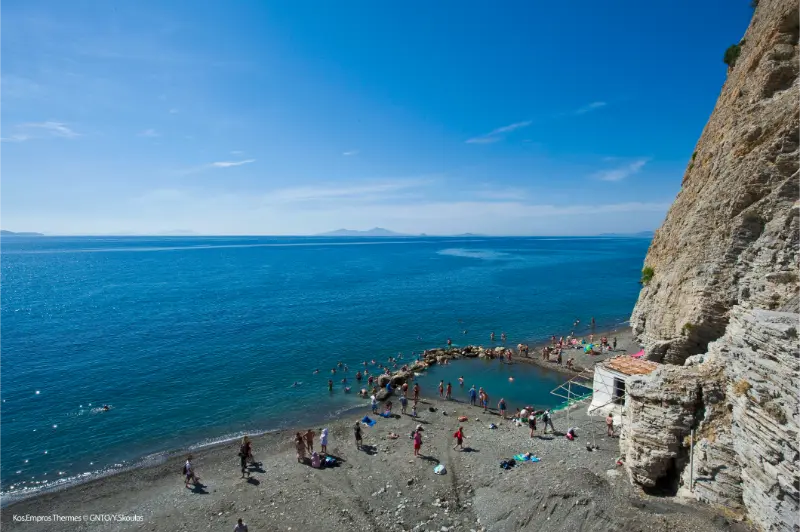
    \n

    Related itinerary: Eastern Crete in 7 Days: Heraklion, Agios Nikolaos, Sitia and Vai Road Trip.

  • Kos with Kids: Best Family Beaches, Easy Days, Cycling and Practical Tips

    Kos with Kids: Best Family Beaches, Easy Days, Cycling and Practical Tips

    Kos is one of the easiest Greek islands to recommend to families because it combines shallow sandy beaches, a flat capital, bike culture, resort infrastructure and enough archaeology to make days interesting without requiring a full road trip every morning. The island also has several possible bases, so families can choose the level of activity that matches their children rather than forcing everyone into the same style of holiday.

    The best family itinerary is rarely the one with the most attractions. Alternate a sightseeing morning with a beach afternoon, keep one flexible day for wind or tired children, and choose accommodation close to the things you will use every day. This reduces stress far more than collecting “must-see” locations.

    Best family bases

    Tigaki is the obvious first choice for young children because of the long sandy beach, shallow water and straightforward resort layout. Marmari offers similar shallow sand with more space but can be windier. Kos Town is excellent for older children who enjoy cycling, boats and evening walks. Kardamena is self-contained and practical for families who want a resort routine.

    Kefalos works for families with a car who care about southwest beaches. Check slopes carefully when booking the old village; Kamari is easier if you want to walk to the sea.

    Family beach days: choose by depth and wind

    Tigaki, Marmari and Paradise Beach are good starting points for shallow water. Agios Stefanos adds archaeology and the view toward Kastri. Even on a family beach, supervise children actively: wind and waves change, water depth varies by section and inflatables can drift quickly.

    Bring or buy water shoes if your children dislike stones, because not every beach is soft sand. Shade is also more important than chasing the prettiest water colour. A beach with an umbrella, toilet and easy lunch can be the better family choice than a remote cove reached by rough road.

    Cycling with children

    Kos’s flat areas make cycling a genuine family activity, particularly around the capital. Start with a short protected or low-traffic route and see how everyone handles heat and unfamiliar junctions. Do not choose the longest advertised route simply because your children cycle confidently at home.

    Use correctly sized bicycles, helmets and lights. For child seats or trailers, ask a reputable rental company to fit the equipment and suggest a suitable route. The safest route is more important than the most scenic one.

    Archaeology without exhausting the family

    The Asklepieion is the most important archaeological excursion, but open terraces become hot. Visit early and turn the site into a short story about ancient medicine rather than a lecture. In Kos Town, ruins are integrated into everyday streets, which lets children encounter history in smaller doses.

    Agios Stefanos is especially good for families because the basilica remains sit directly beside the beach. Teach children not to climb on fragile archaeology, then reward the cultural stop with swimming rather than scheduling another museum immediately.

    Therma with children

    Therma is memorable but less straightforward than a sandy beach. The natural water can be very hot near the spring source, the shore is stony and the access includes a downhill/uphill walk. Older children may enjoy the contrast; toddlers may be happier with a shorter visit or a different beach altogether.

    Keep hot-water exposure brief, supervise constantly and make sure everyone has drinking water for the climb back.

    A heat-smart family day

    TimeFamily rhythm
    08:00–10:30Archaeology, village walk or cycling
    10:30–13:00Beach or pool
    13:00–16:30Lunch, shade, nap or indoor rest
    16:30–19:30Second swim or short excursion
    EveningDinner and promenade close to the hotel

    This rhythm is not a rigid rule, but it acknowledges that young children do not experience 35°C sightseeing as an educational privilege. Shift activity away from the harshest hours whenever possible.

    Eating with children

    Greek tavernas are generally easy for families because shared plates, grilled meat, fish, pasta, potatoes, salads and bread offer flexible choices. If allergies are involved, carry the relevant Greek wording and speak directly with staff instead of assuming ingredients from a menu description.

    Keep snacks and water for bus waits and beach transfers. A tired child rarely benefits from delaying lunch because one more viewpoint is “on the way.”

    Car seats, buses and taxis

    If you rent a car, reserve an age-appropriate child seat rather than assuming one will be available on arrival. Inspect it at collection. For taxis, request a suitable seat in advance if required for your family. Buses reduce driving stress, but prams and beach gear make peak-hour travel less pleasant, so pack lightly.

    How Kos with kids fits into a wider Kos trip

    Use this guide together with the main Kos travel guide, Kos Town guide and Asklepieion guide. The newer in-depth pages on Tigaki and Marmari, Kefalos and Kamari, Kardamena, Zia and Mount Dikeos, Therma, cycling, the best beaches, Kos without a car, Kos with kids and where to stay in Kos make it easier to build a trip around one area instead of crossing the island repeatedly.

    Dodecanese Kos Empros Therma

    Kos works especially well for families who mix easy beach time with one activity or cultural stop each day. The most useful rule is to group places geographically. Kos is compact compared with many Greek islands, but a holiday still feels much better when a beach, village and archaeological stop naturally belong to the same side of the island.

    Getting around and checking transport

    Buses are useful for major resorts, while a short car rental can unlock Kefalos and inland villages. Cycling is a bonus around flatter areas, not an obligation.

    Choose accommodation close to the beach or promenade you will use most; a slightly higher room rate can be worth it if it removes two taxi journeys every day. Public transport is useful, but seasonal frequency matters. The official KTEL Kos general routes page currently lists services for Kefalos, Kardamena, Marmari, Zia, Antimachia, Tigaki, Pyli and Mastichari. KTEL also announced timetable changes taking effect from 29 June 2026, so always open the live timetable again shortly before the day you travel rather than saving an old screenshot.

    Kefalos Kos Greece

    Booking excursions and activities

    Boat trips, island excursions and guided experiences are highly seasonal on Kos. Before booking, compare the actual time spent at each stop, whether transfers are included, the size of the boat or group, shade, swimming opportunities and cancellation conditions. Do not choose an excursion simply because it has the longest list of stops.

    Mistakes that make the day harder

    • Planning every day around distant “must-see” sights.
    • Choosing a remote villa without understanding the need for a car.
    • Cycling with children on roads that are fast or unprotected.
    • Visiting open archaeological sites at midday during severe heat.
    • Assuming a beach described as family-friendly has identical conditions every day.

    Frequently asked questions

    Which part of Kos is best for families?

    Tigaki is one of the easiest choices for young children. Kos Town suits active families and older children; Kardamena offers a self-contained resort; Kefalos works well with a car.

    Greece Kos Island Bay Kefalos

    What are the best family beaches?

    Tigaki, Marmari and Paradise are strong choices for sandy, shallow sections. Always judge wind and water conditions on the day.

    Is Kos good with a stroller?

    Kos Town and resort promenades can be relatively easy, but historic sites, Zia’s lanes and Therma’s access track are less stroller-friendly.

    Can children cycle safely in Kos?

    Yes on appropriate protected or low-traffic routes with correctly fitted equipment. Do not assume every road is a cycle lane.

    How many days should a family stay?

    A week is ideal for mixing beaches, Kos Town, one archaeological day and one or two wider excursions without rushing.

    Final planning advice

    Kos is at its best when you leave some space between the headline attractions. The island is easy enough to explore that there is little benefit in forcing four distant stops into one day. Pick one anchor experience, add one or two nearby places, and keep time for a swim, a long lunch or an evening walk. That slower structure usually produces a better holiday and makes delays, wind or summer heat much easier to handle.

    How to plan around wind and summer heat

    Wind and heat should be treated as planning variables, not annoyances that have ruined the schedule. Kos has enough coastline and enough non-beach alternatives that you can move a swimming day, shorten an exposed walk or swap a western drive for a museum and town afternoon. Check conditions each morning, especially before a boat trip, long cycle ride or remote-beach drive.

    In July and August, schedule archaeological sites, village walks and cycling early. Keep the middle of the day for swimming, shade or a long lunch, then use late afternoon for another short outing. This is more comfortable and usually produces better photographs than forcing outdoor sightseeing under the harshest sun.

    How much should you plan in advance?

    Reserve the things with real capacity constraints—specific hotels, popular boat excursions and important airport transfers—then leave ordinary beach days flexible. A rigid seven-day schedule is vulnerable to one windy day; a flexible plan can move the boat trip and still protect the experiences that matter most.

    Keep addresses, bus information and booking confirmations available offline. Mobile coverage is generally good in populated areas, but a dead battery or weak signal is a poor reason to miss the last bus. For driving days, download an offline map and verify that navigation is not sending a standard rental car onto an unnecessary rough track.